

Mathematical Model for the Prediction of Dissolved Oxygen Levels
ill
Proposed models for the Prediction of D.O. Concentration
Application of equation (2) offers the possibility of predicting the D.O. concentrations
at any time of the day when the six characteristic parameters of the stream are known. As
each reach of the stream has perceptibly different conditions, the parameters may also
differ.
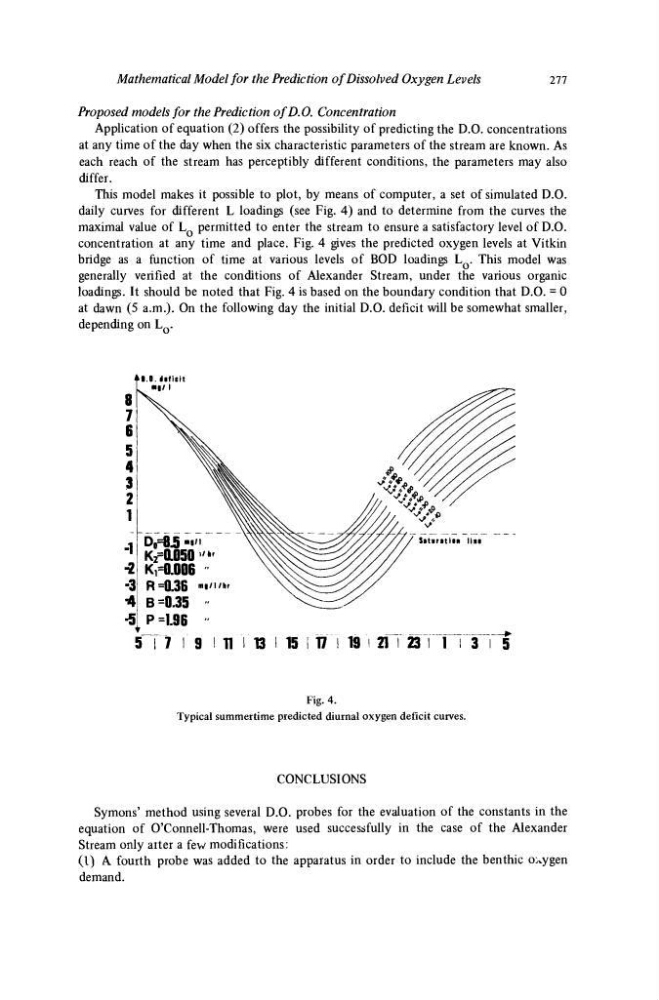
This model makes it possible to plot, by means of computer, a set of simulated D.O.
daily curves for different L loadings (see Fig. 4) and to determine from the curves the
maximal value of L permitted to enter the stream to ensure a satisfactory level of D.O.
concentration at any time and place. Fig. 4 gives the predicted oxygen levels at Vitkin
bridge as a function of time at various levels of BOD loadings L Q . This model was
generally verified at the conditions of Alexander Stream, under the various organic
loadings. It should be noted that Fig. 4 is based on the boundary condition that D.O. = 0
at dawn (5 a.m.). On the following day the initial D.O. deficit will be somewhat smaller,
depending on L .
Fig. 4.
Typical summertime predicted diurnal oxygen deficit curves.
CONCLUSIONS
Symons' method using several D.O. probes for the evaluation of the constants in the
equation of O'Connell-Thomas, were used successfully in the case of the Alexander
Stream only alter a few modifications:
(I) A fourth probe was added to the apparatus in order to include the benthic oxygen
demand.
ill
Proposed models for the Prediction of D.O. Concentration
Application of equation (2) offers the possibility of predicting the D.O. concentrations
at any time of the day when the six characteristic parameters of the stream are known. As
each reach of the stream has perceptibly different conditions, the parameters may also
differ.
This model makes it possible to plot, by means of computer, a set of simulated D.O.
daily curves for different L loadings (see Fig. 4) and to determine from the curves the
maximal value of L permitted to enter the stream to ensure a satisfactory level of D.O.
concentration at any time and place. Fig. 4 gives the predicted oxygen levels at Vitkin
bridge as a function of time at various levels of BOD loadings L Q . This model was
generally verified at the conditions of Alexander Stream, under the various organic
loadings. It should be noted that Fig. 4 is based on the boundary condition that D.O. = 0
at dawn (5 a.m.). On the following day the initial D.O. deficit will be somewhat smaller,
depending on L .
Fig. 4.
Typical summertime predicted diurnal oxygen deficit curves.
CONCLUSIONS
Symons' method using several D.O. probes for the evaluation of the constants in the
equation of O'Connell-Thomas, were used successfully in the case of the Alexander
Stream only alter a few modifications:
(I) A fourth probe was added to the apparatus in order to include the benthic oxygen
demand.