

260
T. Sueishi and W. Yoshikoshi
The continuity equation for water volume is written as
ΘΙ
8x
q i n
%ut>
(4)
where q m q'out are lateral in- and out-flow rate per unit length and time, q'out equals to
qout
m actual fact.
The analytical solution of c, Q and u will be obtained by Eq. (1) (or Eq. (2) or Eq.
(3)), Eq. (4) and the equation of motion, for instance
u = I R
2 '
3 !
1 '
2 '
(5)
where n is roughness factor, R the hydraulic radius and I the slope. Eq. (1) has been used
by many researchers, especially on solutions accompanied with supposed boundary
conditions or mathematical expressions of f t (c). In many cases, however, u is regarded as
constant and besides, Eq. (4) is ignored by using the constant Q. In actual river
management programs, the measurement of flow rate is most important. This concept
involves difficulties as described later. Although further investigation would be necessary
on transformations related to F(x, y, t,), equations of quality continuity (3) and quantity
continuity (4) become equivalent by using a non-evolutional index such as Cl . It might
be possible, therefore, that quantity observation is replaced by quality observation for the
purpose of regional water quality management.
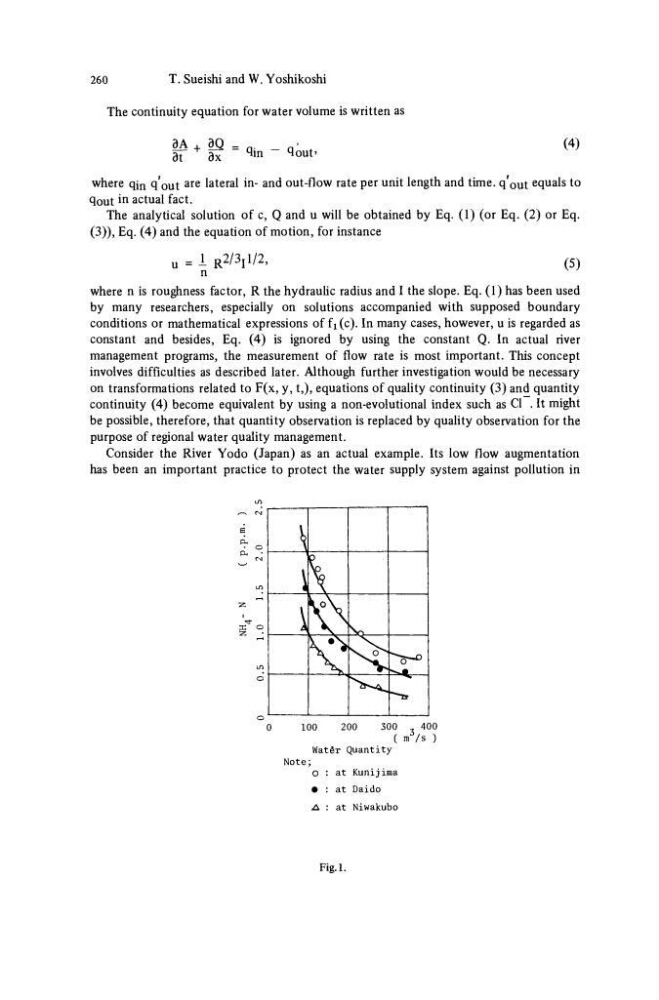
Consider the River Yodo (Japan) as an actual example. Its low flow augmentation
has been an important practice to protect the water supply system against pollution in
\
\
\
it o \
K
v V . o ^ ^ ■ ^ - o
^-%
^»
100
200
300
400
( nf/s )
Watör Quantity
Note;
O : at Kunijima
• : at Daido
Λ : at Niwakubo
Fig.l.
T. Sueishi and W. Yoshikoshi
The continuity equation for water volume is written as
ΘΙ
8x
q i n
%ut>
(4)
where q m q'out are lateral in- and out-flow rate per unit length and time, q'out equals to
qout
m actual fact.
The analytical solution of c, Q and u will be obtained by Eq. (1) (or Eq. (2) or Eq.
(3)), Eq. (4) and the equation of motion, for instance
u = I R
2 '
3 !
1 '
2 '
(5)
where n is roughness factor, R the hydraulic radius and I the slope. Eq. (1) has been used
by many researchers, especially on solutions accompanied with supposed boundary
conditions or mathematical expressions of f t (c). In many cases, however, u is regarded as
constant and besides, Eq. (4) is ignored by using the constant Q. In actual river
management programs, the measurement of flow rate is most important. This concept
involves difficulties as described later. Although further investigation would be necessary
on transformations related to F(x, y, t,), equations of quality continuity (3) and quantity
continuity (4) become equivalent by using a non-evolutional index such as Cl . It might
be possible, therefore, that quantity observation is replaced by quality observation for the
purpose of regional water quality management.
Consider the River Yodo (Japan) as an actual example. Its low flow augmentation
has been an important practice to protect the water supply system against pollution in
\
\
\
it o \
K
v V . o ^ ^ ■ ^ - o
^-%
^»
100
200
300
400
( nf/s )
Watör Quantity
Note;
O : at Kunijima
• : at Daido
Λ : at Niwakubo
Fig.l.