

M O D E L L I N G
A QUALITY MANAGEMENT MODEL
FOR RIVER AND UNDERGROUND
FLOW SYSTEM
T. SUEISHI* and W. YOSHIKOSHI
*Prof. of Environmental Planning, Kyoto University, Department of
Sanitary Engineering, Yoshida, Sakyo-Ku, Kyoto, Japan
INTRODUCTION
The principle of water pollution control has hitherto been based upon water quality
surveys and pollutant behavior analysis which is represented by a D.O. curve; the former
enables regulation of a waste discharge and the latter evaluates self-purification and
treatment plant design. However, following our recent research of simulation technique
on this problem, water quality surveys or the use of the Streeter-Phelps equation is not
satisfactory for identifying regional hydrological phenomena involving water quality with
respect to time and distance. The boundaries of a river flow are irregular in general. Two
procedures might be adopted to consider the irregularity; one is to assume a regular
channel with stochastic process and the other is of the channel extention to the
underflow zone which is less influenced by irregular boundary conditions. This latter will
be the main issue in this paper.
The idea of 'adaptive control' related to monitoring systems requires analysis of
quality evolution in the water zone. The discussion below also contributes to this system,
with several new findings.
BASIC CONSIDERATION FOR STREAM QUALITY CONTROL
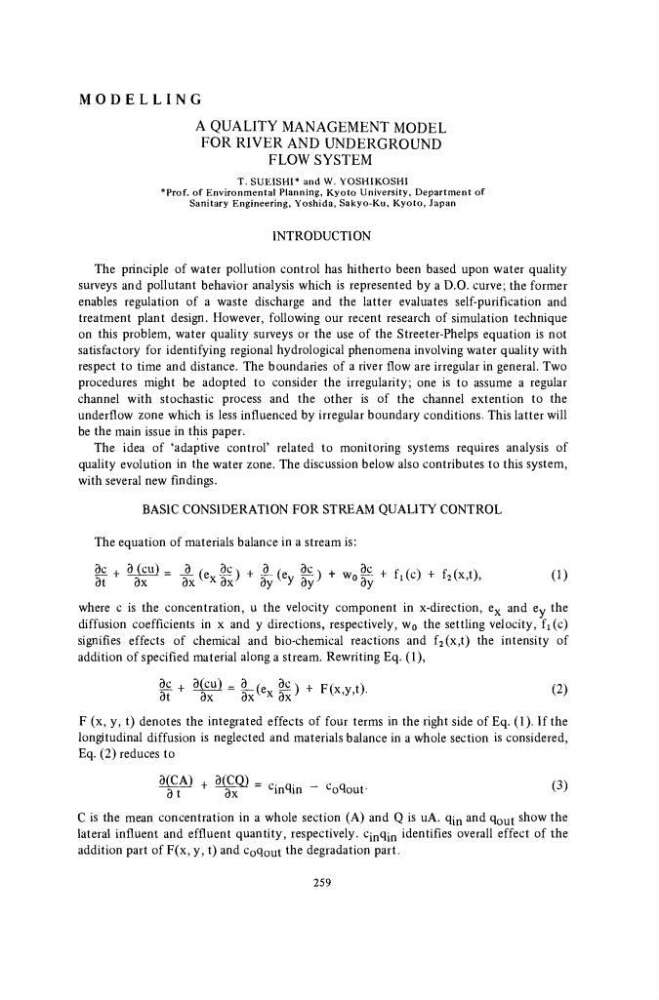
The equation of materials balance in a stream is:
where c is the concentration, u the velocity component in x-direction, e x and e y the
diffusion coefficients in x and y directions, respectively, w 0 the settling velocity, ^(c)
signifies effects of chemical and bio-chemical reactions and f2(x,t) the intensity of
addition of specified material along a stream. Rewriting Eq. (1),
F (x, y, t) denotes the integrated effects of four terms in the right side of Eq. (1). If the
longitudinal diffusion is neglected and materials balance in a whole section is considered,
Eq. (2) reduces to
ψ> + ^ P = C in q in - C oqout .
(3)
C is the mean concentration in a whole section (A) and Q is uA. q m and q ou j- show the
lateral influent and effluent quantity, respectively. c m q m identifies overall effect of the
addition part of F(x, y, t) and c 0 q o u t the degradation part.
259
A QUALITY MANAGEMENT MODEL
FOR RIVER AND UNDERGROUND
FLOW SYSTEM
T. SUEISHI* and W. YOSHIKOSHI
*Prof. of Environmental Planning, Kyoto University, Department of
Sanitary Engineering, Yoshida, Sakyo-Ku, Kyoto, Japan
INTRODUCTION
The principle of water pollution control has hitherto been based upon water quality
surveys and pollutant behavior analysis which is represented by a D.O. curve; the former
enables regulation of a waste discharge and the latter evaluates self-purification and
treatment plant design. However, following our recent research of simulation technique
on this problem, water quality surveys or the use of the Streeter-Phelps equation is not
satisfactory for identifying regional hydrological phenomena involving water quality with
respect to time and distance. The boundaries of a river flow are irregular in general. Two
procedures might be adopted to consider the irregularity; one is to assume a regular
channel with stochastic process and the other is of the channel extention to the
underflow zone which is less influenced by irregular boundary conditions. This latter will
be the main issue in this paper.
The idea of 'adaptive control' related to monitoring systems requires analysis of
quality evolution in the water zone. The discussion below also contributes to this system,
with several new findings.
BASIC CONSIDERATION FOR STREAM QUALITY CONTROL
The equation of materials balance in a stream is:
where c is the concentration, u the velocity component in x-direction, e x and e y the
diffusion coefficients in x and y directions, respectively, w 0 the settling velocity, ^(c)
signifies effects of chemical and bio-chemical reactions and f2(x,t) the intensity of
addition of specified material along a stream. Rewriting Eq. (1),
F (x, y, t) denotes the integrated effects of four terms in the right side of Eq. (1). If the
longitudinal diffusion is neglected and materials balance in a whole section is considered,
Eq. (2) reduces to
ψ> + ^ P = C in q in - C oqout .
(3)
C is the mean concentration in a whole section (A) and Q is uA. q m and q ou j- show the
lateral influent and effluent quantity, respectively. c m q m identifies overall effect of the
addition part of F(x, y, t) and c 0 q o u t the degradation part.
259