

Ecosystem Simulation for Water Pollution Research
245
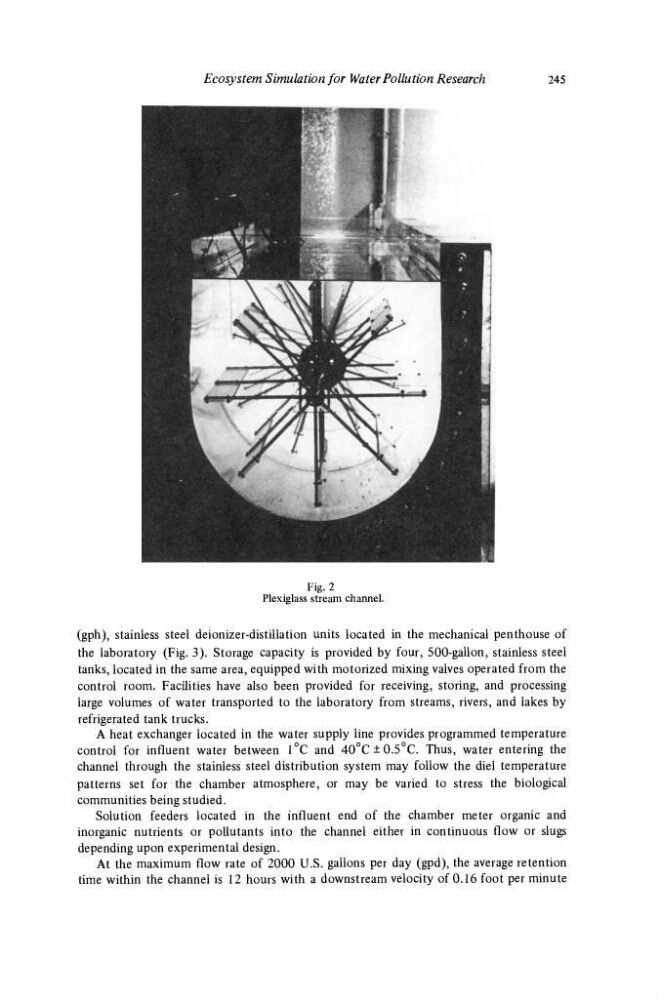
Fig. 2
Plexiglass stream channel.
(gph), stainless steel deionizer-distillation units located in the mechanical penthouse of
the laboratory (Fig. 3). Storage capacity is provided by four, 500-gallon, stainless steel
tanks, located in the same area, equipped with motorized mixing valves operated from the
control room. Facilities have also been provided for receiving, storing, and processing
large volumes of water transported to the laboratory from streams, rivers, and lakes by
refrigerated tank trucks.
A heat exchanger located in the water supply line provides programmed temperature
control for influent water between 1°C and 40°C ± 0.5°C. Thus, water entering the
channel through the stainless steel distribution system may follow the diel temperature
patterns set for the chamber atmosphere, or may be varied to stress the biological
communities being studied.
Solution feeders located in the influent end of the chamber meter organic and
inorganic nutrients or pollutants into the channel either in continuous flow or slugs
depending upon experimental design.
At the maximum flow rate of 2000 U.S. gallons per day (gpd), the average retention
time within the channel is 12 hours with a downstream velocity of 0.16 foot per minute
245
Fig. 2
Plexiglass stream channel.
(gph), stainless steel deionizer-distillation units located in the mechanical penthouse of
the laboratory (Fig. 3). Storage capacity is provided by four, 500-gallon, stainless steel
tanks, located in the same area, equipped with motorized mixing valves operated from the
control room. Facilities have also been provided for receiving, storing, and processing
large volumes of water transported to the laboratory from streams, rivers, and lakes by
refrigerated tank trucks.
A heat exchanger located in the water supply line provides programmed temperature
control for influent water between 1°C and 40°C ± 0.5°C. Thus, water entering the
channel through the stainless steel distribution system may follow the diel temperature
patterns set for the chamber atmosphere, or may be varied to stress the biological
communities being studied.
Solution feeders located in the influent end of the chamber meter organic and
inorganic nutrients or pollutants into the channel either in continuous flow or slugs
depending upon experimental design.
At the maximum flow rate of 2000 U.S. gallons per day (gpd), the average retention
time within the channel is 12 hours with a downstream velocity of 0.16 foot per minute