

G R O U N D W A T E R
P O L L U T I O N
UNDERGROUND TRAVEL OF
POLLUTANTS
R.P. MATHUR and N.S. GREWAL
University of Roorkee, Roorkee(U.P.), India
One proposal for the reclamation of water that is most economically feasible at
present involves returning these waste waters underground, taking advantage of the
filtering ability of the soil and the diluting effect of ground water. It was generally felt
that the passage of polluted water through porous media would purify it (1). However, it
has been found that this purifying action has its limitations. The underground aquifier
which becomes polluted will stay polluted for a long time and the areas of pollution will
gradually expand. The movement of ground water may be so slow that pollution
sometimes persists for decades.
The present investigation is an attempt to study how waste water is likely to travel
after its introduction into the ground water. A model study of dispersion of organic
matter in the form of synthetic sewage has been made. The parameters selected were
organic matter (oxygen consumed by the KMn0 4 test) and the Enterococcus group of
bacteria.
Mechanism of bacterial travel
Many workers have investigated the phenomenon of bacterial travel but their results
are far from uniform. They have assessed safe distances between the source of pollution
and the point of extraction of ground water. Mathur, Chandra and Bharadwaj (2) while
working on a two dimensional model have pointed out that the pollution travelled
vertically downwards with no lateral dispersion and on intercepting the water table this
movement continued vertically as well as horizontally; 99.9% of the bacteria were
removed in a length of travel of 15" and in a depth of travel of 17". There is some
confirmation in the results of bacterial travel, (3,4), since (i) Bacterial travel is a function
of the characteristics of the medium; accumulation of sewage solids produces a defence
against bacterial penetration; (ii) Once bacteria enter the ground water table, they follow
the ground water flow; (iii) The removal is accomplished by mechanical straining
although bacterial breakthrough may occur.
Mechanism of dispersion in porous media
The dispersion phenomenon in porous media depends on the geometry of the
pore-grain system (5, 6). The mechanisms affecting the travel of pollutants are believed to
be adsorption and biological action (7, 8). With the passage of time the adsorptive
capacities of soil become progressively exhausted and pollution may be expected to
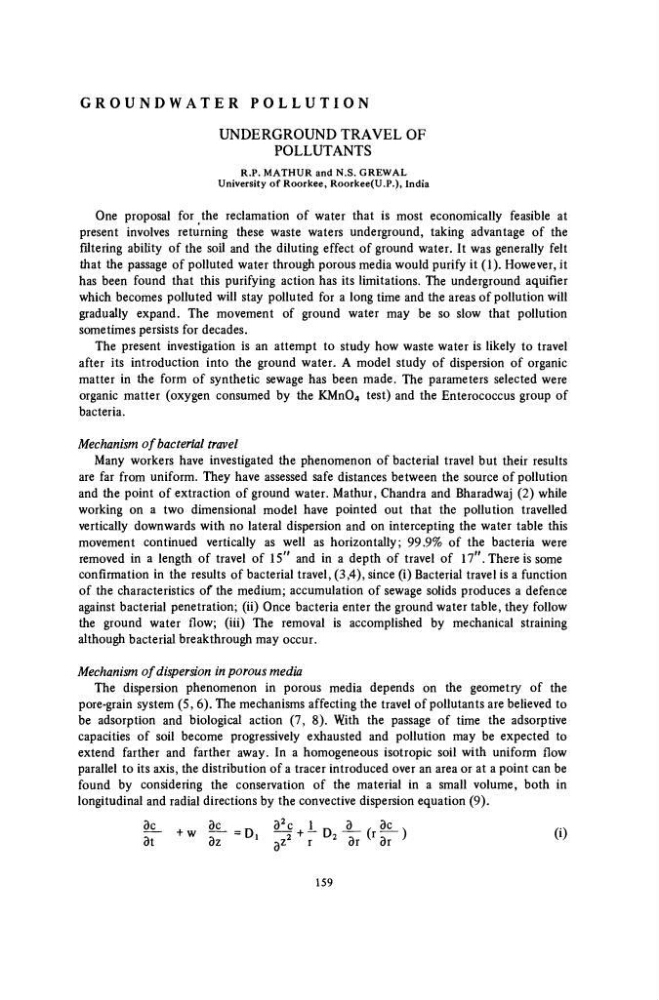
extend farther and farther away. In a homogeneous isotropic soil with uniform flow
parallel to its axis, the distribution of a tracer introduced over an area or at a point can be
found by considering the conservation of the material in a small volume, both in
longitudinal and radial directions by the convective dispersion equation (9).
^Γ
+ w
^ "
= D l
^ + Τ^Τχ^
(1)
159
P O L L U T I O N
UNDERGROUND TRAVEL OF
POLLUTANTS
R.P. MATHUR and N.S. GREWAL
University of Roorkee, Roorkee(U.P.), India
One proposal for the reclamation of water that is most economically feasible at
present involves returning these waste waters underground, taking advantage of the
filtering ability of the soil and the diluting effect of ground water. It was generally felt
that the passage of polluted water through porous media would purify it (1). However, it
has been found that this purifying action has its limitations. The underground aquifier
which becomes polluted will stay polluted for a long time and the areas of pollution will
gradually expand. The movement of ground water may be so slow that pollution
sometimes persists for decades.
The present investigation is an attempt to study how waste water is likely to travel
after its introduction into the ground water. A model study of dispersion of organic
matter in the form of synthetic sewage has been made. The parameters selected were
organic matter (oxygen consumed by the KMn0 4 test) and the Enterococcus group of
bacteria.
Mechanism of bacterial travel
Many workers have investigated the phenomenon of bacterial travel but their results
are far from uniform. They have assessed safe distances between the source of pollution
and the point of extraction of ground water. Mathur, Chandra and Bharadwaj (2) while
working on a two dimensional model have pointed out that the pollution travelled
vertically downwards with no lateral dispersion and on intercepting the water table this
movement continued vertically as well as horizontally; 99.9% of the bacteria were
removed in a length of travel of 15" and in a depth of travel of 17". There is some
confirmation in the results of bacterial travel, (3,4), since (i) Bacterial travel is a function
of the characteristics of the medium; accumulation of sewage solids produces a defence
against bacterial penetration; (ii) Once bacteria enter the ground water table, they follow
the ground water flow; (iii) The removal is accomplished by mechanical straining
although bacterial breakthrough may occur.
Mechanism of dispersion in porous media
The dispersion phenomenon in porous media depends on the geometry of the
pore-grain system (5, 6). The mechanisms affecting the travel of pollutants are believed to
be adsorption and biological action (7, 8). With the passage of time the adsorptive
capacities of soil become progressively exhausted and pollution may be expected to
extend farther and farther away. In a homogeneous isotropic soil with uniform flow
parallel to its axis, the distribution of a tracer introduced over an area or at a point can be
found by considering the conservation of the material in a small volume, both in
longitudinal and radial directions by the convective dispersion equation (9).
^Γ
+ w
^ "
= D l
^ + Τ^Τχ^
(1)
159