

The Virus Problem in the Windhoek Waste Water Reclamation Project
139
following sources; notification of the above diseases by all medical practitioners, records
from clinics and hospitals, records of laboratory isolations and death certificates. For
correlation with the above data, a study is also in progress of the Windhoek reticulation
system and the distribution of the various sources of water supply to different areas in
the city. This should enable determination of random distribution of cases or clustering
of cases in such a way as to correspond with the idiosyncrasies in the water distribution
and, in so doing, facilitate detection of the occurrence of a higher rate of a disease
amongst those using a certain supply, than that among persons living in adjacent areas
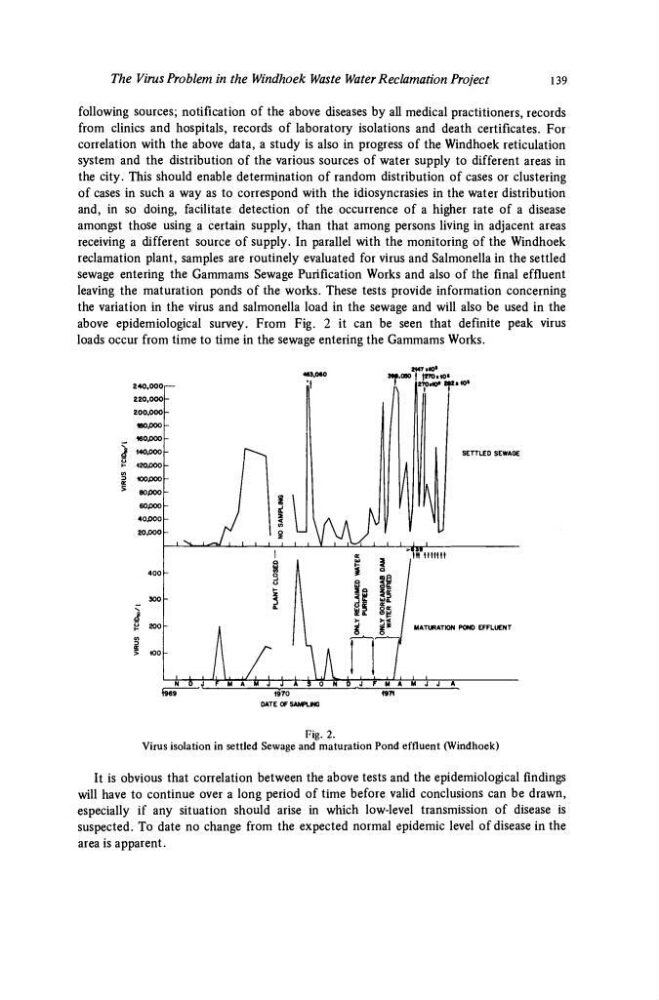
receiving a different source of supply. In parallel with the monitoring of the Windhoek
reclamation plant, samples are routinely evaluated for virus and Salmonella in the settled
sewage entering the Gammams Sewage Purification Works and also of the final effluent
leaving the maturation ponds of the works. These tests provide information concerning
the variation in the virus and salmonella load in the sewage and will also be used in the
above epidemiological survey. From Fig. 2 it can be seen that definite peak virus
loads occur from time to time in the sewage entering the Gammams Works.
2447.40»
080 f t»TO «10»
|2TO«iO»2t«»<0»
SETTLED SEWAGE
1969
1970
DATE OF SAMPLING
Fig. 2.
Virus isolation in settled Sewage and maturation Pond effluent (Windhoek)
It is obvious that correlation between the above tests and the epidemiological findings
will have to continue over a long period of time before valid conclusions can be drawn,
especially if any situation should arise in which low-level transmission of disease is
suspected. To date no change from the expected normal epidemic level of disease in the
area is apparent.
139
following sources; notification of the above diseases by all medical practitioners, records
from clinics and hospitals, records of laboratory isolations and death certificates. For
correlation with the above data, a study is also in progress of the Windhoek reticulation
system and the distribution of the various sources of water supply to different areas in
the city. This should enable determination of random distribution of cases or clustering
of cases in such a way as to correspond with the idiosyncrasies in the water distribution
and, in so doing, facilitate detection of the occurrence of a higher rate of a disease
amongst those using a certain supply, than that among persons living in adjacent areas
receiving a different source of supply. In parallel with the monitoring of the Windhoek
reclamation plant, samples are routinely evaluated for virus and Salmonella in the settled
sewage entering the Gammams Sewage Purification Works and also of the final effluent
leaving the maturation ponds of the works. These tests provide information concerning
the variation in the virus and salmonella load in the sewage and will also be used in the
above epidemiological survey. From Fig. 2 it can be seen that definite peak virus
loads occur from time to time in the sewage entering the Gammams Works.
2447.40»
080 f t»TO «10»
|2TO«iO»2t«»<0»
SETTLED SEWAGE
1969
1970
DATE OF SAMPLING
Fig. 2.
Virus isolation in settled Sewage and maturation Pond effluent (Windhoek)
It is obvious that correlation between the above tests and the epidemiological findings
will have to continue over a long period of time before valid conclusions can be drawn,
especially if any situation should arise in which low-level transmission of disease is
suspected. To date no change from the expected normal epidemic level of disease in the
area is apparent.