

138
E.M. Nupen and G.J. Stander
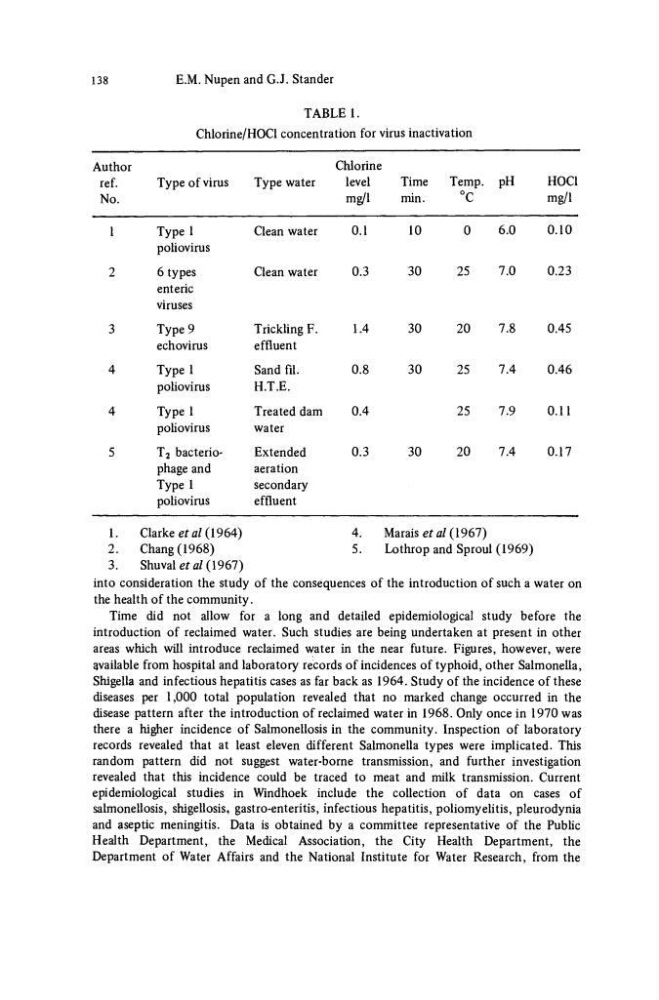
TABLE 1.
Chlorine/HOCl concentration for virus inactivation
Author
ref.
No.
1
2
3
4
4
5
Type of virus
Type 1
poliovirus
6 types
enteric
viruses
Type 9
echovirus
Type 1
poliovirus
Type 1
poliovirus
T 2 bacteriophage and
Type 1
poliovirus
Type water
Clean water
Clean water
Trickling F.
effluent
Sand fil.
H.T.E.
Treated dam
water
Extended
aeration
secondary
effluent
Chlorine
level
mg/1
0.1
0.3
1.4
0.8
0.4
0.3
Time
min.
10
30
30
30
30
Temp.
°C
0
25
20
25
25
20
pH
6.0
7.0
7.8
7.4
7.9
7.4
HOC1
mg/1
0.10
0.23
0.45
0.46
0.11
0.17
Maraise/0/(1967)
Lothrop and Sproul (1969)
1.
Clarke ef al (1964)
4.
2.
Chang (1968)
5.
3.
Shuval et al (1967)
into consideration the study of the consequences of the introduction of such a water on
the health of the community.
Time did not allow for a long and detailed epidemiological study before the
introduction of reclaimed water. Such studies are being undertaken at present in other
areas which will introduce reclaimed water in the near future. Figures, however, were
available from hospital and laboratory records of incidences of typhoid, other Salmonella,
Shigella and infectious hepatitis cases as far back as 1964. Study of the incidence of these
diseases per 1,000 total population revealed that no marked change occurred in the
disease pattern after the introduction of reclaimed water in 1968. Only once in 1970 was
there a higher incidence of Salmonellosis in the community. Inspection of laboratory
records revealed that at least eleven different Salmonella types were implicated. This
random pattern did not suggest water-borne transmission, and further investigation
revealed that this incidence could be traced to meat and milk transmission. Current
epidemiological studies in Windhoek include the collection of data on cases of
salmonellosis, shigellosis, gastro-enteritis, infectious hepatitis, poliomyelitis, pleurodynia
and aseptic meningitis. Data is obtained by a committee representative of the Public
Health Department, the Medical Association, the City Health Department, the
Department of Water Affairs and the National Institute for Water Research, from the
E.M. Nupen and G.J. Stander
TABLE 1.
Chlorine/HOCl concentration for virus inactivation
Author
ref.
No.
1
2
3
4
4
5
Type of virus
Type 1
poliovirus
6 types
enteric
viruses
Type 9
echovirus
Type 1
poliovirus
Type 1
poliovirus
T 2 bacteriophage and
Type 1
poliovirus
Type water
Clean water
Clean water
Trickling F.
effluent
Sand fil.
H.T.E.
Treated dam
water
Extended
aeration
secondary
effluent
Chlorine
level
mg/1
0.1
0.3
1.4
0.8
0.4
0.3
Time
min.
10
30
30
30
30
Temp.
°C
0
25
20
25
25
20
pH
6.0
7.0
7.8
7.4
7.9
7.4
HOC1
mg/1
0.10
0.23
0.45
0.46
0.11
0.17
Maraise/0/(1967)
Lothrop and Sproul (1969)
1.
Clarke ef al (1964)
4.
2.
Chang (1968)
5.
3.
Shuval et al (1967)
into consideration the study of the consequences of the introduction of such a water on
the health of the community.
Time did not allow for a long and detailed epidemiological study before the
introduction of reclaimed water. Such studies are being undertaken at present in other
areas which will introduce reclaimed water in the near future. Figures, however, were
available from hospital and laboratory records of incidences of typhoid, other Salmonella,
Shigella and infectious hepatitis cases as far back as 1964. Study of the incidence of these
diseases per 1,000 total population revealed that no marked change occurred in the
disease pattern after the introduction of reclaimed water in 1968. Only once in 1970 was
there a higher incidence of Salmonellosis in the community. Inspection of laboratory
records revealed that at least eleven different Salmonella types were implicated. This
random pattern did not suggest water-borne transmission, and further investigation
revealed that this incidence could be traced to meat and milk transmission. Current
epidemiological studies in Windhoek include the collection of data on cases of
salmonellosis, shigellosis, gastro-enteritis, infectious hepatitis, poliomyelitis, pleurodynia
and aseptic meningitis. Data is obtained by a committee representative of the Public
Health Department, the Medical Association, the City Health Department, the
Department of Water Affairs and the National Institute for Water Research, from the