

A Portable Virus Concentrator for Use in the Field
123
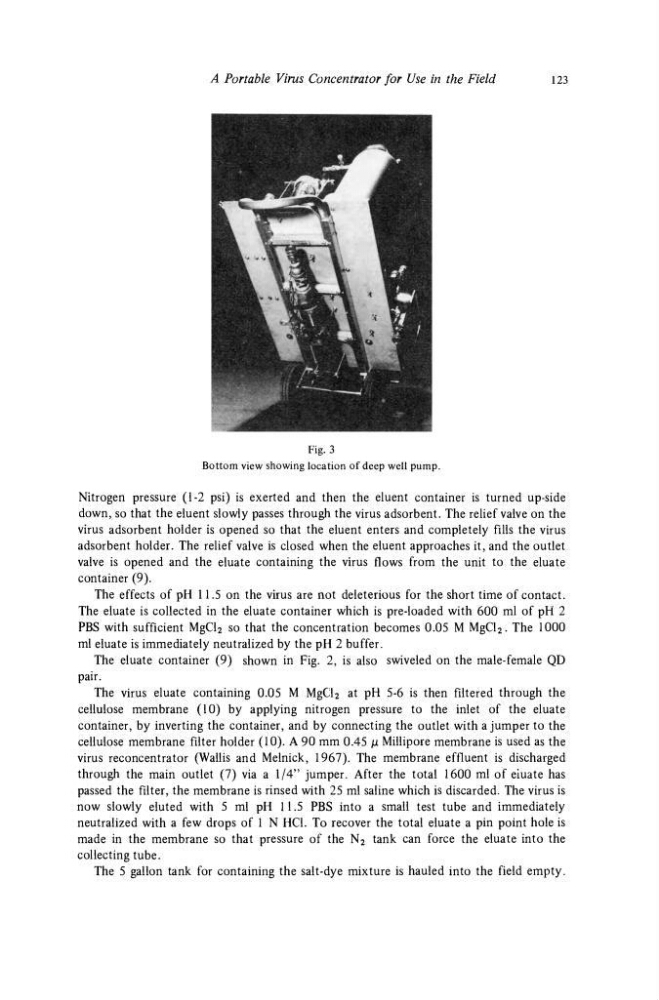
Fig. 3
Bottom view showing location of deep well pump.
Nitrogen pressure (1-2 psi) is exerted and then the eluent container is turned up-side
down, so that the eluent slowly passes through the virus adsorbent. The relief valve on the
virus adsorbent holder is opened so that the eluent enters and completely fills the virus
adsorbent holder. The relief valve is closed when the eluent approaches it, and the outlet
valve is opened and the eluate containing the virus flows from the unit to the eluate
container (9).
The effects of pH 11.5 on the virus are not deleterious for the short time of contact.
The eluate is collected in the eluate container which is pre-loaded with 600 ml of pH 2
PBS with sufficient MgCl 2 so that the concentration becomes 0.05 M MgCl 2 . The 1000
ml eluate is immediately neutralized by the pH 2 buffer.
The eluate container (9) shown in Fig. 2, is also swiveled on the male-female QD
pair.
The virus eluate containing 0.05 M MgCl 2 at pH 5-6 is then filtered through the
cellulose membrane (10) by applying nitrogen pressure to the inlet of the eluate
container, by inverting the container, and by connecting the outlet with a jumper to the
cellulose membrane filter holder (10). A 90 mm 0.45 μ Millipore membrane is used as the
virus reconcentrator (Wallis and Melnick, 1967). The membrane effluent is discharged
through the main outlet (7) via a 1/4" jumper. After the total 1600 ml of eiuate has
passed the filter, the membrane is rinsed with 25 ml saline which is discarded. The virus is
now slowly eluted with 5 ml pH 11.5 PBS into a small test tube and immediately
neutralized with a few drops of 1 N HCl. To recover the total eluate a pin point hole is
made in the membrane so that pressure of the N 2 tank can force the eluate into the
collecting tube.
The 5 gallon tank for containing the salt-dye mixture is hauled into the field empty.
123
Fig. 3
Bottom view showing location of deep well pump.
Nitrogen pressure (1-2 psi) is exerted and then the eluent container is turned up-side
down, so that the eluent slowly passes through the virus adsorbent. The relief valve on the
virus adsorbent holder is opened so that the eluent enters and completely fills the virus
adsorbent holder. The relief valve is closed when the eluent approaches it, and the outlet
valve is opened and the eluate containing the virus flows from the unit to the eluate
container (9).
The effects of pH 11.5 on the virus are not deleterious for the short time of contact.
The eluate is collected in the eluate container which is pre-loaded with 600 ml of pH 2
PBS with sufficient MgCl 2 so that the concentration becomes 0.05 M MgCl 2 . The 1000
ml eluate is immediately neutralized by the pH 2 buffer.
The eluate container (9) shown in Fig. 2, is also swiveled on the male-female QD
pair.
The virus eluate containing 0.05 M MgCl 2 at pH 5-6 is then filtered through the
cellulose membrane (10) by applying nitrogen pressure to the inlet of the eluate
container, by inverting the container, and by connecting the outlet with a jumper to the
cellulose membrane filter holder (10). A 90 mm 0.45 μ Millipore membrane is used as the
virus reconcentrator (Wallis and Melnick, 1967). The membrane effluent is discharged
through the main outlet (7) via a 1/4" jumper. After the total 1600 ml of eiuate has
passed the filter, the membrane is rinsed with 25 ml saline which is discarded. The virus is
now slowly eluted with 5 ml pH 11.5 PBS into a small test tube and immediately
neutralized with a few drops of 1 N HCl. To recover the total eluate a pin point hole is
made in the membrane so that pressure of the N 2 tank can force the eluate into the
collecting tube.
The 5 gallon tank for containing the salt-dye mixture is hauled into the field empty.