

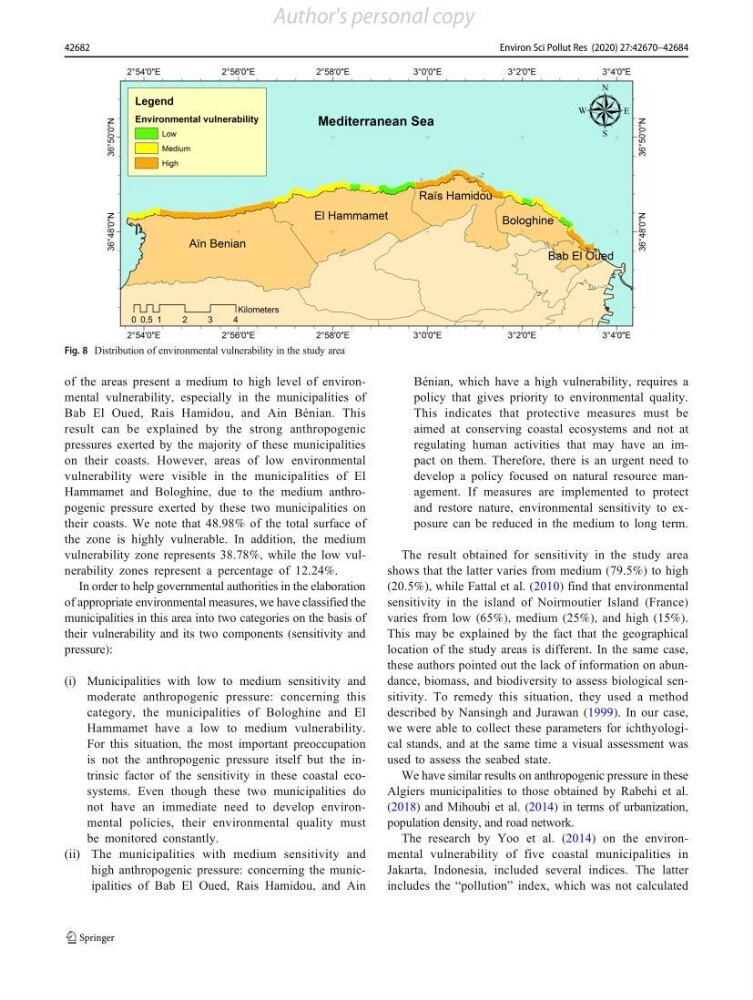
of the areas present a medium to high level of environmental vulnerability, especially in the municipalities of
Bab El Oued, Rais Hamidou, and Ain Bénian. This
result can be explained by the strong anthropogenic
pressures exerted by the majority of these municipalities
on their coasts. However, areas of low environmental
vulnerability were visible in the municipalities of El
Hammamet and Bologhine, due to the medium anthropogenic pressure exerted by these two municipalities on
their coasts. We note that 48.98% of the total surface of
the zone is highly vulnerable. In addition, the medium
vulnerability zone represents 38.78%, while the low vulnerability zones represent a percentage of 12.24%.
In order to help governmental authorities in the elaboration
of appropriate environmental measures, we have classified the
municipalities in this area into two categories on the basis of
their vulnerability and its two components (sensitivity and
pressure):
(i) Municipalities with low to medium sensitivity and
moderate anthropogenic pressure: concerning this
category, the municipalities of Bologhine and El
Hammamet have a low to medium vulnerability.
For this situation, the most important preoccupation
is not the anthropogenic pressure itself but the intrinsic factor of the sensitivity in these coastal ecosystems. Even though these two municipalities do
not have an immediate need to develop environmental policies, their environmental quality must
be monitored constantly.
(ii) The municipalities with medium sensitivity and
high anthropogenic pressure: concerning the municipalities of Bab El Oued, Rais Hamidou, and Ain
Bénian, which have a high vulnerability, requires a
policy that gives priority to environmental quality.
This indicates that protective measures must be
aimed at conserving coastal ecosystems and not at
regulating human activities that may have an impact on them. Therefore, there is an urgent need to
develop a policy focused on natural resource management. If measures are implemented to protect
and restore nature, environmental sensitivity to exposure can be reduced in the medium to long term.
The result obtained for sensitivity in the study area
shows that the latter varies from medium (79.5%) to high
(20.5%), while Fattal et al. (2010) find that environmental
sensitivity in the island of Noirmoutier Island (France)
varies from low (65%), medium (25%), and high (15%).
This may be explained by the fact that the geographical
location of the study areas is different. In the same case,
these authors pointed out the lack of information on abundance, biomass, and biodiversity to assess biological sensitivity. To remedy this situation, they used a method
described by Nansingh and Jurawan (1999). In our case,
we were able to collect these parameters for ichthyological stands, and at the same time a visual assessment was
used to assess the seabed state.
We have similar results on anthropogenic pressure in these
Algiers municipalities to those obtained by Rabehi et al.
(2018) and Mihoubi et al. (2014) in terms of urbanization,
population density, and road network.
The research by Yoo et al. (2014) on the environmental vulnerability of five coastal municipalities in
Jakarta, Indonesia, included several indices. The latter
includes the “pollution” index, which was not calculated
Fig. 8 Distribution of environmental vulnerability in the study area
42682
Environ Sci Pollut Res (2020) 27:42670–42684
Author's personal copy
Bab El Oued, Rais Hamidou, and Ain Bénian. This
result can be explained by the strong anthropogenic
pressures exerted by the majority of these municipalities
on their coasts. However, areas of low environmental
vulnerability were visible in the municipalities of El
Hammamet and Bologhine, due to the medium anthropogenic pressure exerted by these two municipalities on
their coasts. We note that 48.98% of the total surface of
the zone is highly vulnerable. In addition, the medium
vulnerability zone represents 38.78%, while the low vulnerability zones represent a percentage of 12.24%.
In order to help governmental authorities in the elaboration
of appropriate environmental measures, we have classified the
municipalities in this area into two categories on the basis of
their vulnerability and its two components (sensitivity and
pressure):
(i) Municipalities with low to medium sensitivity and
moderate anthropogenic pressure: concerning this
category, the municipalities of Bologhine and El
Hammamet have a low to medium vulnerability.
For this situation, the most important preoccupation
is not the anthropogenic pressure itself but the intrinsic factor of the sensitivity in these coastal ecosystems. Even though these two municipalities do
not have an immediate need to develop environmental policies, their environmental quality must
be monitored constantly.
(ii) The municipalities with medium sensitivity and
high anthropogenic pressure: concerning the municipalities of Bab El Oued, Rais Hamidou, and Ain
Bénian, which have a high vulnerability, requires a
policy that gives priority to environmental quality.
This indicates that protective measures must be
aimed at conserving coastal ecosystems and not at
regulating human activities that may have an impact on them. Therefore, there is an urgent need to
develop a policy focused on natural resource management. If measures are implemented to protect
and restore nature, environmental sensitivity to exposure can be reduced in the medium to long term.
The result obtained for sensitivity in the study area
shows that the latter varies from medium (79.5%) to high
(20.5%), while Fattal et al. (2010) find that environmental
sensitivity in the island of Noirmoutier Island (France)
varies from low (65%), medium (25%), and high (15%).
This may be explained by the fact that the geographical
location of the study areas is different. In the same case,
these authors pointed out the lack of information on abundance, biomass, and biodiversity to assess biological sensitivity. To remedy this situation, they used a method
described by Nansingh and Jurawan (1999). In our case,
we were able to collect these parameters for ichthyological stands, and at the same time a visual assessment was
used to assess the seabed state.
We have similar results on anthropogenic pressure in these
Algiers municipalities to those obtained by Rabehi et al.
(2018) and Mihoubi et al. (2014) in terms of urbanization,
population density, and road network.
The research by Yoo et al. (2014) on the environmental vulnerability of five coastal municipalities in
Jakarta, Indonesia, included several indices. The latter
includes the “pollution” index, which was not calculated
Fig. 8 Distribution of environmental vulnerability in the study area
42682
Environ Sci Pollut Res (2020) 27:42670–42684
Author's personal copy