

(Epinephelus marginatus,15%), brown meagre (Sciaena umbra), common dentex (Dentex
dentex), seabeams (Diplodus spp, Sparus spp), baraccudas (Sphyraena barracuda) and common octopus (Octopus vulgaris) with 15%.
Overall, total recreational catches in Algeria increased from 6,149 tonnes in 2011 to 6,695
tonnes in 2015, with a peak of 7,600 tonnes in 2013 due to the peak of the number of active
licenses.
Revenues of the recreational fishing sector
The total revenue generated by recreational fisheries is estimated at around $41.8 million US
per year, of which $40, 2 million US is landed value, if we remove operational costs ($2, 288
139 US), the net income is estimated at $39.58 million US, and around $1, 607 580 US is earnings that would otherwise be taxed by the government if the sector’s catches were accordingly
regulated, hence constituting a loss to the government of Algeria in taxes. The total revenue
per vessel is equivalent to $2, 400 US monthly, which is almost 6.1 times higher than Algerian
average salary of 392 USD (http://www.tsa-algerie.com/20161119/algeriens-gagnentmoyenne-39-200-da-net-mois/). The landed value for spearfishers is assessed at $4.9 million
US, or $562 USÁmonth
-1
Áspearfisher
-1
, which is 1.4 times higher than the Algerian average salary. Considering the illusion that catches are not sold, none of this income is captured by the
Government of Algeria, and despite regulations–which otherwise lack implementation–most
of this value is captured in the form of a nontaxable, black market income.
Table 2. Effort and CPUE of the Spearfishing sector, used to estimate catches, 2011–2015.
Year
Number of licenses
Fishing days per year
Weight
(kg)
Catch (tonnes)
2011
620
50
20
620
2012
696
50
20
696
2013
693
50
20
693
2014
743
50
20
743
2015
730
50
20
730
https://doi.org/10.1371/journal.pone.0201602.t002
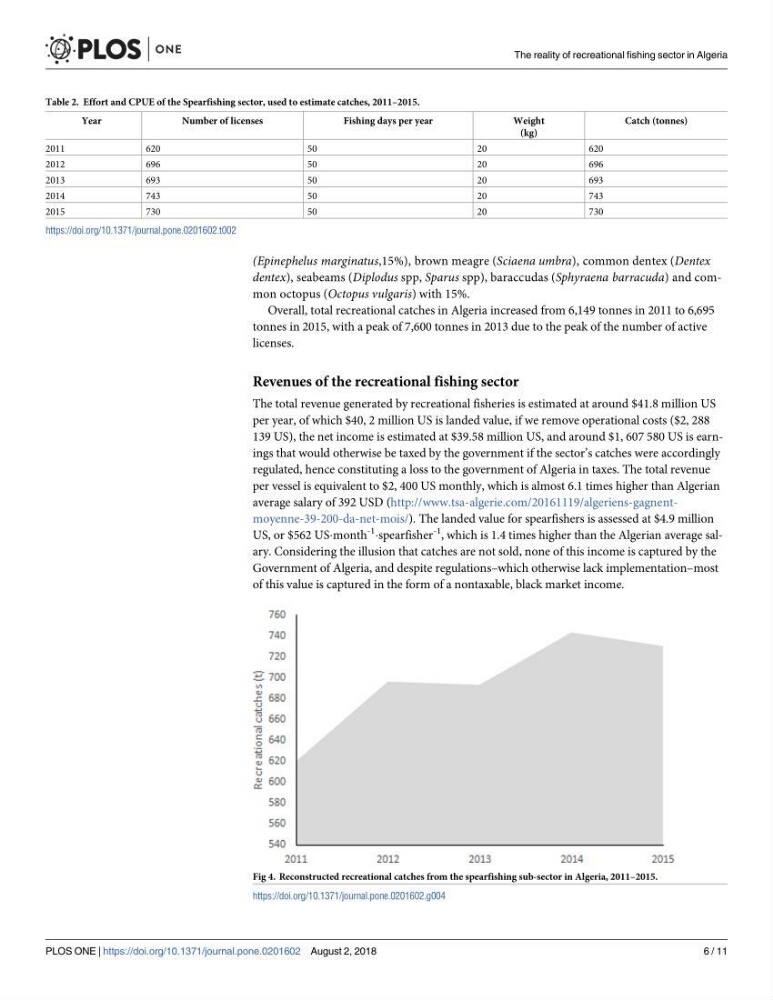
Fig 4. Reconstructed recreational catches from the spearfishing sub-sector in Algeria, 2011–2015.
https://doi.org/10.1371/journal.pone.0201602.g004
The reality of recreational fishing sector in Algeria
PLOS ONE | https://doi.org/10.1371/journal.pone.0201602 August 2, 2018
6 / 11
dentex), seabeams (Diplodus spp, Sparus spp), baraccudas (Sphyraena barracuda) and common octopus (Octopus vulgaris) with 15%.
Overall, total recreational catches in Algeria increased from 6,149 tonnes in 2011 to 6,695
tonnes in 2015, with a peak of 7,600 tonnes in 2013 due to the peak of the number of active
licenses.
Revenues of the recreational fishing sector
The total revenue generated by recreational fisheries is estimated at around $41.8 million US
per year, of which $40, 2 million US is landed value, if we remove operational costs ($2, 288
139 US), the net income is estimated at $39.58 million US, and around $1, 607 580 US is earnings that would otherwise be taxed by the government if the sector’s catches were accordingly
regulated, hence constituting a loss to the government of Algeria in taxes. The total revenue
per vessel is equivalent to $2, 400 US monthly, which is almost 6.1 times higher than Algerian
average salary of 392 USD (http://www.tsa-algerie.com/20161119/algeriens-gagnentmoyenne-39-200-da-net-mois/). The landed value for spearfishers is assessed at $4.9 million
US, or $562 USÁmonth
-1
Áspearfisher
-1
, which is 1.4 times higher than the Algerian average salary. Considering the illusion that catches are not sold, none of this income is captured by the
Government of Algeria, and despite regulations–which otherwise lack implementation–most
of this value is captured in the form of a nontaxable, black market income.
Table 2. Effort and CPUE of the Spearfishing sector, used to estimate catches, 2011–2015.
Year
Number of licenses
Fishing days per year
Weight
(kg)
Catch (tonnes)
2011
620
50
20
620
2012
696
50
20
696
2013
693
50
20
693
2014
743
50
20
743
2015
730
50
20
730
https://doi.org/10.1371/journal.pone.0201602.t002
Fig 4. Reconstructed recreational catches from the spearfishing sub-sector in Algeria, 2011–2015.
https://doi.org/10.1371/journal.pone.0201602.g004
The reality of recreational fishing sector in Algeria
PLOS ONE | https://doi.org/10.1371/journal.pone.0201602 August 2, 2018
6 / 11