

deep waters). Regressions for the eastern and western gyres of the AB
were also tested based on Testor et al. (2005)’s findings. Additionally,
we evaluated previously published equations for the AB (Gemayel et al.,
2015; Hassoun et al., 2015b; Touratier and Goyet, 2009; Touratier and
Goyet, 2011). The Root Mean Square Deviation (RMSD) always exceeded 20 μmol/kg for the latter equations. The most appropriate
equations for the intermediate and deep waters were found to be
( ± RMSD):
=
±
TA
S
131.005
9.118
2329.812 ( 4.6 µmol/kg)
p
(1)
=
+
±
DIC
S
AOU
64.812
5.384
0.483
120.117 ( 8.2 µmol/kg)
p
(2)
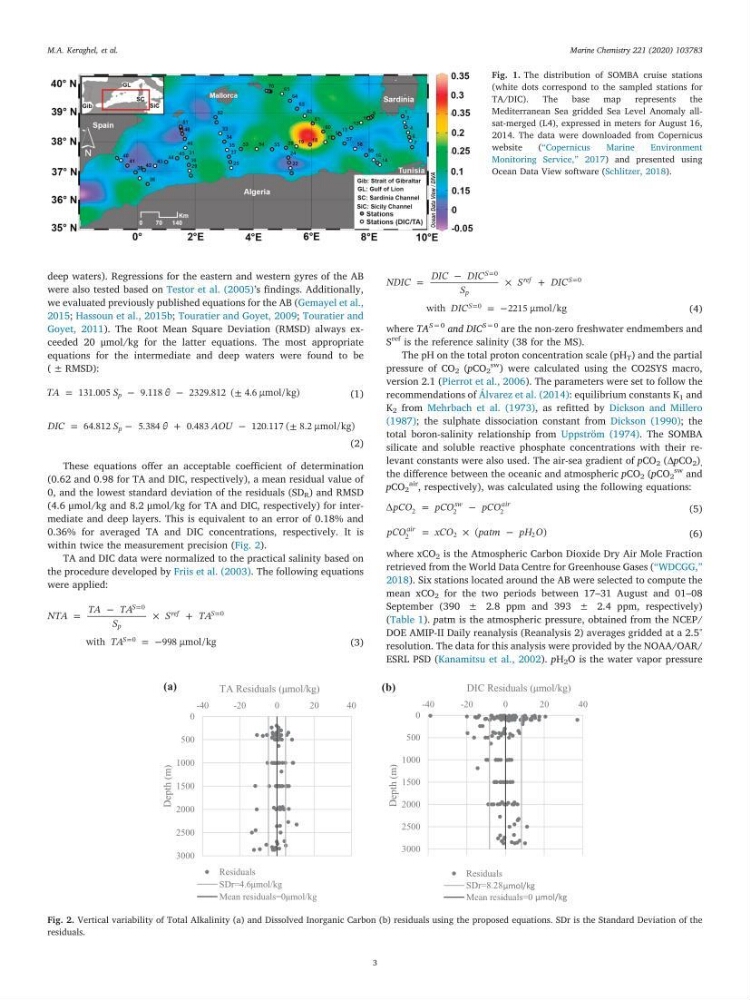
These equations offer an acceptable coefficient of determination
(0.62 and 0.98 for TA and DIC, respectively), a mean residual value of
0, and the lowest standard deviation of the residuals (SD R ) and RMSD
(4.6 μmol/kg and 8.2 μmol/kg for TA and DIC, respectively) for intermediate and deep layers. This is equivalent to an error of 0.18% and
0.36% for averaged TA and DIC concentrations, respectively. It is
within twice the measurement precision (Fig. 2).
TA and DIC data were normalized to the practical salinity based on
the procedure developed by Friis et al. (2003). The following equations
were applied:
=
×
+
=
=
=
=
NTA
TA
TA
S
S
TA
TA
with
998 µmol/kg
S
p
ref
S
S
0
0
0
(3)
=
×
+
=
=
=
=
NDIC
DIC
DIC
S
S
DIC
DIC
with
2215 µmol/kg
S
p
ref
S
S
0
0
0
(4)
where TA
S=0
and DIC
S=0
are the non-zero freshwater endmembers and
S
ref
is the reference salinity (38 for the MS).
The pH on the total proton concentration scale (pH T ) and the partial
pressure of CO 2 (pCO 2
sw
) were calculated using the CO2SYS macro,
version 2.1 (Pierrot et al., 2006). The parameters were set to follow the
recommendations of Álvarez et al. (2014): equilibrium constants K 1 and
K 2 from Mehrbach et al. (1973), as refitted by Dickson and Millero
(1987); the sulphate dissociation constant from Dickson (1990); the
total boron-salinity relationship from Uppström (1974). The SOMBA
silicate and soluble reactive phosphate concentrations with their relevant constants were also used. The air-sea gradient of pCO 2 (ΔpCO 2 ) ,
the difference between the oceanic and atmospheric pCO 2 (pCO 2
sw
and
pCO 2
air
, respectively), was calculated using the following equations:
=
pCO
pCO
pCO
sw
air
2
2
2
(5)
=
×
pCO
xCO
patm
pH O
(
)
air
2
2
2
(6)
where xCO 2 is the Atmospheric Carbon Dioxide Dry Air Mole Fraction
retrieved from the World Data Centre for Greenhouse Gases (“WDCGG,”
2018). Six stations located around the AB were selected to compute the
mean xCO 2 for the two periods between 17–31 August and 01–08
September (390 ± 2.8 ppm and 393 ± 2.4 ppm, respectively)
(Table 1). patm is the atmospheric pressure, obtained from the NCEP/
DOE AMIP-II Daily reanalysis (Reanalysis 2) averages gridded at a 2.5°
resolution. The data for this analysis were provided by the NOAA/OAR/
ESRL PSD (Kanamitsu et al., 2002). pH 2 O is the water vapor pressure
Fig. 1. The distribution of SOMBA cruise stations
(white dots correspond to the sampled stations for
TA/DIC).
The
base
map
represents
the
Mediterranean Sea gridded Sea Level Anomaly allsat-merged (L4), expressed in meters for August 16,
2014. The data were downloaded from Copernicus
website
(“Copernicus
Marine
Environment
Monitoring Service,” 2017) and presented using
Ocean Data View software (Schlitzer, 2018).
0
500
1000
1500
2000
2500
3000
-40
-20
0
20
40
Depth (m)
TA Residuals (µmol/kg)
Residuals
SDr=4.6µmol/kg
Mean residuals=0µmol/kg
(a)
0
500
1000
1500
2000
2500
3000
-40
-20
0
20
40
Depth (m)
DIC Residuals (µmol/kg)
Residuals
SDr=8.28
Mean residuals=0
µmol/kg
µmol/kg
(b)
Fig. 2. Vertical variability of Total Alkalinity (a) and Dissolved Inorganic Carbon (b) residuals using the proposed equations. SDr is the Standard Deviation of the
residuals.
M.A. Keraghel, et al.
Marine Chemistry 221 (2020) 103783
3
were also tested based on Testor et al. (2005)’s findings. Additionally,
we evaluated previously published equations for the AB (Gemayel et al.,
2015; Hassoun et al., 2015b; Touratier and Goyet, 2009; Touratier and
Goyet, 2011). The Root Mean Square Deviation (RMSD) always exceeded 20 μmol/kg for the latter equations. The most appropriate
equations for the intermediate and deep waters were found to be
( ± RMSD):
=
±
TA
S
131.005
9.118
2329.812 ( 4.6 µmol/kg)
p
(1)
=
+
±
DIC
S
AOU
64.812
5.384
0.483
120.117 ( 8.2 µmol/kg)
p
(2)
These equations offer an acceptable coefficient of determination
(0.62 and 0.98 for TA and DIC, respectively), a mean residual value of
0, and the lowest standard deviation of the residuals (SD R ) and RMSD
(4.6 μmol/kg and 8.2 μmol/kg for TA and DIC, respectively) for intermediate and deep layers. This is equivalent to an error of 0.18% and
0.36% for averaged TA and DIC concentrations, respectively. It is
within twice the measurement precision (Fig. 2).
TA and DIC data were normalized to the practical salinity based on
the procedure developed by Friis et al. (2003). The following equations
were applied:
=
×
+
=
=
=
=
NTA
TA
TA
S
S
TA
TA
with
998 µmol/kg
S
p
ref
S
S
0
0
0
(3)
=
×
+
=
=
=
=
NDIC
DIC
DIC
S
S
DIC
DIC
with
2215 µmol/kg
S
p
ref
S
S
0
0
0
(4)
where TA
S=0
and DIC
S=0
are the non-zero freshwater endmembers and
S
ref
is the reference salinity (38 for the MS).
The pH on the total proton concentration scale (pH T ) and the partial
pressure of CO 2 (pCO 2
sw
) were calculated using the CO2SYS macro,
version 2.1 (Pierrot et al., 2006). The parameters were set to follow the
recommendations of Álvarez et al. (2014): equilibrium constants K 1 and
K 2 from Mehrbach et al. (1973), as refitted by Dickson and Millero
(1987); the sulphate dissociation constant from Dickson (1990); the
total boron-salinity relationship from Uppström (1974). The SOMBA
silicate and soluble reactive phosphate concentrations with their relevant constants were also used. The air-sea gradient of pCO 2 (ΔpCO 2 ) ,
the difference between the oceanic and atmospheric pCO 2 (pCO 2
sw
and
pCO 2
air
, respectively), was calculated using the following equations:
=
pCO
pCO
pCO
sw
air
2
2
2
(5)
=
×
pCO
xCO
patm
pH O
(
)
air
2
2
2
(6)
where xCO 2 is the Atmospheric Carbon Dioxide Dry Air Mole Fraction
retrieved from the World Data Centre for Greenhouse Gases (“WDCGG,”
2018). Six stations located around the AB were selected to compute the
mean xCO 2 for the two periods between 17–31 August and 01–08
September (390 ± 2.8 ppm and 393 ± 2.4 ppm, respectively)
(Table 1). patm is the atmospheric pressure, obtained from the NCEP/
DOE AMIP-II Daily reanalysis (Reanalysis 2) averages gridded at a 2.5°
resolution. The data for this analysis were provided by the NOAA/OAR/
ESRL PSD (Kanamitsu et al., 2002). pH 2 O is the water vapor pressure
Fig. 1. The distribution of SOMBA cruise stations
(white dots correspond to the sampled stations for
TA/DIC).
The
base
map
represents
the
Mediterranean Sea gridded Sea Level Anomaly allsat-merged (L4), expressed in meters for August 16,
2014. The data were downloaded from Copernicus
website
(“Copernicus
Marine
Environment
Monitoring Service,” 2017) and presented using
Ocean Data View software (Schlitzer, 2018).
0
500
1000
1500
2000
2500
3000
-40
-20
0
20
40
Depth (m)
TA Residuals (µmol/kg)
Residuals
SDr=4.6µmol/kg
Mean residuals=0µmol/kg
(a)
0
500
1000
1500
2000
2500
3000
-40
-20
0
20
40
Depth (m)
DIC Residuals (µmol/kg)
Residuals
SDr=8.28
Mean residuals=0
µmol/kg
µmol/kg
(b)
Fig. 2. Vertical variability of Total Alkalinity (a) and Dissolved Inorganic Carbon (b) residuals using the proposed equations. SDr is the Standard Deviation of the
residuals.
M.A. Keraghel, et al.
Marine Chemistry 221 (2020) 103783
3