

60
Liquid Water in Organisms and their Environment
Solution. Assume a temperature of 293 K (20" C), then Eq. (4.13)
becomes
kg
J
0.018- x @ -
mol
kg
h, = exp
@
J
= exp -
8.31 x
K
x 293K
135000
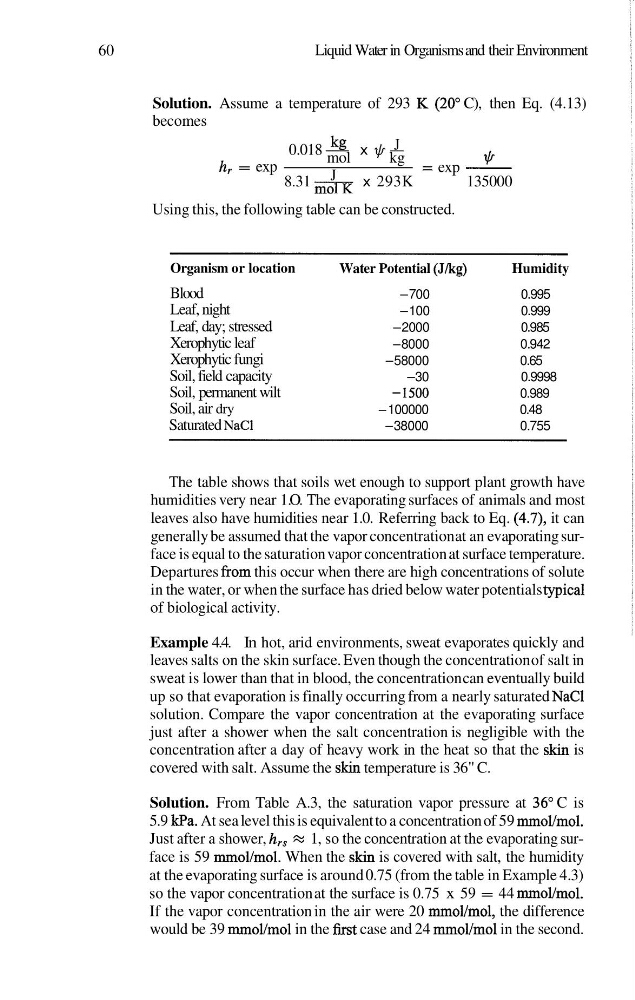
Using this, the following table can be constructed.
Organism or location
Blood
Leaf, night
Leaf, day; stressed
Xerophytic leaf
Xerophytic fungi
Soil, field capacity
Soil, permanent wilt
Soil, air dry
Saturated NaCl
Water Potential (Jlkg)
-700
-100
-2000
-8000
-58000
-30
- 1500
- 100000
-38000
Humidity
0.995
0.999
0.985
0.942
0.65
0.9998
0.989
0.48
0.755
The table shows that soils wet enough to support plant growth have
humidities very near 1 .O. The evaporating surfaces of animals and most
leaves also have humidities near 1.0. Referring back to Eq. (4.7), it can
generally be assumed that the vapor concentration at an evaporating surface is equal to the saturation vapor concentration at surface temperature.
Departures from this occur when there are high concentrations of solute
in the water, or when the surface has dried below water potentials typical
of biological activity.
Example 4.4. In hot, arid environments, sweat evaporates quickly and
leaves salts on the skin surface. Even though the concentration of salt in
sweat is lower than that in blood, the concentration can eventually build
up so that evaporation is finally occurring from a nearly saturated NaCl
solution. Compare the vapor concentration at the evaporating surface
just after a shower when the salt concentration is negligible with the
concentration after a day of heavy work in the heat so that the skin is
covered with salt. Assume the skin temperature is 36" C.
Solution. From Table A.3, the saturation vapor pressure at 36" C is
5.9 kPa. At sea level this is equivalent to a concentration of 59 mmoYmo1.
Just after a shower, h,, x 1, so the concentration at the evaporating surface is 59 mmollmol. When the skin is covered with salt, the humidity
at the evaporating surface is around 0.75 (from the table in Example 4.3)
so the vapor concentration at the surface is 0.75 x 59 = 44 mmoYmo1.
If the vapor concentration in the air were 20 mmoYmol, the difference
would be 39 mmoYmol in the first case and 24 mmoYmol in the second.
Liquid Water in Organisms and their Environment
Solution. Assume a temperature of 293 K (20" C), then Eq. (4.13)
becomes
kg
J
0.018- x @ -
mol
kg
h, = exp
@
J
= exp -
8.31 x
K
x 293K
135000
Using this, the following table can be constructed.
Organism or location
Blood
Leaf, night
Leaf, day; stressed
Xerophytic leaf
Xerophytic fungi
Soil, field capacity
Soil, permanent wilt
Soil, air dry
Saturated NaCl
Water Potential (Jlkg)
-700
-100
-2000
-8000
-58000
-30
- 1500
- 100000
-38000
Humidity
0.995
0.999
0.985
0.942
0.65
0.9998
0.989
0.48
0.755
The table shows that soils wet enough to support plant growth have
humidities very near 1 .O. The evaporating surfaces of animals and most
leaves also have humidities near 1.0. Referring back to Eq. (4.7), it can
generally be assumed that the vapor concentration at an evaporating surface is equal to the saturation vapor concentration at surface temperature.
Departures from this occur when there are high concentrations of solute
in the water, or when the surface has dried below water potentials typical
of biological activity.
Example 4.4. In hot, arid environments, sweat evaporates quickly and
leaves salts on the skin surface. Even though the concentration of salt in
sweat is lower than that in blood, the concentration can eventually build
up so that evaporation is finally occurring from a nearly saturated NaCl
solution. Compare the vapor concentration at the evaporating surface
just after a shower when the salt concentration is negligible with the
concentration after a day of heavy work in the heat so that the skin is
covered with salt. Assume the skin temperature is 36" C.
Solution. From Table A.3, the saturation vapor pressure at 36" C is
5.9 kPa. At sea level this is equivalent to a concentration of 59 mmoYmo1.
Just after a shower, h,, x 1, so the concentration at the evaporating surface is 59 mmollmol. When the skin is covered with salt, the humidity
at the evaporating surface is around 0.75 (from the table in Example 4.3)
so the vapor concentration at the surface is 0.75 x 59 = 44 mmoYmo1.
If the vapor concentration in the air were 20 mmoYmol, the difference
would be 39 mmoYmol in the first case and 24 mmoYmol in the second.