

Relation of Liquid- to Gas-Phase Water
59
tween the liquid water phase and the gas phase. In Ch. 3 we said that the
concentration of vapor at this interface is the saturation vapor concentration at surface temperature if the surface is free water. If the surface is not
a free water surface, then we expect the surface to have a humidity less
than 1.0 and a vapor concentration less than the saturation concentration.
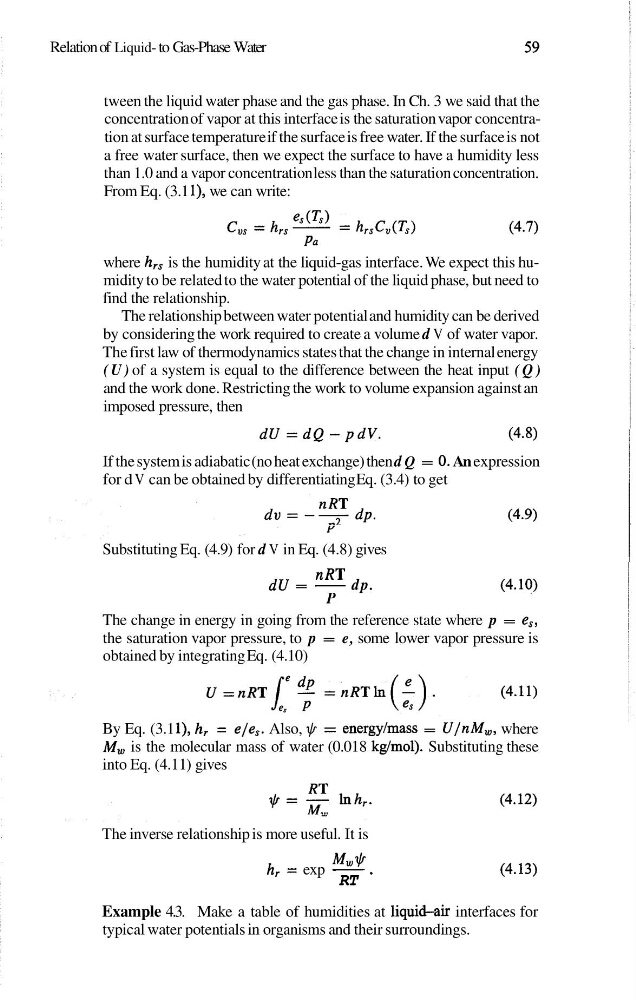
From Eq. (3.1 l), we can write:
where hrs is the humidity at the liquid-gas interface. We expect this humidity to be related to the water potential of the liquid phase, but need to
find the relationship.
The relationship between water potential and humidity can be derived
by considering the work required to create a volume d V of water vapor.
The first law of thermodynamics states that the change in internal energy
( U ) of a system is equal to the difference between the heat input ( Q )
and the work done. Restricting the work to volume expansion against an
imposed pressure, then
If the system is adiabatic (no heat exchange) then d Q = 0. An expression
for d V can be obtained by differentiating Eq. (3.4) to get
Substituting Eq. (4.9) for d V in Eq. (4.8) gives
nRT
dU = - dp.
P
The change in energy in going from the reference state where p = es,
the saturation vapor pressure, to p = e, some lower vapor pressure is
obtained by integrating Eq. (4.10)
By Eq. (3.1 l), hr = e/es. Also, + = energylmass = U/nMw, where
M, is the molecular mass of water (0.018 kglmol). Substituting these
into Eq. (4.1 1) gives
Mw+
h, = exp -
RT '
The inverse relationship is more useful. It is
Example 4.3. Make a table of humidities at liquibair interfaces for
typical water potentials in organisms and their surroundings.
59
tween the liquid water phase and the gas phase. In Ch. 3 we said that the
concentration of vapor at this interface is the saturation vapor concentration at surface temperature if the surface is free water. If the surface is not
a free water surface, then we expect the surface to have a humidity less
than 1.0 and a vapor concentration less than the saturation concentration.
From Eq. (3.1 l), we can write:
where hrs is the humidity at the liquid-gas interface. We expect this humidity to be related to the water potential of the liquid phase, but need to
find the relationship.
The relationship between water potential and humidity can be derived
by considering the work required to create a volume d V of water vapor.
The first law of thermodynamics states that the change in internal energy
( U ) of a system is equal to the difference between the heat input ( Q )
and the work done. Restricting the work to volume expansion against an
imposed pressure, then
If the system is adiabatic (no heat exchange) then d Q = 0. An expression
for d V can be obtained by differentiating Eq. (3.4) to get
Substituting Eq. (4.9) for d V in Eq. (4.8) gives
nRT
dU = - dp.
P
The change in energy in going from the reference state where p = es,
the saturation vapor pressure, to p = e, some lower vapor pressure is
obtained by integrating Eq. (4.10)
By Eq. (3.1 l), hr = e/es. Also, + = energylmass = U/nMw, where
M, is the molecular mass of water (0.018 kglmol). Substituting these
into Eq. (4.1 1) gives
Mw+
h, = exp -
RT '
The inverse relationship is more useful. It is
Example 4.3. Make a table of humidities at liquibair interfaces for
typical water potentials in organisms and their surroundings.