

Problems
13
References
Page, C.H. and P. Vigoureux (1974) The International System of Units,
Nat. Bur. Stand. Spec. Publ. 330 U.S. Govt. Printing Office,
Washington, D.C.
Seeger, R.J. (1973) Benjamin Franklin, New World Physicist, New York:
Pergamon Press.
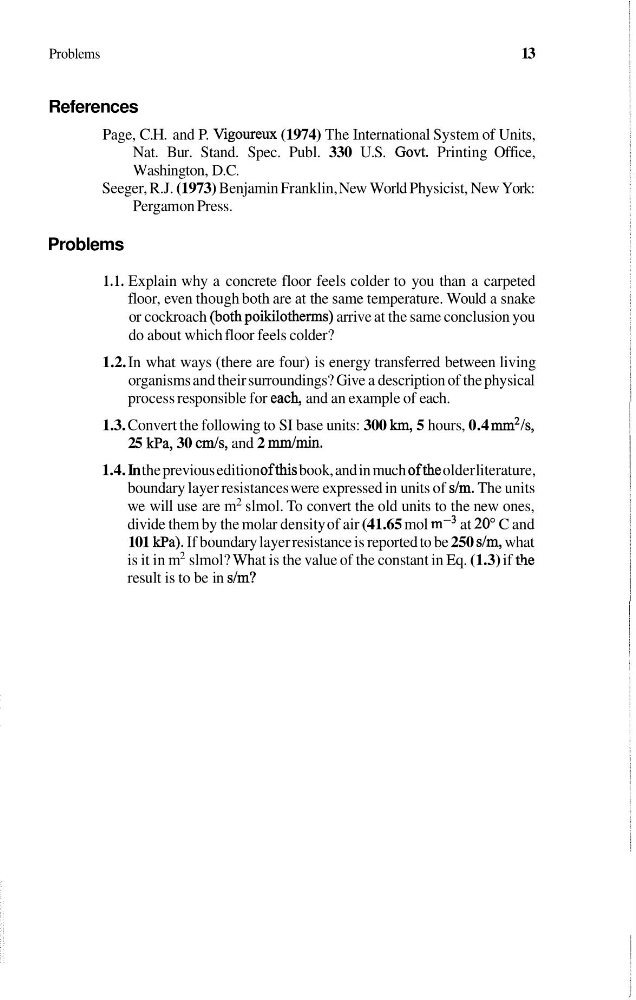
Problems
1.1. Explain why a concrete floor feels colder to you than a carpeted
floor, even though both are at the same temperature. Would a snake
or cockroach (both poikilothem) arrive at the same conclusion you
do about which floor feels colder?
1.2. In what ways (there are four) is energy transferred between living
organisms and their surroundings? Give a description of the physical
process responsible for eack and an example of each.
1.3. Convert the following to SI base units: 300 km, 5 hours, 0.4 rnm2/s,
25 kPa, 30 crnls, and 2 mmlmin.
1.4. In the previous edition ofthis book, and in much ofthe older literature,
boundary layer resistances were expressed in units of slm. The units
we will use are m 2 slmol. To convert the old units to the new ones,
divide them by the molar density of air (41.65 mol m-3 at 20' C and
101 Ha). If boundary layer resistance is reported to be 250 slrn, what
is it in m 2 slmol? What is the value of the constant in Eq. (1.3) if Ae
result is to be in slrn?
13
References
Page, C.H. and P. Vigoureux (1974) The International System of Units,
Nat. Bur. Stand. Spec. Publ. 330 U.S. Govt. Printing Office,
Washington, D.C.
Seeger, R.J. (1973) Benjamin Franklin, New World Physicist, New York:
Pergamon Press.
Problems
1.1. Explain why a concrete floor feels colder to you than a carpeted
floor, even though both are at the same temperature. Would a snake
or cockroach (both poikilothem) arrive at the same conclusion you
do about which floor feels colder?
1.2. In what ways (there are four) is energy transferred between living
organisms and their surroundings? Give a description of the physical
process responsible for eack and an example of each.
1.3. Convert the following to SI base units: 300 km, 5 hours, 0.4 rnm2/s,
25 kPa, 30 crnls, and 2 mmlmin.
1.4. In the previous edition ofthis book, and in much ofthe older literature,
boundary layer resistances were expressed in units of slm. The units
we will use are m 2 slmol. To convert the old units to the new ones,
divide them by the molar density of air (41.65 mol m-3 at 20' C and
101 Ha). If boundary layer resistance is reported to be 250 slrn, what
is it in m 2 slmol? What is the value of the constant in Eq. (1.3) if Ae
result is to be in slrn?