

Introduction
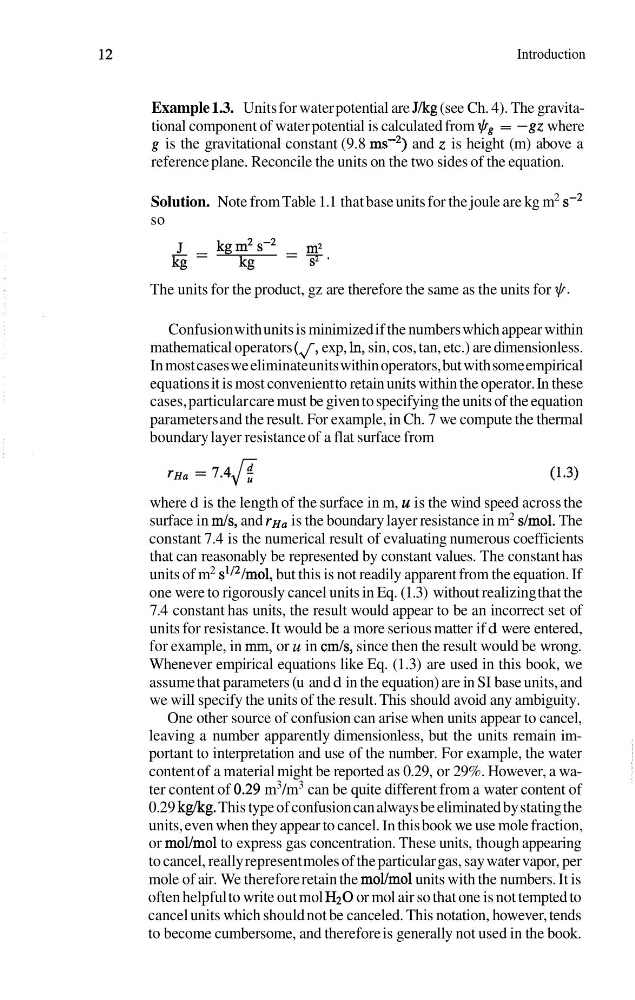
Example 1.3. Units for water potential are Jlkg (see Ch. 4). The gravitational component of water potential is calculated from llrg = -gz where
g is the gravitational constant (9.8
and z is height (m) above a
reference plane. Reconcile the units on the two sides of the equation.
Solution. Note from Table 1.1 that base units for the joule are kg m
2 s-2
so
The units for the product, gz are therefore the same as the units for @.
Confusion with units is minimized if the numbers which appear within
mathematical operators ( J , exp, In, sin, cos, tan, etc.) are dimensionless.
In most cases we eliminate units within operators, but with some empirical
equations it is most convenient to retain units within the operator. In these
cases, particular care must be given to specifying the units of the equation
parameters and the result. For example, in Ch. 7 we compute the thermal
boundary layer resistance of a flat surface from
where d is the length of the surface in m, u is the wind speed across the
surface in d s , and rHa is the boundary layer resistance in m 2 slmol. The
constant 7.4 is the numerical result of evaluating numerous coefficients
that can reasonably be represented by constant values. The constant has
units of m 2 s1/2/mol, but this is not readily apparent from the equation. If
one were to rigorously cancel units in Eq. (1.3) without realizing that the
7.4 constant has units, the result would appear to be an incorrect set of
units for resistance. It would be a more serious matter if d were entered,
for example, in mm, or u in cm/s, since then the result would be wrong.
Whenever empirical equations like Eq. (1.3) are used in this book, we
assume that parameters (u and d in the equation) are in SI base units, and
we will specify the units of the result. This should avoid any ambiguity.
One other source of confusion can arise when units appear to cancel,
leaving a number apparently dimensionless, but the units remain important to interpretation and use of the number. For example, the water
content of a material might be reported as 0.29, or 29%. However, a water content of 0.29 m
3
/m
3 can be quite different from a water content of
0.29 kgkg. This type of confusion can always be eliminated by stating the
units, even when they appear to cancel. In this book we use mole fraction,
or mol/mol to express gas concentration. These units, though appearing
to cancel, really represent moles of the particular gas, say water vapor, per
mole of air. We therefore retain the moYmol units with the numbers. It is
often helpful to write out mol H20 or mol air so that one is not tempted to
cancel units which should not be canceled. This notation, however, tends
to become cumbersome, and therefore is generally not used in the book.
Example 1.3. Units for water potential are Jlkg (see Ch. 4). The gravitational component of water potential is calculated from llrg = -gz where
g is the gravitational constant (9.8
and z is height (m) above a
reference plane. Reconcile the units on the two sides of the equation.
Solution. Note from Table 1.1 that base units for the joule are kg m
2 s-2
so
The units for the product, gz are therefore the same as the units for @.
Confusion with units is minimized if the numbers which appear within
mathematical operators ( J , exp, In, sin, cos, tan, etc.) are dimensionless.
In most cases we eliminate units within operators, but with some empirical
equations it is most convenient to retain units within the operator. In these
cases, particular care must be given to specifying the units of the equation
parameters and the result. For example, in Ch. 7 we compute the thermal
boundary layer resistance of a flat surface from
where d is the length of the surface in m, u is the wind speed across the
surface in d s , and rHa is the boundary layer resistance in m 2 slmol. The
constant 7.4 is the numerical result of evaluating numerous coefficients
that can reasonably be represented by constant values. The constant has
units of m 2 s1/2/mol, but this is not readily apparent from the equation. If
one were to rigorously cancel units in Eq. (1.3) without realizing that the
7.4 constant has units, the result would appear to be an incorrect set of
units for resistance. It would be a more serious matter if d were entered,
for example, in mm, or u in cm/s, since then the result would be wrong.
Whenever empirical equations like Eq. (1.3) are used in this book, we
assume that parameters (u and d in the equation) are in SI base units, and
we will specify the units of the result. This should avoid any ambiguity.
One other source of confusion can arise when units appear to cancel,
leaving a number apparently dimensionless, but the units remain important to interpretation and use of the number. For example, the water
content of a material might be reported as 0.29, or 29%. However, a water content of 0.29 m
3
/m
3 can be quite different from a water content of
0.29 kgkg. This type of confusion can always be eliminated by stating the
units, even when they appear to cancel. In this book we use mole fraction,
or mol/mol to express gas concentration. These units, though appearing
to cancel, really represent moles of the particular gas, say water vapor, per
mole of air. We therefore retain the moYmol units with the numbers. It is
often helpful to write out mol H20 or mol air so that one is not tempted to
cancel units which should not be canceled. This notation, however, tends
to become cumbersome, and therefore is generally not used in the book.