

Leaf Temperature
225
Some species have stomata on only one side of the leaf (usually the
abaxial side). Such leaves are called hypostomatous. The conductance
for these leaves is computed from just the first term on the right of Eq.
(14.2), since, for zero surface conductance, the second term is zero. Leaves
with stomates on both sides of the leaf are called amphistomatous. In
the special case where an amphistomatous leaf has equal abaxial and
adaxial conductances, the overall conductance for the leaf is equal to the
conductance for either side. For simplicity, the examples in this chapter
assume equal conductances on the two sides of the leaf. Leaves of this
type are most common in grasses.
Equation (14.1) shows the explicit relationships for radiant emittance,
sensible heat, and latent heat loss. It therefore relates leaf thermodynamic
temperature explicitly to leaf properties and environmental variables. The
equation for leaf temperature could be solved using mathematical procedures for nonlinear equations, but we cannot obtain an explicit solution
because of the nonlinear emittance and saturation vapor pressure terms.
Since an explicit form of the equation is useful for our analyses, we obtain
an approximate solution using the linearization techniques introduced in
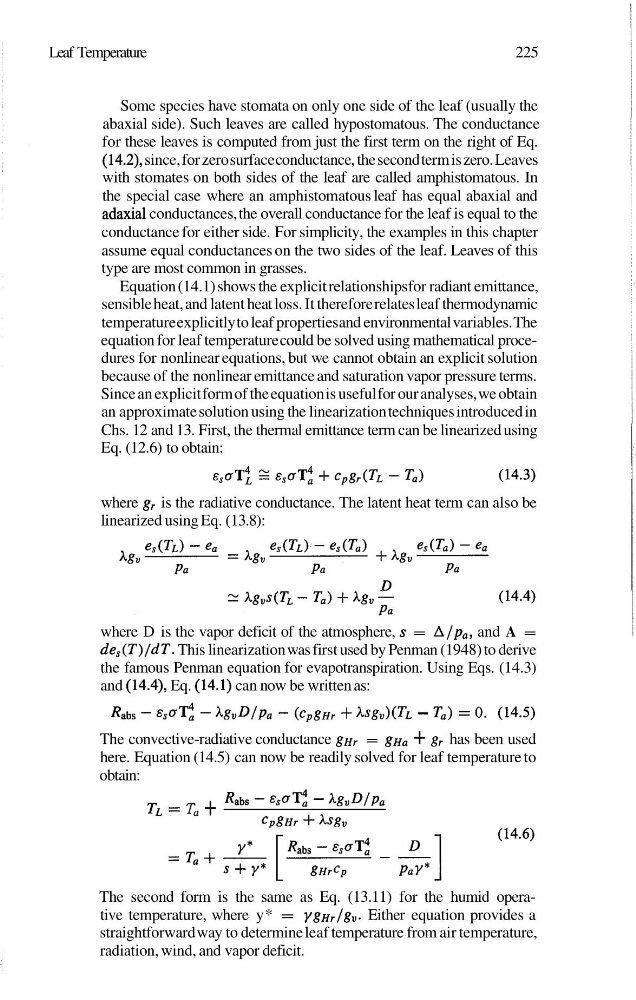
Chs. 12 and 13. First, the thermal emittance term can be linearized using
Eq. (12.6) to obtain:
where gr is the radiative conductance. The latent heat term can also be
linearized using Eq. (1 3.8):
where D is the vapor deficit of the atmosphere, s = Alp,, and A =
de, (T)/dT. This linearization was first used by Penman (1948) to derive
the famous Penman equation for evapotranspiration. Using Eqs. (14.3)
and (14.4), Eq. (14.1) can now be written as:
Rabs - &,aT; - hguD/pa - ( c p g ~ r + J-sgu)(T~ - Ta) = 0. (14.5)
The convective-radiative conductance g~~ = g~~ + gr has been used
here. Equation (14.5) can now be readily solved for leaf temperature to
obtain:
TL = Ta +
Rabs - & s u e - hgvD/pa
CpgHr + h~gu
The second form is the same as Eq. (13.11) for the humid operative temperature, where y* = ygH,/gv. Either equation provides a
straightforward way to determine leaf temperature from air temperature,
radiation, wind, and vapor deficit.
225
Some species have stomata on only one side of the leaf (usually the
abaxial side). Such leaves are called hypostomatous. The conductance
for these leaves is computed from just the first term on the right of Eq.
(14.2), since, for zero surface conductance, the second term is zero. Leaves
with stomates on both sides of the leaf are called amphistomatous. In
the special case where an amphistomatous leaf has equal abaxial and
adaxial conductances, the overall conductance for the leaf is equal to the
conductance for either side. For simplicity, the examples in this chapter
assume equal conductances on the two sides of the leaf. Leaves of this
type are most common in grasses.
Equation (14.1) shows the explicit relationships for radiant emittance,
sensible heat, and latent heat loss. It therefore relates leaf thermodynamic
temperature explicitly to leaf properties and environmental variables. The
equation for leaf temperature could be solved using mathematical procedures for nonlinear equations, but we cannot obtain an explicit solution
because of the nonlinear emittance and saturation vapor pressure terms.
Since an explicit form of the equation is useful for our analyses, we obtain
an approximate solution using the linearization techniques introduced in
Chs. 12 and 13. First, the thermal emittance term can be linearized using
Eq. (12.6) to obtain:
where gr is the radiative conductance. The latent heat term can also be
linearized using Eq. (1 3.8):
where D is the vapor deficit of the atmosphere, s = Alp,, and A =
de, (T)/dT. This linearization was first used by Penman (1948) to derive
the famous Penman equation for evapotranspiration. Using Eqs. (14.3)
and (14.4), Eq. (14.1) can now be written as:
Rabs - &,aT; - hguD/pa - ( c p g ~ r + J-sgu)(T~ - Ta) = 0. (14.5)
The convective-radiative conductance g~~ = g~~ + gr has been used
here. Equation (14.5) can now be readily solved for leaf temperature to
obtain:
TL = Ta +
Rabs - & s u e - hgvD/pa
CpgHr + h~gu
The second form is the same as Eq. (13.11) for the humid operative temperature, where y* = ygH,/gv. Either equation provides a
straightforward way to determine leaf temperature from air temperature,
radiation, wind, and vapor deficit.