

224
Plants and Plant Communities
model temperature, transpiration, and photosynthesis in plant communities. The equations for such models are similar to those for individual
leaves, but with conductances adjusted appropriately. The big leaf models
for plant communities are presented in this chapter. In Ch. 15 we present
the more complex models that deal with plant communities as collections of individual leaves. We first consider the effects of environment
on transpiration and leaf or canopy temperature, and then present several
models that relate photosynthesis to light, temperature, and transpiration.
Finally, we combine the photosynthesis and energy balance equations to
predict response of photosynthesis to plant and environmental variables,
and attempt to specify optimum leaf form for a particular environment.
14.1 Leaf Temperature
The temperature of a leaf is determined, as with a poikilothermic animal,
by the energy budget of the leaf. In Chs. 12 and 13 equations for the temperature of poikilotherms are derived. For a dry system, where latent heat
exchange is a small and predictable fraction of the total energy budget,
the operative temperature gives the temperature of the poikilotherm. For
a wet system, where latent heat loss is an important part of the energy
budget, the humid operative temperature (Eq. (13.11)) is the temperature
of the poikilotherm. The leaf normally is a wet system, so its temperature is equal to the humid operative temperature. We derive that equation
again here to clarify its connection to the energy budget for a leaf. If heat
storage and metabolic heat production are assumed negligible, the energy
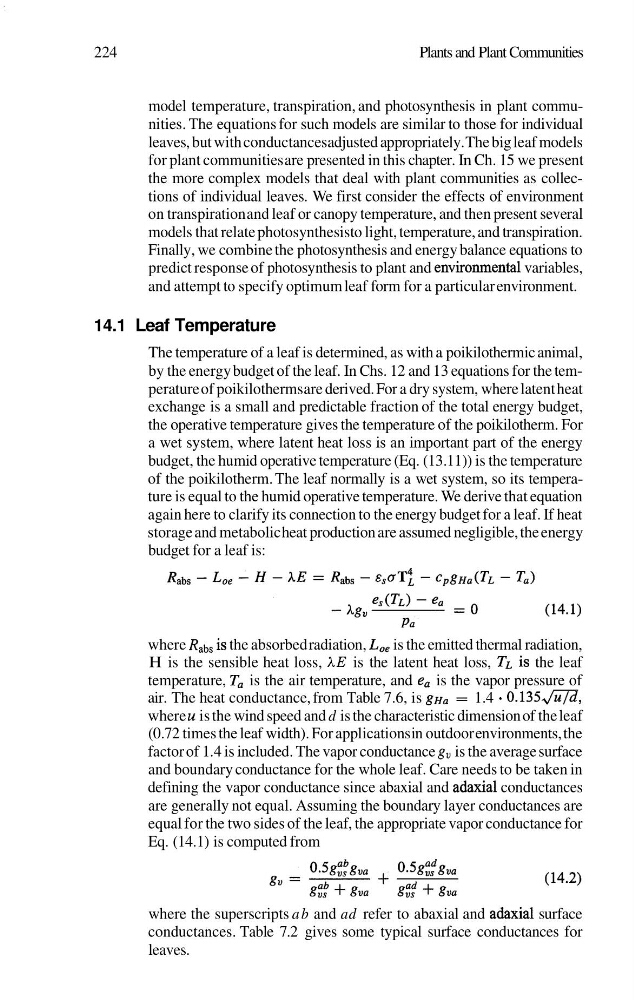
budget for a leaf is:
where Rabs is the absorbed radiation, Lo, is the emitted thermal radiation,
H is the sensible heat loss, h E is the latent heat loss, TL is the leaf
temperature, Ta is the air temperature, and ea is the vapor pressure of
air. The heat conductance, from Table 7.6, is g ~ , = 1.4 0 . 1 3 5 m ,
where u is the wind speed and d is the characteristic dimension of the leaf
(0.72 times the leaf width). For applications in outdoor environments, the
factor of 1.4 is included. The vapor conductance g, is the average surface
and boundary conductance for the whole leaf. Care needs to be taken in
defining the vapor conductance since abaxial and adaxial conductances
are generally not equal. Assuming the boundary layer conductances are
equal for the two sides of the leaf, the appropriate vapor conductance for
Eq. (14.1) is computed from
where the superscripts a b and ad refer to abaxial and adaxial surface
conductances. Table 7.2 gives some typical surface conductances for
leaves.
Plants and Plant Communities
model temperature, transpiration, and photosynthesis in plant communities. The equations for such models are similar to those for individual
leaves, but with conductances adjusted appropriately. The big leaf models
for plant communities are presented in this chapter. In Ch. 15 we present
the more complex models that deal with plant communities as collections of individual leaves. We first consider the effects of environment
on transpiration and leaf or canopy temperature, and then present several
models that relate photosynthesis to light, temperature, and transpiration.
Finally, we combine the photosynthesis and energy balance equations to
predict response of photosynthesis to plant and environmental variables,
and attempt to specify optimum leaf form for a particular environment.
14.1 Leaf Temperature
The temperature of a leaf is determined, as with a poikilothermic animal,
by the energy budget of the leaf. In Chs. 12 and 13 equations for the temperature of poikilotherms are derived. For a dry system, where latent heat
exchange is a small and predictable fraction of the total energy budget,
the operative temperature gives the temperature of the poikilotherm. For
a wet system, where latent heat loss is an important part of the energy
budget, the humid operative temperature (Eq. (13.11)) is the temperature
of the poikilotherm. The leaf normally is a wet system, so its temperature is equal to the humid operative temperature. We derive that equation
again here to clarify its connection to the energy budget for a leaf. If heat
storage and metabolic heat production are assumed negligible, the energy
budget for a leaf is:
where Rabs is the absorbed radiation, Lo, is the emitted thermal radiation,
H is the sensible heat loss, h E is the latent heat loss, TL is the leaf
temperature, Ta is the air temperature, and ea is the vapor pressure of
air. The heat conductance, from Table 7.6, is g ~ , = 1.4 0 . 1 3 5 m ,
where u is the wind speed and d is the characteristic dimension of the leaf
(0.72 times the leaf width). For applications in outdoor environments, the
factor of 1.4 is included. The vapor conductance g, is the average surface
and boundary conductance for the whole leaf. Care needs to be taken in
defining the vapor conductance since abaxial and adaxial conductances
are generally not equal. Assuming the boundary layer conductances are
equal for the two sides of the leaf, the appropriate vapor conductance for
Eq. (14.1) is computed from
where the superscripts a b and ad refer to abaxial and adaxial surface
conductances. Table 7.2 gives some typical surface conductances for
leaves.