

Comfort
22 1
the energy budget approach still gives the needed answers. We need
only put in physiological parameters that we think represent comfort.
These, of course, vary considerably from individual to individual. For
our purposes we assume that a person is comfortable if Tb = 37O C,
and gffr = 1 rnol m-2 s-'. For normal indoor conditions we take
g ~ = = 0.2 mol mP2 s-' and g, = 0.2 mol mW2 s-' so g ~ ,
=
0.4 mol m-2 s-'. Thermal conductance of normal indoor clothing is assumed to be 0.4 mol m-2 s-'. Combining Eqs. (12.15) and 12.16, and
assuming both skin and expired air temperature are 34" C, gives:
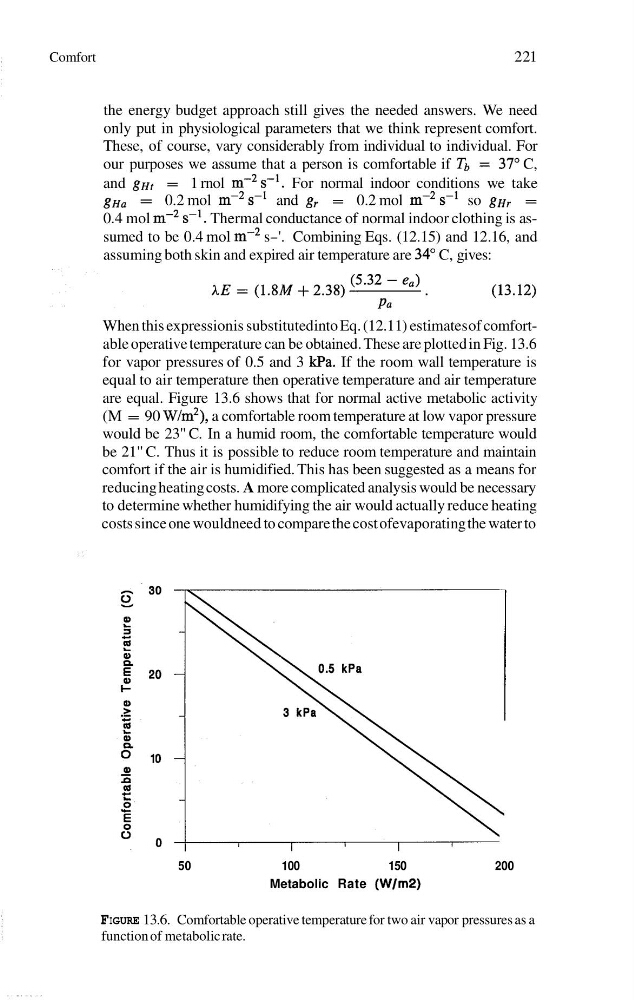
When this expression is substituted into Eq. (12.1 1) estimates of comfortable operative temperature can be obtained. These are plotted in Fig. 13.6
for vapor pressures of 0.5 and 3 kPa. If the room wall temperature is
equal to air temperature then operative temperature and air temperature
are equal. Figure 13.6 shows that for normal active metabolic activity
(M = 90 w/m2), a comfortable room temperature at low vapor pressure
would be 23" C. In a humid room, the comfortable temperature would
be 21" C. Thus it is possible to reduce room temperature and maintain
comfort if the air is humidified. This has been suggested as a means for
reducing heating costs. A more complicated analysis would be necessary
to determine whether humidifying the air would actually reduce heating
costs since one wouldneed to compare the cost ofevaporating the water to
50
100
150
200
Metabolic Rate (Wlm2)
FIGURE 13.6. Comfortable operative temperature for two air vapor pressures as a
function of metabolic rate.
22 1
the energy budget approach still gives the needed answers. We need
only put in physiological parameters that we think represent comfort.
These, of course, vary considerably from individual to individual. For
our purposes we assume that a person is comfortable if Tb = 37O C,
and gffr = 1 rnol m-2 s-'. For normal indoor conditions we take
g ~ = = 0.2 mol mP2 s-' and g, = 0.2 mol mW2 s-' so g ~ ,
=
0.4 mol m-2 s-'. Thermal conductance of normal indoor clothing is assumed to be 0.4 mol m-2 s-'. Combining Eqs. (12.15) and 12.16, and
assuming both skin and expired air temperature are 34" C, gives:
When this expression is substituted into Eq. (12.1 1) estimates of comfortable operative temperature can be obtained. These are plotted in Fig. 13.6
for vapor pressures of 0.5 and 3 kPa. If the room wall temperature is
equal to air temperature then operative temperature and air temperature
are equal. Figure 13.6 shows that for normal active metabolic activity
(M = 90 w/m2), a comfortable room temperature at low vapor pressure
would be 23" C. In a humid room, the comfortable temperature would
be 21" C. Thus it is possible to reduce room temperature and maintain
comfort if the air is humidified. This has been suggested as a means for
reducing heating costs. A more complicated analysis would be necessary
to determine whether humidifying the air would actually reduce heating
costs since one wouldneed to compare the cost ofevaporating the water to
50
100
150
200
Metabolic Rate (Wlm2)
FIGURE 13.6. Comfortable operative temperature for two air vapor pressures as a
function of metabolic rate.