

220
Humans and their Environment
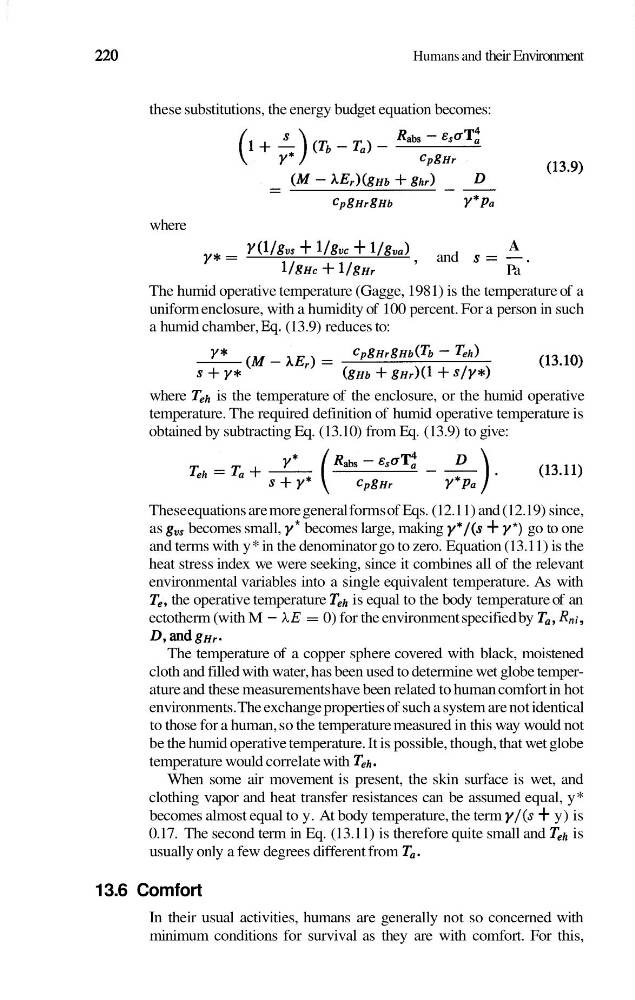
these substitutions, the energy budget equation becomes:
where
y* =
Y Wgus + l/gu, + l/g,,)
A
, and s = - .
l/gHc + l/gHr
Pa
The humid operative temperature (Gagge, 1981) is the temperature of a
uniform enclosure, with a humidity of 100 percent. For a person in such
a humid chamber, Eq. (13.9) reduces to:
where Teh is the temperature of the enclosure, or the humid operative
temperature. The required definition of humid operative temperature is
obtained by subtracting Eq. (1 3.10) from Eq. (1 3.9) to give:
These equations are more general forms of Eqs. (12.1 1) and (12.19) since,
as gvs becomes small, y * becomes large, making y */(s + y *) go to one
and terms with y* in the denominator go to zero. Equation (13.1 1) is the
heat stress index we were seeking, since it combines all of the relevant
environmental variables into a single equivalent temperature. As with
Te, the operative temperature Teh is equal to the body temperature of an
ectotherm (with M - hE = 0) for the environment specified by To, Rni ,
D, and gHr.
The temperature of a copper sphere covered with black, moistened
cloth and filled with water, has been used to determine wet globe temperature and these measurements have been related to human comfort in hot
environments. The exchange properties of such a system are not identical
to those for a human, so the temperature measured in this way would not
be the humid operative temperature. It is possible, though, that wet globe
temperature would correlate with Teh .
When some air movement is present, the skin surface is wet, and
clothing vapor and heat transfer resistances can be assumed equal, y*
becomes almost equal to y. At body temperature, the term y /(s + y) is
0.17. The second term in Eq. (13.1 1) is therefore quite small and Teh is
usually only a few degrees different from T,.
13.6 Comfort
In their usual activities, humans are generally not so concerned with
minimum conditions for survival as they are with comfort. For this,
Humans and their Environment
these substitutions, the energy budget equation becomes:
where
y* =
Y Wgus + l/gu, + l/g,,)
A
, and s = - .
l/gHc + l/gHr
Pa
The humid operative temperature (Gagge, 1981) is the temperature of a
uniform enclosure, with a humidity of 100 percent. For a person in such
a humid chamber, Eq. (13.9) reduces to:
where Teh is the temperature of the enclosure, or the humid operative
temperature. The required definition of humid operative temperature is
obtained by subtracting Eq. (1 3.10) from Eq. (1 3.9) to give:
These equations are more general forms of Eqs. (12.1 1) and (12.19) since,
as gvs becomes small, y * becomes large, making y */(s + y *) go to one
and terms with y* in the denominator go to zero. Equation (13.1 1) is the
heat stress index we were seeking, since it combines all of the relevant
environmental variables into a single equivalent temperature. As with
Te, the operative temperature Teh is equal to the body temperature of an
ectotherm (with M - hE = 0) for the environment specified by To, Rni ,
D, and gHr.
The temperature of a copper sphere covered with black, moistened
cloth and filled with water, has been used to determine wet globe temperature and these measurements have been related to human comfort in hot
environments. The exchange properties of such a system are not identical
to those for a human, so the temperature measured in this way would not
be the humid operative temperature. It is possible, though, that wet globe
temperature would correlate with Teh .
When some air movement is present, the skin surface is wet, and
clothing vapor and heat transfer resistances can be assumed equal, y*
becomes almost equal to y. At body temperature, the term y /(s + y) is
0.17. The second term in Eq. (13.1 1) is therefore quite small and Teh is
usually only a few degrees different from T,.
13.6 Comfort
In their usual activities, humans are generally not so concerned with
minimum conditions for survival as they are with comfort. For this,