

Survival in Hot Environments
217
-
maximum sweat rate
-
-
I
I
I
0.0
1.0
2.0
3.0
4.0
5.0
6.0
Air Vapor Pressure (kPa)
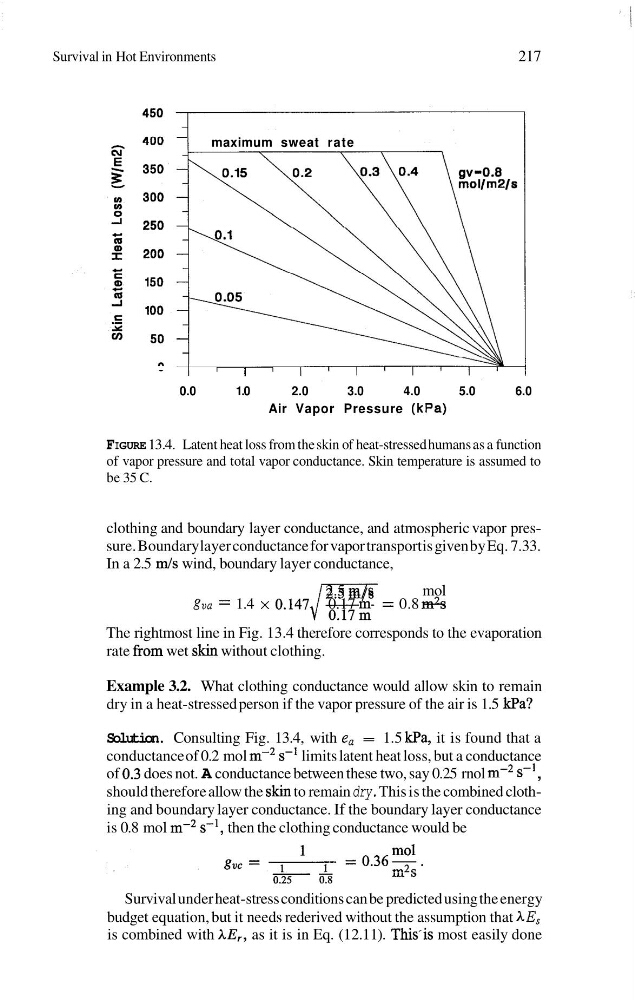
FIGURE 13.4. Latent heat loss from the skin of heat-stressed humans as a function
of vapor pressure and total vapor conductance. Skin temperature is assumed to
be 35 C.
clothing and boundary layer conductance, and atmospheric vapor pressure. Boundary layer conductance for vapor transport is given by Eq. 7.33.
In a 2.5 mls wind, boundary layer conductance,
2.5 m/s
mol
gua = 1.4 x 0 . 1 4 7 J y
0.17 m = 0.8 - m2 s
The rightmost line in Fig. 13.4 therefore corresponds to the evaporation
rate ftom wet skin without clothing.
Example 3.2. What clothing conductance would allow skin to remain
dry in a heat-stressed person if the vapor pressure of the air is 1.5 kPa?
Solution. Consulting Fig. 13.4, with ea = 1.5 kPa, it is found that a
conductance of 0.2 mol m-2 s-' limits latent heat loss, but a conductance
of 0.3 does not. A conductance between these two, say 0.25 rnol m-2 s-' ,
should therefore allow the skin to remain dry. This is the combined clothing and boundary layer conductance. If the boundary layer conductance
is 0.8 mol m-2 s-', then the clothing conductance would be
Survival under heat-stress conditions can be predicted using the energy
budget equation, but it needs rederived without the assumption that h E,
is combined with hE,, as it is in Eq. (12.1 1). Thiscis most easily done
217
-
maximum sweat rate
-
-
I
I
I
0.0
1.0
2.0
3.0
4.0
5.0
6.0
Air Vapor Pressure (kPa)
FIGURE 13.4. Latent heat loss from the skin of heat-stressed humans as a function
of vapor pressure and total vapor conductance. Skin temperature is assumed to
be 35 C.
clothing and boundary layer conductance, and atmospheric vapor pressure. Boundary layer conductance for vapor transport is given by Eq. 7.33.
In a 2.5 mls wind, boundary layer conductance,
2.5 m/s
mol
gua = 1.4 x 0 . 1 4 7 J y
0.17 m = 0.8 - m2 s
The rightmost line in Fig. 13.4 therefore corresponds to the evaporation
rate ftom wet skin without clothing.
Example 3.2. What clothing conductance would allow skin to remain
dry in a heat-stressed person if the vapor pressure of the air is 1.5 kPa?
Solution. Consulting Fig. 13.4, with ea = 1.5 kPa, it is found that a
conductance of 0.2 mol m-2 s-' limits latent heat loss, but a conductance
of 0.3 does not. A conductance between these two, say 0.25 rnol m-2 s-' ,
should therefore allow the skin to remain dry. This is the combined clothing and boundary layer conductance. If the boundary layer conductance
is 0.8 mol m-2 s-', then the clothing conductance would be
Survival under heat-stress conditions can be predicted using the energy
budget equation, but it needs rederived without the assumption that h E,
is combined with hE,, as it is in Eq. (12.1 1). Thiscis most easily done