

Humans and their Environment
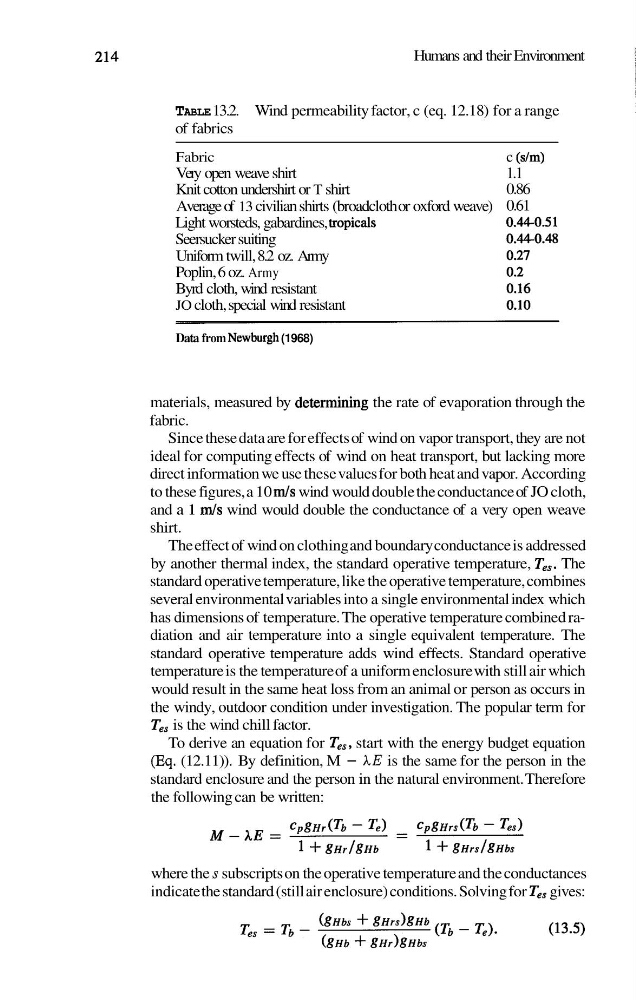
TABLE 13.2. Wind permeability factor, c (eq. 12.18) for a range
of fabrics
Fabric
c (dm)
Very open weave shirt
1.1
Knit cotton undershirt or T shirt
0.86
Average of 13 civilian shirts (broadcloth or oxford weave) 0.61
Light worsteds, gabardines, tropicals
Seersucker suiting
Uniform twill, 8.2 oz. Army
Poplin, 6 oz. Army
Byrd cloth, wind resistant
JO cloth, special wind resistant
Data from Newburgh (1968)
materials, measured by determining the rate of evaporation through the
fabric.
Since these data are for effects of wind on vapor transport, they are not
ideal for computing effects of wind on heat transport, but lacking more
direct information we use these values for both heat and vapor. According
to these figures, a 10 mls wind would double the conductance of JO cloth,
and a 1 mls wind would double the conductance of a very open weave
shirt.
The effect of wind on clothing and boundary conductance is addressed
by another thermal index, the standard operative temperature, T , . The
standard operative temperature, like the operative temperature, combines
several environmental variables into a single environmental index which
has dimensions of temperature. The operative temperature combined radiation and air temperature into a single equivalent temperature. The
standard operative temperature adds wind effects. Standard operative
temperature is the temperature of a uniform enclosure with still air which
would result in the same heat loss from an animal or person as occurs in
the windy, outdoor condition under investigation. The popular term for
T, is the wind chill factor.
To derive an equation for Te,, start with the energy budget equation
(Eq. (12.11)). By definition, M - hE is the same for the person in the
standard enclosure and the person in the natural environment. Therefore
the following can be written:
where the s subscripts on the operative temperature and the conductances
indicate the standard (still air enclosure) conditions. Solving for Tes gives:
TABLE 13.2. Wind permeability factor, c (eq. 12.18) for a range
of fabrics
Fabric
c (dm)
Very open weave shirt
1.1
Knit cotton undershirt or T shirt
0.86
Average of 13 civilian shirts (broadcloth or oxford weave) 0.61
Light worsteds, gabardines, tropicals
Seersucker suiting
Uniform twill, 8.2 oz. Army
Poplin, 6 oz. Army
Byrd cloth, wind resistant
JO cloth, special wind resistant
Data from Newburgh (1968)
materials, measured by determining the rate of evaporation through the
fabric.
Since these data are for effects of wind on vapor transport, they are not
ideal for computing effects of wind on heat transport, but lacking more
direct information we use these values for both heat and vapor. According
to these figures, a 10 mls wind would double the conductance of JO cloth,
and a 1 mls wind would double the conductance of a very open weave
shirt.
The effect of wind on clothing and boundary conductance is addressed
by another thermal index, the standard operative temperature, T , . The
standard operative temperature, like the operative temperature, combines
several environmental variables into a single environmental index which
has dimensions of temperature. The operative temperature combined radiation and air temperature into a single equivalent temperature. The
standard operative temperature adds wind effects. Standard operative
temperature is the temperature of a uniform enclosure with still air which
would result in the same heat loss from an animal or person as occurs in
the windy, outdoor condition under investigation. The popular term for
T, is the wind chill factor.
To derive an equation for Te,, start with the energy budget equation
(Eq. (12.11)). By definition, M - hE is the same for the person in the
standard enclosure and the person in the natural environment. Therefore
the following can be written:
where the s subscripts on the operative temperature and the conductances
indicate the standard (still air enclosure) conditions. Solving for Tes gives: