

Wind Chill and Standard Operative Temperature
-40
-30
-20
-10
0
10
20
Operative Temperature (C)
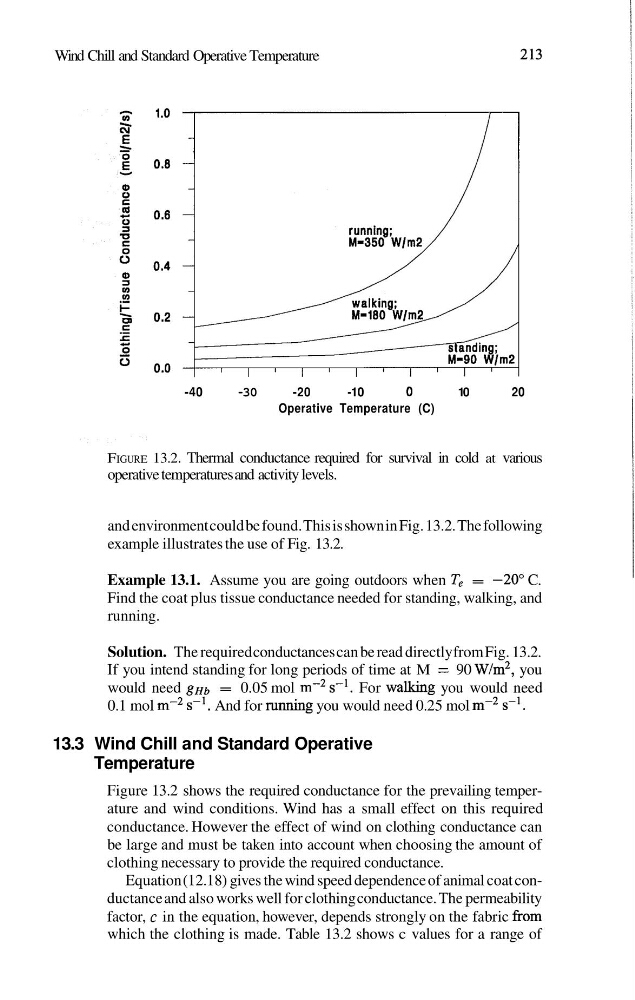
FIGURE 13.2. Thermal conductance required for survival in cold at various
operative temperatures and activity levels.
and environment could be found. This is shown in Fig. 13.2. The following
example illustrates the use of Fig. 13.2.
Example 13.1. Assume you are going outdoors when T, = -20" C.
Find the coat plus tissue conductance needed for standing, walking, and
running.
Solution. The required conductances can be read directly from Fig. 13.2.
If you intend standing for long periods of time at M = 90 w/m2, you
would need g ~ b
= 0.05 mol m-2 s-'. For walking you would need
0.1 mol m-2 s-' . And for running you would need 0.25 mol mP2 s-'.
13.3 Wind Chill and Standard Operative
Temperature
Figure 13.2 shows the required conductance for the prevailing temperature and wind conditions. Wind has a small effect on this required
conductance. However the effect of wind on clothing conductance can
be large and must be taken into account when choosing the amount of
clothing necessary to provide the required conductance.
Equation (12.18) gives the wind speed dependence of animal coat conductance and also works well for clothing conductance. The permeability
factor, c in the equation, however, depends strongly on the fabric from
which the clothing is made. Table 13.2 shows c values for a range of
-40
-30
-20
-10
0
10
20
Operative Temperature (C)
FIGURE 13.2. Thermal conductance required for survival in cold at various
operative temperatures and activity levels.
and environment could be found. This is shown in Fig. 13.2. The following
example illustrates the use of Fig. 13.2.
Example 13.1. Assume you are going outdoors when T, = -20" C.
Find the coat plus tissue conductance needed for standing, walking, and
running.
Solution. The required conductances can be read directly from Fig. 13.2.
If you intend standing for long periods of time at M = 90 w/m2, you
would need g ~ b
= 0.05 mol m-2 s-'. For walking you would need
0.1 mol m-2 s-' . And for running you would need 0.25 mol mP2 s-'.
13.3 Wind Chill and Standard Operative
Temperature
Figure 13.2 shows the required conductance for the prevailing temperature and wind conditions. Wind has a small effect on this required
conductance. However the effect of wind on clothing conductance can
be large and must be taken into account when choosing the amount of
clothing necessary to provide the required conductance.
Equation (12.18) gives the wind speed dependence of animal coat conductance and also works well for clothing conductance. The permeability
factor, c in the equation, however, depends strongly on the fabric from
which the clothing is made. Table 13.2 shows c values for a range of