

Survival in Cold Environments
21 1
2.8 rnol mP2 s-' for vasodilation. These values were calculated from Kerslake (1972, Fig. 7.22). Monteith gives a range of 0.35 to 1.4 rnol m-2 s-' .
The difference is probably due to acclimatization of subjects or possible subject-to-subject variation. In any case, we use the range 0.46 to
2.8 rnol m-2 s-' for our calculations.
Clothing conductance for humans is more difficult to treat than coat
conductance for animals because of the extremely wide possible range of
clothing available (down parkas to bathing suits). Normal indoor clothing
has a conductance of around 0.4 rnol m-2 s-' in still air. In moving air,
this is drastically increased, as common experience will verify. In the
absence of conductance measurements for a given assemblage of clothing,
one can use estimates based on windspeed, permeability, thickness, and
ventilation of the clothing.
13.2 Survival in Cold Environments
Equation (12.1 1) will be used as the basis for our examination of energy
and thermal resistance requirements for humans. Consider fist the lowest
temperature at which a human can survive. This can be found by assuming
extreme values for M, g ~ b ,
h E, and g ~ ~ .
If we assume d = 0.17 m,
u = 3 d s , hEr = O.lM, hEs = 12 w/m2, and Tb = 36O C then the
lowest equivalent temperature for survival can be calculated for various
resistances and metabolic rates. From Table A.3, with Ta = 0" C, gr =
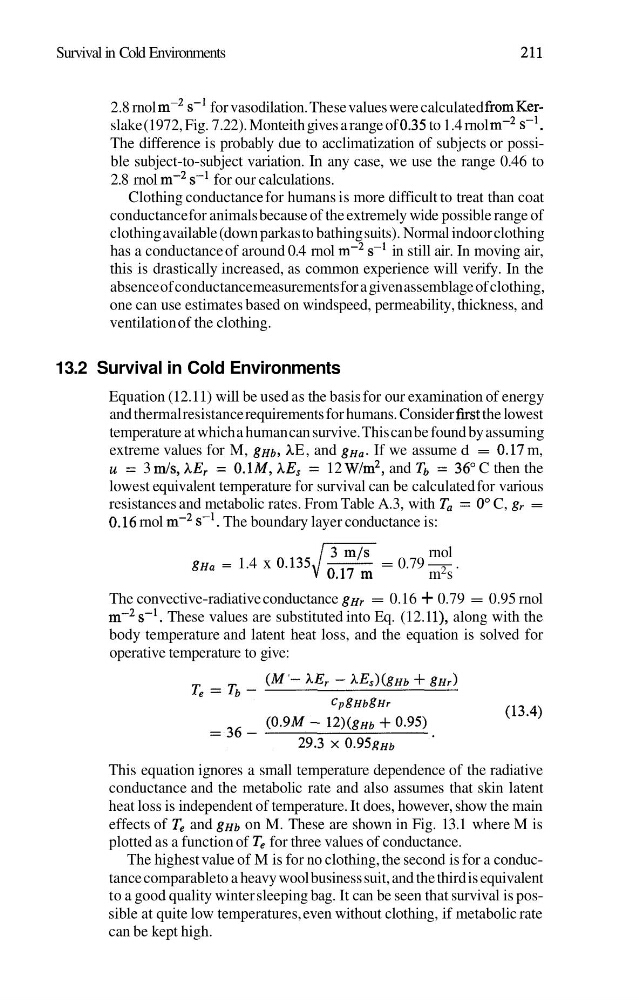
0.16 rnol m-2 s-I . The boundary layer conductance is:
rnol
- 1.4 x 0.135/=
= 0.79-.
gHa -
0.17 m
m 2 s
The convective-radiative conductance g ~ ,
= 0.16 + 0.79 = 0.95 rnol
m-2 s-'. These values are substituted into Eq. (12.1 l), along with the
body temperature and latent heat loss, and the equation is solved for
operative temperature to give:
This equation ignores a small temperature dependence of the radiative
conductance and the metabolic rate and also assumes that skin latent
heat loss is independent of temperature. It does, however, show the main
effects of T, and g ~ b
on M. These are shown in Fig. 13.1 where M is
plotted as a function of Te for three values of conductance.
The highest value of M is for no clothing, the second is for a conductance comparable to a heavy wool business suit, and the third is equivalent
to a good quality winter sleeping bag. It can be seen that survival is possible at quite low temperatures, even without clothing, if metabolic rate
can be kept high.
21 1
2.8 rnol mP2 s-' for vasodilation. These values were calculated from Kerslake (1972, Fig. 7.22). Monteith gives a range of 0.35 to 1.4 rnol m-2 s-' .
The difference is probably due to acclimatization of subjects or possible subject-to-subject variation. In any case, we use the range 0.46 to
2.8 rnol m-2 s-' for our calculations.
Clothing conductance for humans is more difficult to treat than coat
conductance for animals because of the extremely wide possible range of
clothing available (down parkas to bathing suits). Normal indoor clothing
has a conductance of around 0.4 rnol m-2 s-' in still air. In moving air,
this is drastically increased, as common experience will verify. In the
absence of conductance measurements for a given assemblage of clothing,
one can use estimates based on windspeed, permeability, thickness, and
ventilation of the clothing.
13.2 Survival in Cold Environments
Equation (12.1 1) will be used as the basis for our examination of energy
and thermal resistance requirements for humans. Consider fist the lowest
temperature at which a human can survive. This can be found by assuming
extreme values for M, g ~ b ,
h E, and g ~ ~ .
If we assume d = 0.17 m,
u = 3 d s , hEr = O.lM, hEs = 12 w/m2, and Tb = 36O C then the
lowest equivalent temperature for survival can be calculated for various
resistances and metabolic rates. From Table A.3, with Ta = 0" C, gr =
0.16 rnol m-2 s-I . The boundary layer conductance is:
rnol
- 1.4 x 0.135/=
= 0.79-.
gHa -
0.17 m
m 2 s
The convective-radiative conductance g ~ ,
= 0.16 + 0.79 = 0.95 rnol
m-2 s-'. These values are substituted into Eq. (12.1 l), along with the
body temperature and latent heat loss, and the equation is solved for
operative temperature to give:
This equation ignores a small temperature dependence of the radiative
conductance and the metabolic rate and also assumes that skin latent
heat loss is independent of temperature. It does, however, show the main
effects of T, and g ~ b
on M. These are shown in Fig. 13.1 where M is
plotted as a function of Te for three values of conductance.
The highest value of M is for no clothing, the second is for a conductance comparable to a heavy wool business suit, and the third is equivalent
to a good quality winter sleeping bag. It can be seen that survival is possible at quite low temperatures, even without clothing, if metabolic rate
can be kept high.