

210
Humans and their Environment
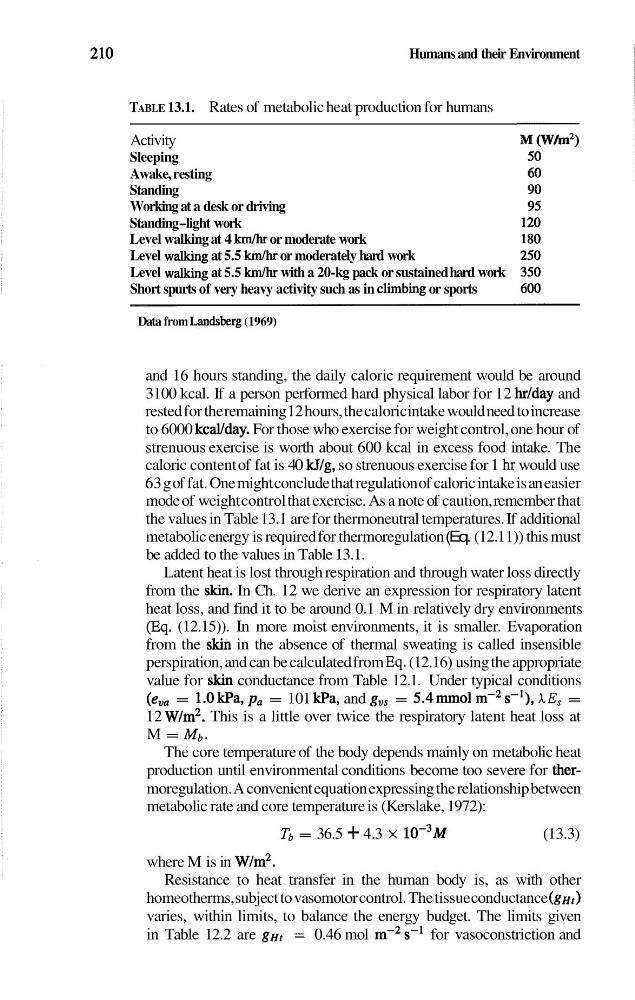
TABLE 13.1. Rates of metabolic heat production for humans
Activity
Sleeping
Awake, resting
Standing
Working at a desk or driving
Standing-light work
Level walking at 4 km/hr or moderate work
Level walking at 5.5 km/hr or moderately hard work
Level walking at 5.5 kdhr with a 20-kg pack or sustained hard work
Short spurts of very heavy activity such as in climbing or sports
Data from Landsberg (1969)
and 16 hours standing, the daily caloric requirement would be around
3100 kcal. If a person performed hard physical labor for 12 hrlday and
rested for the remaining 12 hours, the caloric intake would need to increase
to 6000 kcallday. For those who exercise for weight control, one hour of
strenuous exercise is worth about 600 kcal in excess food intake. The
caloric content of fat is 40 Wg, so strenuous exercise for 1 hr would use
63 g of fat. One might conclude that regulation of caloric intake is an easier
mode of weight control that exercise. As a note of caution, remember that
the values in Table 13.1 are for thermoneutral temperatures. If additional
metabolic energy is required for thermoregulation (Eq. (12.1 1)) this must
be added to the values in Table 13.1.
Latent heat is lost through respiration and through water loss directly
from the skin. In Ch. 12 we derive an expression for respiratory latent
heat loss, and find it to be around 0.1 M in relatively dry environments
(Eq. (12.15)). In more moist environments, it is smaller. Evaporation
from the skin in the absence of thermal sweating is called insensible
perspiration, and can be calculated from Eq. (12.16) using the appropriate
value for skin conductance from Table 12.1. Under typical conditions
(e,, = l.OkPa, pa = 101 kPa, and g,, = 5.4mmol m-2 s-I), AE, =
12 w/m2. This is a little over twice the respiratory latent heat loss at
M = Mb.
The core temperature of the body depends mainly on metabolic heat
production until environmental conditions become too severe for thermoregulation. A convenient equation expressing the relationship between
metabolic rate and core temperature is (Kerslake, 1972):
Tb = 36.5 + 4.3 x I O - ~ M
(13.3)
where M is in w/m2.
Resistance to heat transfer in the human body is, as with other
homeotherms, subject to vasomotor control. The tissue conductance ( g , ~ )
varies, within limits, to balance the energy budget. The limits given
in Table 12.2 are g~~ = 0.46 mol m-2 s-I for vasoconstriction and
Humans and their Environment
TABLE 13.1. Rates of metabolic heat production for humans
Activity
Sleeping
Awake, resting
Standing
Working at a desk or driving
Standing-light work
Level walking at 4 km/hr or moderate work
Level walking at 5.5 km/hr or moderately hard work
Level walking at 5.5 kdhr with a 20-kg pack or sustained hard work
Short spurts of very heavy activity such as in climbing or sports
Data from Landsberg (1969)
and 16 hours standing, the daily caloric requirement would be around
3100 kcal. If a person performed hard physical labor for 12 hrlday and
rested for the remaining 12 hours, the caloric intake would need to increase
to 6000 kcallday. For those who exercise for weight control, one hour of
strenuous exercise is worth about 600 kcal in excess food intake. The
caloric content of fat is 40 Wg, so strenuous exercise for 1 hr would use
63 g of fat. One might conclude that regulation of caloric intake is an easier
mode of weight control that exercise. As a note of caution, remember that
the values in Table 13.1 are for thermoneutral temperatures. If additional
metabolic energy is required for thermoregulation (Eq. (12.1 1)) this must
be added to the values in Table 13.1.
Latent heat is lost through respiration and through water loss directly
from the skin. In Ch. 12 we derive an expression for respiratory latent
heat loss, and find it to be around 0.1 M in relatively dry environments
(Eq. (12.15)). In more moist environments, it is smaller. Evaporation
from the skin in the absence of thermal sweating is called insensible
perspiration, and can be calculated from Eq. (12.16) using the appropriate
value for skin conductance from Table 12.1. Under typical conditions
(e,, = l.OkPa, pa = 101 kPa, and g,, = 5.4mmol m-2 s-I), AE, =
12 w/m2. This is a little over twice the respiratory latent heat loss at
M = Mb.
The core temperature of the body depends mainly on metabolic heat
production until environmental conditions become too severe for thermoregulation. A convenient equation expressing the relationship between
metabolic rate and core temperature is (Kerslake, 1972):
Tb = 36.5 + 4.3 x I O - ~ M
(13.3)
where M is in w/m2.
Resistance to heat transfer in the human body is, as with other
homeotherms, subject to vasomotor control. The tissue conductance ( g , ~ )
varies, within limits, to balance the energy budget. The limits given
in Table 12.2 are g~~ = 0.46 mol m-2 s-I for vasoconstriction and