

Animals and their Environment
we can write:
where V is the body volume, A is surface area, pb and cb are the body
density and specific heat, and Tb is body temperature. Equation (12.1 1)
can be rewritten to include transient effects as:
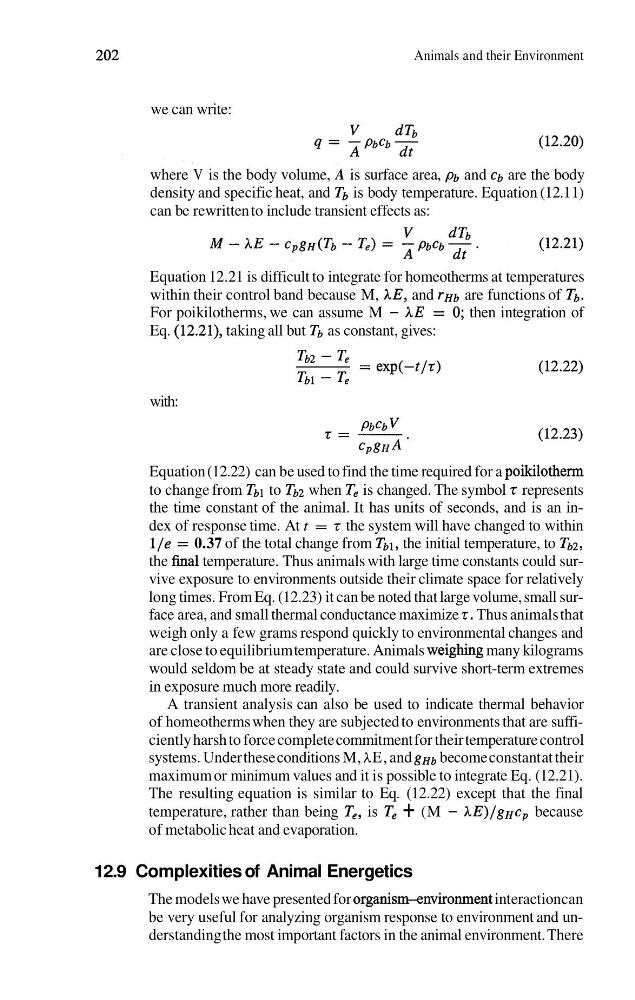
Equation 12.21 is difficult to integrate for homeotherms at temperatures
within their control band because M, hE, and rHb are functions of Tb.
For poikilotherms, we can assume M - h E = 0; then integration of
Eq. (12.21), taking all but Tb as constant, gives:
with:
Equation (12.22) can be used to find the time required for a poikilotherm
to change from Tbl to Tb2 when Te is changed. The symbol t represents
the time constant of the animal. It has units of seconds, and is an index of response time. At t = t the system will have changed to within
l l e = 0.37 of the total change from Tbl, the initial temperature, to Tb2,
the h a 1 temperature. Thus animals with large time constants could survive exposure to environments outside their climate space for relatively
long times. From Eq. (12.23) it can be noted that large volume, small surface area, and small thermal conductance maximize t . Thus animals that
weigh only a few grams respond quickly to environmental changes and
are close to equilibrium temperature. Animals weighmg many kilograms
would seldom be at steady state and could survive short-term extremes
in exposure much more readily.
A transient analysis can also be used to indicate thermal behavior
of homeotherms when they are subjected to environments that are sufficiently harsh to force complete commitment for their temperature control
systems. Under these conditions M, h E, and g ~ b
become constant at their
maximum or minimum values and it is possible to integrate Eq. (12.21).
The resulting equation is similar to Eq. (12.22) except that the final
temperature, rather than being T,, is T, + (M - hE)/gHc, because
of metabolic heat and evaporation.
12.9 Complexities of Animal Energetics
The models we have presented for organis~nvironment interaction can
be very useful for analyzing organism response to environment and understanding the most important factors in the animal environment. There
we can write:
where V is the body volume, A is surface area, pb and cb are the body
density and specific heat, and Tb is body temperature. Equation (12.1 1)
can be rewritten to include transient effects as:
Equation 12.21 is difficult to integrate for homeotherms at temperatures
within their control band because M, hE, and rHb are functions of Tb.
For poikilotherms, we can assume M - h E = 0; then integration of
Eq. (12.21), taking all but Tb as constant, gives:
with:
Equation (12.22) can be used to find the time required for a poikilotherm
to change from Tbl to Tb2 when Te is changed. The symbol t represents
the time constant of the animal. It has units of seconds, and is an index of response time. At t = t the system will have changed to within
l l e = 0.37 of the total change from Tbl, the initial temperature, to Tb2,
the h a 1 temperature. Thus animals with large time constants could survive exposure to environments outside their climate space for relatively
long times. From Eq. (12.23) it can be noted that large volume, small surface area, and small thermal conductance maximize t . Thus animals that
weigh only a few grams respond quickly to environmental changes and
are close to equilibrium temperature. Animals weighmg many kilograms
would seldom be at steady state and could survive short-term extremes
in exposure much more readily.
A transient analysis can also be used to indicate thermal behavior
of homeotherms when they are subjected to environments that are sufficiently harsh to force complete commitment for their temperature control
systems. Under these conditions M, h E, and g ~ b
become constant at their
maximum or minimum values and it is possible to integrate Eq. (12.21).
The resulting equation is similar to Eq. (12.22) except that the final
temperature, rather than being T,, is T, + (M - hE)/gHc, because
of metabolic heat and evaporation.
12.9 Complexities of Animal Energetics
The models we have presented for organis~nvironment interaction can
be very useful for analyzing organism response to environment and understanding the most important factors in the animal environment. There