

The Transient State
20 1
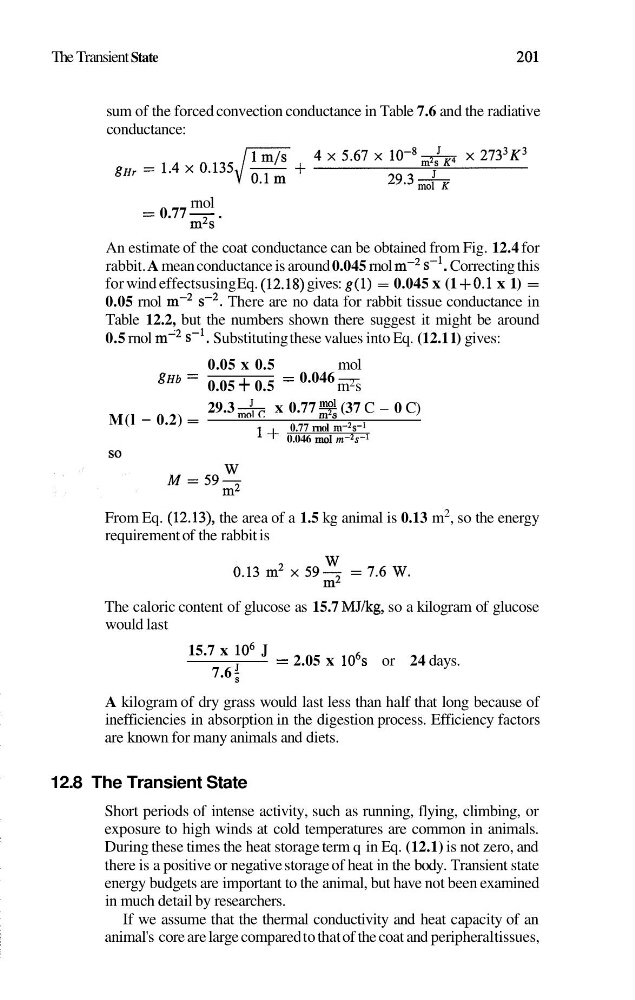
sum of the forced convection conductance in Table 7.6 and the radiative
conductance:
rnol
= 0.77 - .
m2s
An estimate of the coat conductance can be obtained from Fig. 12.4 for
rabbit. A mean conductance is around 0.045 rnol mP2 s-I . Correcting this
for wind effectsusing Eq. (12.18) gives: g(1) = 0.045 x (1 +0.1 x 1) =
0.05 rnol m-2 sV2. There are no data for rabbit tissue conductance in
Table 12.2, but the numbers shown there suggest it might be around
0.5 rnol m-2 s-' . Substituting these values into Eq. (12.1 1) gives:
0.05 x 0.5
mol
g ~ b
=
= 0.046 -
0.05 + 0.5
m 2 s
29.3 & x 0.77 (37 C - 0 C)
M(l - 0.2) =
0.77 rnol m-2s-'
+ 0.046 mol m-2s-1
From Eq. (12.13), the area of a 1.5 kg animal is 0.13 m 2 , so the energy
requirement of the rabbit is
The caloric content of glucose as 15.7 MJIkg, so a kilogram of glucose
would last
15.7 x lo6 J = 2.05 x 10% or 24 days.
7.6
A kilogram of dry grass would last less than half that long because of
inefficiencies in absorption in the digestion process. Efficiency factors
are known for many animals and diets.
12.8 The Transient State
Short periods of intense activity, such as running, flying, climbing, or
exposure to high winds at cold temperatures are common in animals.
During these times the heat storage term q in Eq. (12.1) is not zero, and
there is a positive or negative storage of heat in the body. Transient state
energy budgets are important to the animal, but have not been examined
in much detail by researchers.
If we assume that the thermal conductivity and heat capacity of an
animal's core are large compared to that of the coat and peripheral tissues,
20 1
sum of the forced convection conductance in Table 7.6 and the radiative
conductance:
rnol
= 0.77 - .
m2s
An estimate of the coat conductance can be obtained from Fig. 12.4 for
rabbit. A mean conductance is around 0.045 rnol mP2 s-I . Correcting this
for wind effectsusing Eq. (12.18) gives: g(1) = 0.045 x (1 +0.1 x 1) =
0.05 rnol m-2 sV2. There are no data for rabbit tissue conductance in
Table 12.2, but the numbers shown there suggest it might be around
0.5 rnol m-2 s-' . Substituting these values into Eq. (12.1 1) gives:
0.05 x 0.5
mol
g ~ b
=
= 0.046 -
0.05 + 0.5
m 2 s
29.3 & x 0.77 (37 C - 0 C)
M(l - 0.2) =
0.77 rnol m-2s-'
+ 0.046 mol m-2s-1
From Eq. (12.13), the area of a 1.5 kg animal is 0.13 m 2 , so the energy
requirement of the rabbit is
The caloric content of glucose as 15.7 MJIkg, so a kilogram of glucose
would last
15.7 x lo6 J = 2.05 x 10% or 24 days.
7.6
A kilogram of dry grass would last less than half that long because of
inefficiencies in absorption in the digestion process. Efficiency factors
are known for many animals and diets.
12.8 The Transient State
Short periods of intense activity, such as running, flying, climbing, or
exposure to high winds at cold temperatures are common in animals.
During these times the heat storage term q in Eq. (12.1) is not zero, and
there is a positive or negative storage of heat in the body. Transient state
energy budgets are important to the animal, but have not been examined
in much detail by researchers.
If we assume that the thermal conductivity and heat capacity of an
animal's core are large compared to that of the coat and peripheral tissues,