

168
Radiation Fluxes in Natural Environments
The thermal radiation i n, @r
environments comes from two distinct sources,Jhe ~ o u n d ahd the sky. In ----- enclosures or under vegetation
the thermal radiation comes from the walls of the enclosure or from
the-canopy. All of this radiation is diffuse, and the Gadiance, again, is
r- -
computed by integrating the radiance over all sources surrounding the organism surface.aapter-10 shows how to compute the radiance of these
sources.
11.1 Sun Angles and Daylength
The location of the sun in the sky is described in terms of its altitude (/3,
&vation angiEabo;e the horiz-on) or zenith angle -- (I,+, the an&e%easured'
from the vertical) and its azimuth angle_CA_Z,-angle from true north or
south measured in the horizontal plane). Several coordinate systems are
possible with azimuth angles:
-@athematical:
zero degrees is south and angles increase in the counter
clockwise direction from 0 to 360°,
2. compass: zero degrees is north and angles increase from 0 to 360" in
a clockwise direction, and
3. astronomical: zero degrees is south and positive angles increase from
0 to 180" in a clockwise direction; the counter clockwise direction is
labeled with negative angles from 0 to - 180".
We use the mathematical coordinate representation. Elevation and
* _ _ _^I_X^.
I - - - I _ -
I_
zenith angles are related by / 3 = 90 - I , + (angles in degrees). The zenith
angle of the sun depends on the time of day, the latitude of the site, and
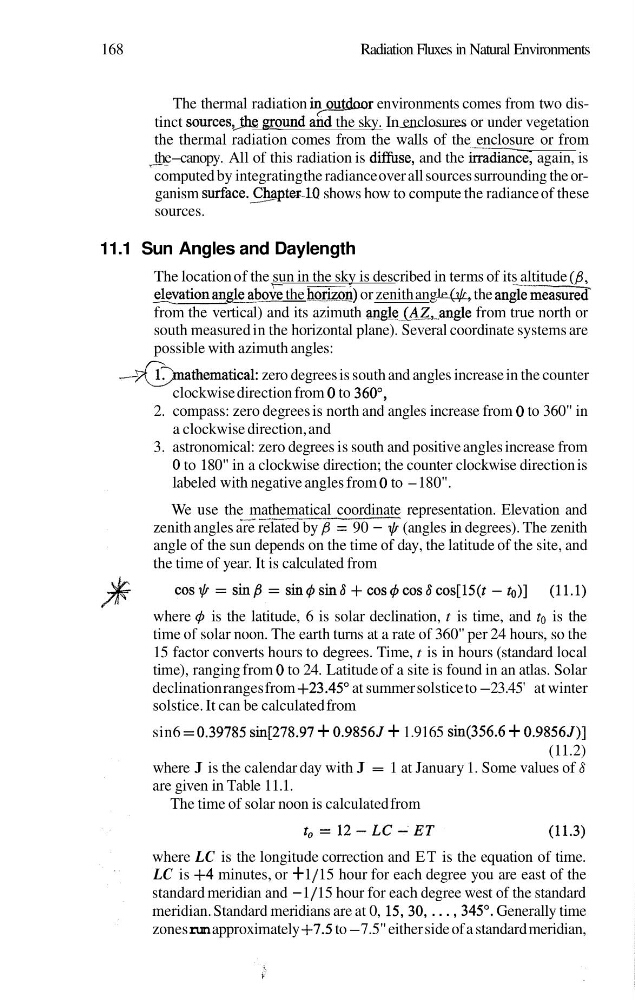
the time of year. It is calculated from
where q5 is the latitude, 6 is solar declination, t is time, and to is the
time of solar noon. The earth turns at a rate of 360" per 24 hours, so the
15 factor converts hours to degrees. Time, t is in hours (standard local
time), ranging from 0 to 24. Latitude of a site is found in an atlas. Solar
declination ranges from +23.45" at summer solstice to -23.45' at winter
solstice. It can be calculated from
sin6 =O.39785 sin[278.97 + 0.9856J + 1.9165 sin(356.6 + 0.9856J)l
(1 1.2)
where J is the calendar day with J = 1 at January 1. Some values of S
are given in Table 1 1.1.
The time of solar noon is calculated from
where LC is the longitude correction and ET is the equation of time.
LC is +4 minutes, or + 1 / 15 hour for each degree you are east of the
standard meridian and - 1 / 15 hour for each degree west of the standard
meridian. Standard meridians are at 0, 15,30, . . . ,345". Generally time
zones run approximately +7.5 to -7.5" either side of a standard meridian,
Radiation Fluxes in Natural Environments
The thermal radiation i n, @r
environments comes from two distinct sources,Jhe ~ o u n d ahd the sky. In ----- enclosures or under vegetation
the thermal radiation comes from the walls of the enclosure or from
the-canopy. All of this radiation is diffuse, and the Gadiance, again, is
r- -
computed by integrating the radiance over all sources surrounding the organism surface.aapter-10 shows how to compute the radiance of these
sources.
11.1 Sun Angles and Daylength
The location of the sun in the sky is described in terms of its altitude (/3,
&vation angiEabo;e the horiz-on) or zenith angle -- (I,+, the an&e%easured'
from the vertical) and its azimuth angle_CA_Z,-angle from true north or
south measured in the horizontal plane). Several coordinate systems are
possible with azimuth angles:
-@athematical:
zero degrees is south and angles increase in the counter
clockwise direction from 0 to 360°,
2. compass: zero degrees is north and angles increase from 0 to 360" in
a clockwise direction, and
3. astronomical: zero degrees is south and positive angles increase from
0 to 180" in a clockwise direction; the counter clockwise direction is
labeled with negative angles from 0 to - 180".
We use the mathematical coordinate representation. Elevation and
* _ _ _^I_X^.
I - - - I _ -
I_
zenith angles are related by / 3 = 90 - I , + (angles in degrees). The zenith
angle of the sun depends on the time of day, the latitude of the site, and
the time of year. It is calculated from
where q5 is the latitude, 6 is solar declination, t is time, and to is the
time of solar noon. The earth turns at a rate of 360" per 24 hours, so the
15 factor converts hours to degrees. Time, t is in hours (standard local
time), ranging from 0 to 24. Latitude of a site is found in an atlas. Solar
declination ranges from +23.45" at summer solstice to -23.45' at winter
solstice. It can be calculated from
sin6 =O.39785 sin[278.97 + 0.9856J + 1.9165 sin(356.6 + 0.9856J)l
(1 1.2)
where J is the calendar day with J = 1 at January 1. Some values of S
are given in Table 1 1.1.
The time of solar noon is calculated from
where LC is the longitude correction and ET is the equation of time.
LC is +4 minutes, or + 1 / 15 hour for each degree you are east of the
standard meridian and - 1 / 15 hour for each degree west of the standard
meridian. Standard meridians are at 0, 15,30, . . . ,345". Generally time
zones run approximately +7.5 to -7.5" either side of a standard meridian,