

Transpiration and Plant Water Uptake
139
0
48
96
144
192
240
288
Time (hrs)
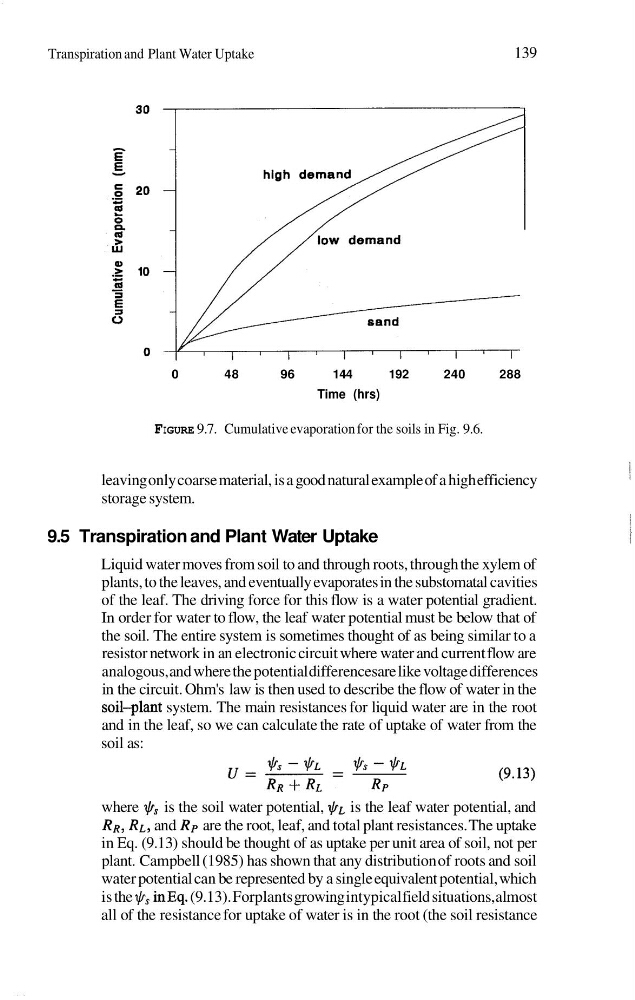
FIGURE 9.7. Cumulative evaporation for the soils in Fig. 9.6.
leaving only coarse material, is a good natural example of a high efficiency
storage system.
9.5 Transpiration and Plant Water Uptake
Liquid water moves from soil to and through roots, through the xylem of
plants, to the leaves, and eventually evaporates in the substomatal cavities
of the leaf. The driving force for this flow is a water potential gradient.
In order for water to flow, the leaf water potential must be below that of
the soil. The entire system is sometimes thought of as being similar to a
resistor network in an electronic circuit where water and current flow are
analogous, and where the potential differences are like voltage differences
in the circuit. Ohm's law is then used to describe the flow of water in the
soil-plant system. The main resistances for liquid water are in the root
and in the leaf, so we can calculate the rate of uptake of water from the
soil as:
where +s is the soil water potential, +L is the leaf water potential, and
RR, RL, and Rp are the root, leaf, and total plant resistances. The uptake
in Eq. (9.13) should be thought of as uptake per unit area of soil, not per
plant. Campbell (1985) has shown that any distribution of roots and soil
water potential can be represented by a single equivalent potential, which
is the Ilr, inEq. (9.13). Forplants growing intypical field situations, almost
all of the resistance for uptake of water is in the root (the soil resistance
139
0
48
96
144
192
240
288
Time (hrs)
FIGURE 9.7. Cumulative evaporation for the soils in Fig. 9.6.
leaving only coarse material, is a good natural example of a high efficiency
storage system.
9.5 Transpiration and Plant Water Uptake
Liquid water moves from soil to and through roots, through the xylem of
plants, to the leaves, and eventually evaporates in the substomatal cavities
of the leaf. The driving force for this flow is a water potential gradient.
In order for water to flow, the leaf water potential must be below that of
the soil. The entire system is sometimes thought of as being similar to a
resistor network in an electronic circuit where water and current flow are
analogous, and where the potential differences are like voltage differences
in the circuit. Ohm's law is then used to describe the flow of water in the
soil-plant system. The main resistances for liquid water are in the root
and in the leaf, so we can calculate the rate of uptake of water from the
soil as:
where +s is the soil water potential, +L is the leaf water potential, and
RR, RL, and Rp are the root, leaf, and total plant resistances. The uptake
in Eq. (9.13) should be thought of as uptake per unit area of soil, not per
plant. Campbell (1985) has shown that any distribution of roots and soil
water potential can be represented by a single equivalent potential, which
is the Ilr, inEq. (9.13). Forplants growing intypical field situations, almost
all of the resistance for uptake of water is in the root (the soil resistance