

Infiltration of Water into Soil
131
hydraulic conductivity and matric potential for various soils at any water
content.
9.2 Infiltration of Water into Soil
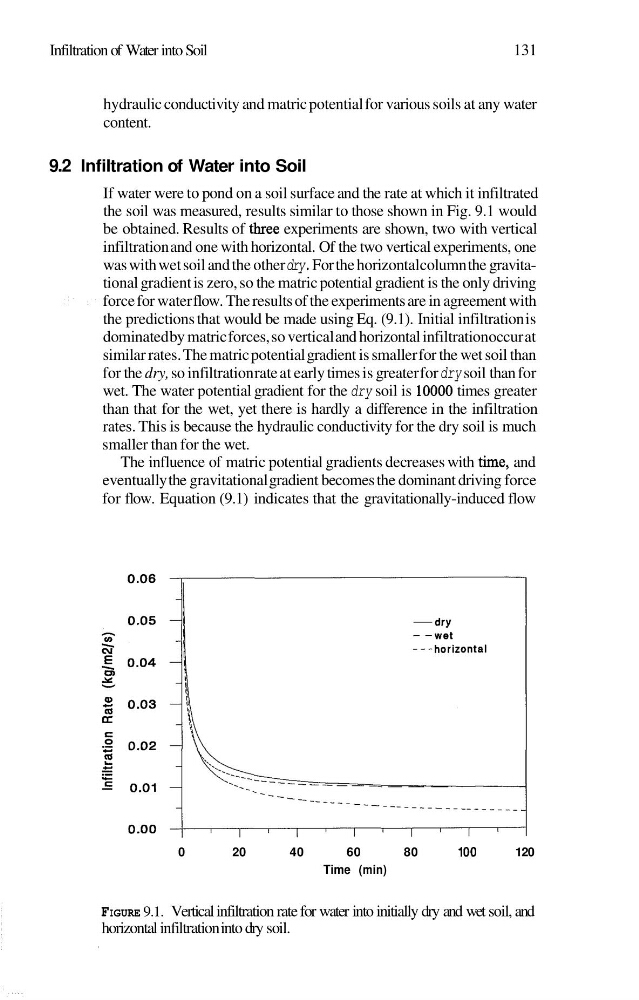
If water were to pond on a soil surface and the rate at which it infiltrated
the soil was measured, results similar to those shown in Fig. 9.1 would
be obtained. Results of three experiments are shown, two with vertical
infiltration and one with horizontal. Of the two vertical experiments, one
was with wet soil and the other dry. For the horizontal column the gravitational gradient is zero, so the matric potential gradient is the only driving
force for water flow. The results of the experiments are in agreement with
the predictions that would be made using Eq. (9.1). Initial infiltration is
dominated by matric forces, so vertical and horizontal infiltration occur at
similar rates. The matric potential gradient is smaller for the wet soil than
for the dry, so infiltration rate at early times is greater for dry soil than for
wet. The water potential gradient for the dry soil is 10000 times greater
than that for the wet, yet there is hardly a difference in the infiltration
rates. This is because the hydraulic conductivity for the dry soil is much
smaller than for the wet.
The influence of matric potential gradients decreases with time, and
eventually the gravitational gradient becomes the dominant driving force
for flow. Equation (9.1) indicates that the gravitationally-induced flow
0
20
40
60
80
100
120
Time (min)
FIGURE 9.1. Vertical infiltration rate for water into initially dry and wet soil, and
horizontal infiltration into dry soil.
131
hydraulic conductivity and matric potential for various soils at any water
content.
9.2 Infiltration of Water into Soil
If water were to pond on a soil surface and the rate at which it infiltrated
the soil was measured, results similar to those shown in Fig. 9.1 would
be obtained. Results of three experiments are shown, two with vertical
infiltration and one with horizontal. Of the two vertical experiments, one
was with wet soil and the other dry. For the horizontal column the gravitational gradient is zero, so the matric potential gradient is the only driving
force for water flow. The results of the experiments are in agreement with
the predictions that would be made using Eq. (9.1). Initial infiltration is
dominated by matric forces, so vertical and horizontal infiltration occur at
similar rates. The matric potential gradient is smaller for the wet soil than
for the dry, so infiltration rate at early times is greater for dry soil than for
wet. The water potential gradient for the dry soil is 10000 times greater
than that for the wet, yet there is hardly a difference in the infiltration
rates. This is because the hydraulic conductivity for the dry soil is much
smaller than for the wet.
The influence of matric potential gradients decreases with time, and
eventually the gravitational gradient becomes the dominant driving force
for flow. Equation (9.1) indicates that the gravitationally-induced flow
0
20
40
60
80
100
120
Time (min)
FIGURE 9.1. Vertical infiltration rate for water into initially dry and wet soil, and
horizontal infiltration into dry soil.