

Turbulent Transport
Equations (7.12) through (7.14) are not very useful in this form because
there is no way of knowing what values to give the coefficients. From the
discussion on turbulent mixing in the surface boundary layer, it is known
that K will increase with height above the surface, wind speed, surface
roughness, and heating at the surface. In the surface boundary layer, at
steady state, the flux densities, t, H, and E are assumed to be independent
of height. Increases in the K coefficients with z will therefore be balanced
by corresponding decreases in the gradients.
It can be assumed that K has some value, characterized by surface
properties, at the exchange surface (where z = d + ZM or z = d + ZH,
etc.) and increases linearly with u* and z. Based on these assumptions,
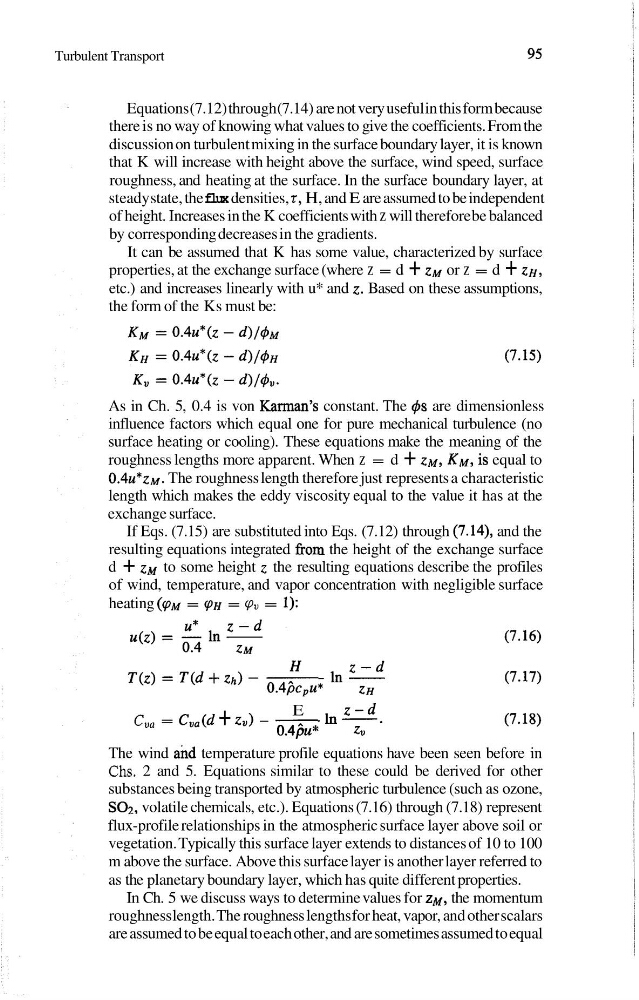
the form of the Ks must be:
As in Ch. 5, 0.4 is von Karman's constant. The 4s are dimensionless
influence factors which equal one for pure mechanical turbulence (no
surface heating or cooling). These equations make the meaning of the
roughness lengths more apparent. When z = d + ZM, KM, is equal to
0.4u*zM. The roughness length therefore just represents a characteristic
length which makes the eddy viscosity equal to the value it has at the
exchange surface.
If Eqs. (7.15) are substituted into Eqs. (7.12) through (7.14), and the
resulting equations integrated from the height of the exchange surface
d + ZM to some height z the resulting equations describe the profiles
of wind, temperature, and vapor concentration with negligible surface
heating (VM = VH = p, = 1):
E
Z - d
C,, = C,,(d + z,) -
In -.
0 . 4 ~ ~ ZV
The wind and temperature profile equations have been seen before in
Chs. 2 and 5. Equations similar to these could be derived for other
substances being transported by atmospheric turbulence (such as ozone,
SO2, volatile chemicals, etc.). Equations (7.16) through (7.18) represent
flux-profile relationships in the atmospheric surface layer above soil or
vegetation. Typically this surface layer extends to distances of 10 to 100
m above the surface. Above this surface layer is another layer referred to
as the planetary boundary layer, which has quite different properties.
In Ch. 5 we discuss ways to determine values for ZM, the momentum
roughness length. The roughness lengths for heat, vapor, and other scalars
are assumed to be equal to each other, and are sometimes assumed to equal
Equations (7.12) through (7.14) are not very useful in this form because
there is no way of knowing what values to give the coefficients. From the
discussion on turbulent mixing in the surface boundary layer, it is known
that K will increase with height above the surface, wind speed, surface
roughness, and heating at the surface. In the surface boundary layer, at
steady state, the flux densities, t, H, and E are assumed to be independent
of height. Increases in the K coefficients with z will therefore be balanced
by corresponding decreases in the gradients.
It can be assumed that K has some value, characterized by surface
properties, at the exchange surface (where z = d + ZM or z = d + ZH,
etc.) and increases linearly with u* and z. Based on these assumptions,
the form of the Ks must be:
As in Ch. 5, 0.4 is von Karman's constant. The 4s are dimensionless
influence factors which equal one for pure mechanical turbulence (no
surface heating or cooling). These equations make the meaning of the
roughness lengths more apparent. When z = d + ZM, KM, is equal to
0.4u*zM. The roughness length therefore just represents a characteristic
length which makes the eddy viscosity equal to the value it has at the
exchange surface.
If Eqs. (7.15) are substituted into Eqs. (7.12) through (7.14), and the
resulting equations integrated from the height of the exchange surface
d + ZM to some height z the resulting equations describe the profiles
of wind, temperature, and vapor concentration with negligible surface
heating (VM = VH = p, = 1):
E
Z - d
C,, = C,,(d + z,) -
In -.
0 . 4 ~ ~ ZV
The wind and temperature profile equations have been seen before in
Chs. 2 and 5. Equations similar to these could be derived for other
substances being transported by atmospheric turbulence (such as ozone,
SO2, volatile chemicals, etc.). Equations (7.16) through (7.18) represent
flux-profile relationships in the atmospheric surface layer above soil or
vegetation. Typically this surface layer extends to distances of 10 to 100
m above the surface. Above this surface layer is another layer referred to
as the planetary boundary layer, which has quite different properties.
In Ch. 5 we discuss ways to determine values for ZM, the momentum
roughness length. The roughness lengths for heat, vapor, and other scalars
are assumed to be equal to each other, and are sometimes assumed to equal