

Heat and Mass Transport
Conductances, however, are better for suggesting significance since the
flux is directly proportional to the conductance. Conductances, rather
than resistances, should be used for statistical operations, since errors
in conductance, rather than the resistance are normally distributed. A
mean conductance is therefore a reliable indicator of expected behavior
of a population of exchange surfaces, while a mean resistance may be
meaningless. This is easy to see if you consider two surfaces; one has
infinite resistance, or zero conductance and the other has a resistance of 5
m
2 slmol, or a conductance of 200 mmol m-2 s-' . The average resistance
of the two is infinite, suggesting that the average water loss is zero; but
the average conductance is 100 mmol
s-', suggesting the correct
average water loss.
We use units of m
2 slmol for resistance, and mol m-2 s-' for conductance. Units for resistance in the previous edition of this book and in
much of the environmental biophysics literature are slm. To convert from
slrn to m 2 slmol, divide the slm resistance by the molar volume of air,
4 1.4 mol m-3 (at sea level and 20" C).
6.4 Resistors and Conductors in Series
Consider the flow of heat from the core of an animal to the surrounding
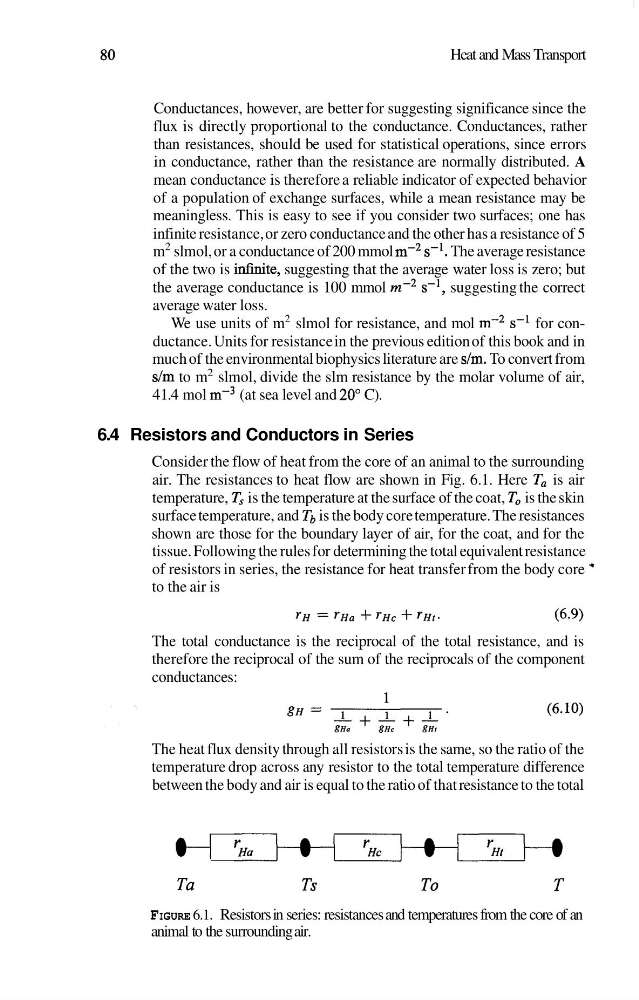
air. The resistances to heat flow are shown in Fig. 6.1. Here Ta is air
temperature, T, is the temperature at the surface of the coat, To is the skin
surface temperature, and Tb is the body core temperature. The resistances
shown are those for the boundary layer of air, for the coat, and for the
tissue. Following the rules for determining the total equivalent resistance
of resistors in series, the resistance for heat transfer from the body core '
to the air is
The total conductance is the reciprocal of the total resistance, and is
therefore the reciprocal of the sum of the reciprocals of the component
conductances:
The heat flux density through all resistors is the same, so the ratio of the
temperature drop across any resistor to the total temperature difference
between the body and air is equal to the ratio of that resistance to the total
FIGURE 6.1. Resistors in series: resistances and temperatures from the core of an
animal to the surrounding air.
Conductances, however, are better for suggesting significance since the
flux is directly proportional to the conductance. Conductances, rather
than resistances, should be used for statistical operations, since errors
in conductance, rather than the resistance are normally distributed. A
mean conductance is therefore a reliable indicator of expected behavior
of a population of exchange surfaces, while a mean resistance may be
meaningless. This is easy to see if you consider two surfaces; one has
infinite resistance, or zero conductance and the other has a resistance of 5
m
2 slmol, or a conductance of 200 mmol m-2 s-' . The average resistance
of the two is infinite, suggesting that the average water loss is zero; but
the average conductance is 100 mmol
s-', suggesting the correct
average water loss.
We use units of m
2 slmol for resistance, and mol m-2 s-' for conductance. Units for resistance in the previous edition of this book and in
much of the environmental biophysics literature are slm. To convert from
slrn to m 2 slmol, divide the slm resistance by the molar volume of air,
4 1.4 mol m-3 (at sea level and 20" C).
6.4 Resistors and Conductors in Series
Consider the flow of heat from the core of an animal to the surrounding
air. The resistances to heat flow are shown in Fig. 6.1. Here Ta is air
temperature, T, is the temperature at the surface of the coat, To is the skin
surface temperature, and Tb is the body core temperature. The resistances
shown are those for the boundary layer of air, for the coat, and for the
tissue. Following the rules for determining the total equivalent resistance
of resistors in series, the resistance for heat transfer from the body core '
to the air is
The total conductance is the reciprocal of the total resistance, and is
therefore the reciprocal of the sum of the reciprocals of the component
conductances:
The heat flux density through all resistors is the same, so the ratio of the
temperature drop across any resistor to the total temperature difference
between the body and air is equal to the ratio of that resistance to the total
FIGURE 6.1. Resistors in series: resistances and temperatures from the core of an
animal to the surrounding air.