

Resistances and Conductances
6.2 Integration of the Transport Equations
In addition to the transport laws previously mentioned, a fifth law is in
common use that describes the flow of current in an electrical circuit.
This is Ohm's law, which states that the current flowing in a conductor
is directly proportional to the applied voltage and inversely proportional
to the electrical resistance of the conductor. This law is different from
the other laws in that it applies to a macroscopic system. The applied
voltage is measured across an entire conductor, not over an infinitesimal
increment as is indicated by the differentials in Eqs. (6.1) through (6.6).
The resistance or conductance of the conductor is a function of size and
shape as well as basic material properties.
In environmental biophysics, our problems are similar to the circuit
problem. It is usually possible to specify concentrations at the organism
surface and in the surroundings some distance from the organism, but it is
usually impossible to measure gradients on a microscopic scale, as would
be needed for the transport equations that we have presented so far. We
therefore write the transport equations, by analogy with Ohm's law, in
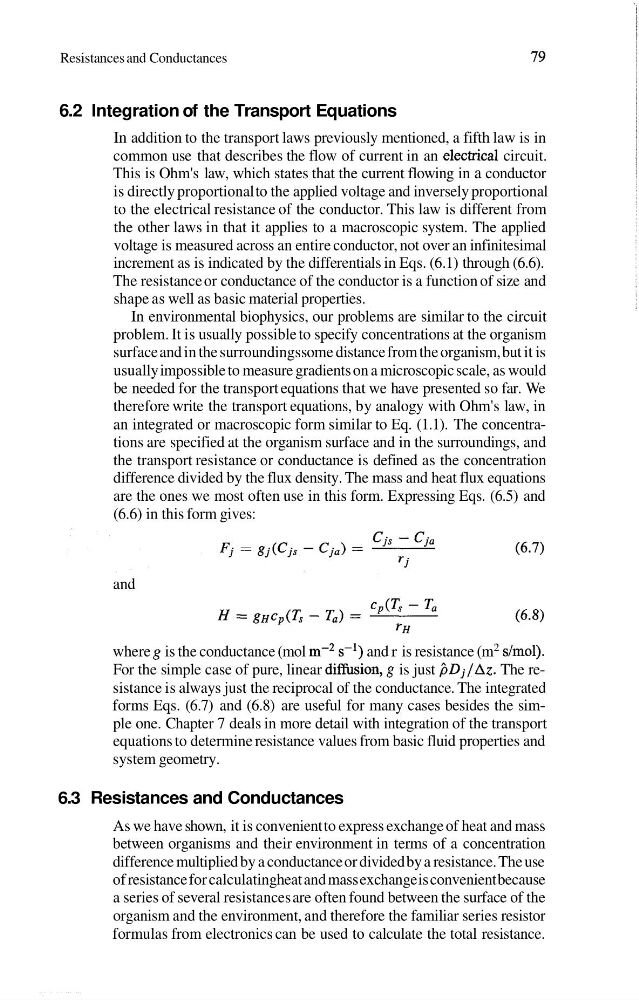
an integrated or macroscopic form similar to Eq. (1.1). The concentrations are specified at the organism surface and in the surroundings, and
the transport resistance or conductance is defined as the concentration
difference divided by the flux density. The mass and heat flux equations
are the ones we most often use in this form. Expressing Eqs. (6.5) and
(6.6) in this form gives:
and
where g is the conductance (mol m-2 s-') and r is resistance (m 2 slmol).
For the simple case of pure, linear diffusion, g is just $ D j / A z . The resistance is always just the reciprocal of the conductance. The integrated
forms Eqs. (6.7) and (6.8) are useful for many cases besides the simple one. Chapter 7 deals in more detail with integration of the transport
equations to determine resistance values from basic fluid properties and
system geometry.
6.3 Resistances and Conductances
As we have shown, it is convenient to express exchange of heat and mass
between organisms and their environment in terms of a concentration
difference multiplied by a conductance or divided by a resistance. The use
of resistance for calculating heat and mass exchange is convenient because
a series of several resistances are often found between the surface of the
organism and the environment, and therefore the familiar series resistor
formulas from electronics can be used to calculate the total resistance.
6.2 Integration of the Transport Equations
In addition to the transport laws previously mentioned, a fifth law is in
common use that describes the flow of current in an electrical circuit.
This is Ohm's law, which states that the current flowing in a conductor
is directly proportional to the applied voltage and inversely proportional
to the electrical resistance of the conductor. This law is different from
the other laws in that it applies to a macroscopic system. The applied
voltage is measured across an entire conductor, not over an infinitesimal
increment as is indicated by the differentials in Eqs. (6.1) through (6.6).
The resistance or conductance of the conductor is a function of size and
shape as well as basic material properties.
In environmental biophysics, our problems are similar to the circuit
problem. It is usually possible to specify concentrations at the organism
surface and in the surroundings some distance from the organism, but it is
usually impossible to measure gradients on a microscopic scale, as would
be needed for the transport equations that we have presented so far. We
therefore write the transport equations, by analogy with Ohm's law, in
an integrated or macroscopic form similar to Eq. (1.1). The concentrations are specified at the organism surface and in the surroundings, and
the transport resistance or conductance is defined as the concentration
difference divided by the flux density. The mass and heat flux equations
are the ones we most often use in this form. Expressing Eqs. (6.5) and
(6.6) in this form gives:
and
where g is the conductance (mol m-2 s-') and r is resistance (m 2 slmol).
For the simple case of pure, linear diffusion, g is just $ D j / A z . The resistance is always just the reciprocal of the conductance. The integrated
forms Eqs. (6.7) and (6.8) are useful for many cases besides the simple one. Chapter 7 deals in more detail with integration of the transport
equations to determine resistance values from basic fluid properties and
system geometry.
6.3 Resistances and Conductances
As we have shown, it is convenient to express exchange of heat and mass
between organisms and their environment in terms of a concentration
difference multiplied by a conductance or divided by a resistance. The use
of resistance for calculating heat and mass exchange is convenient because
a series of several resistances are often found between the surface of the
organism and the environment, and therefore the familiar series resistor
formulas from electronics can be used to calculate the total resistance.