

Reef Mapping
89
Global reef mapping
THAILAND
Hat Nopharat Thara
- Mu i<5 Phi Phi NP
Recent
years have seen a burgeoning of interest
in obtaining global information about the natural
environment. The values of having a global
perspective on coral reef distribution are manifold,
supporting an increased understanding of ecological and
geological processes which, in turn, can fuel more locally
based research into reef processes, or more widely based
studies of global change. Linking this same information to
knowledge of human uses and demographic change can
have considerable value for development and resource
management issues, and can again help in the understanding of these at finer scales.
The increasing role of regional and global organizations
in decision-making processes, and the growing awareness
of large-scale patterns within marine ecosystems across
national boundaries, further increase the need for understanding at the global level. Improved communications
and data availability have strengthened the potential for
developing and utilizing existing global-level datasets.
Global maps of coral reefs have been developed and
are maintained by a number of organizations. As significant topographic and navigational features, reefs
remain important on global map and chart coverages, such
as those produced by the UK and US Hydrographic
Offices, and also the air navigational series, such as the
US Defense Mapping Agency Operational Navigational
Charts. Reefs on such charts are generally not given a
clear geological or biological definition, as discussed
below, but they remain valuable tools in developing a
global understanding of reef distribution. Increasingly,
such datasets are being prepared in digital formats.
One other recent global synthesis of maps with a
clearer ecological and geological focus was the threevolume Coral Reefs of the World, prepared at the lUCN
Conservation Monitoring Centre (now UNEP-World
Conservation Monitoring Centre, UNEP-WCMC). The
volumes contain regional maps and national maps which
were prepared from numerous sources, including scientific
papers, navigational charts and personal communications.
Since 1994, UNEP-WCMC has been developing a global
map of coral reefs on its GIS. These maps have been
published and widely distributed in the global coral reef
database, ReefBase, and utilized in a variety of publications
and analyses. They are now widely used over the Internet.
The global coral reef map in 2001
The only practical means for the preparation of a global
map of coral reefs are through the compilation of existing
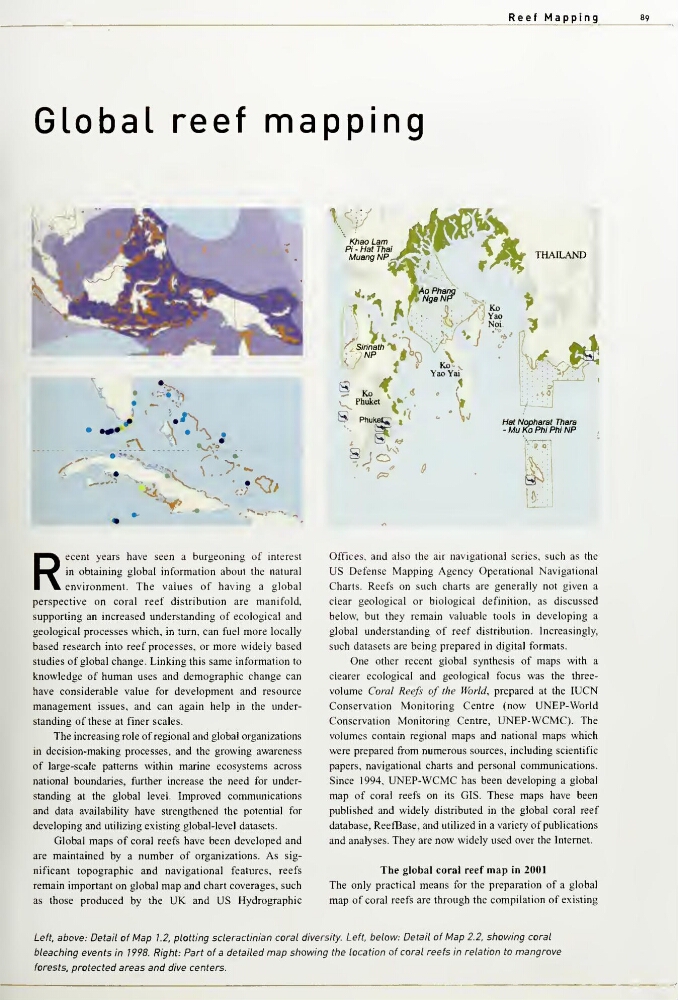
Left, above: Detail of Map 1.2, plotting scleractinian coral diversity. Left, below: Detail of Map 2.2, sfiowing coral
bleacliing events in 1998. Right: Part of a detailed map showing the location of coral reefs m relation to mangrove
forests, protected areas and dive centers.
89
Global reef mapping
THAILAND
Hat Nopharat Thara
- Mu i<5 Phi Phi NP
Recent
years have seen a burgeoning of interest
in obtaining global information about the natural
environment. The values of having a global
perspective on coral reef distribution are manifold,
supporting an increased understanding of ecological and
geological processes which, in turn, can fuel more locally
based research into reef processes, or more widely based
studies of global change. Linking this same information to
knowledge of human uses and demographic change can
have considerable value for development and resource
management issues, and can again help in the understanding of these at finer scales.
The increasing role of regional and global organizations
in decision-making processes, and the growing awareness
of large-scale patterns within marine ecosystems across
national boundaries, further increase the need for understanding at the global level. Improved communications
and data availability have strengthened the potential for
developing and utilizing existing global-level datasets.
Global maps of coral reefs have been developed and
are maintained by a number of organizations. As significant topographic and navigational features, reefs
remain important on global map and chart coverages, such
as those produced by the UK and US Hydrographic
Offices, and also the air navigational series, such as the
US Defense Mapping Agency Operational Navigational
Charts. Reefs on such charts are generally not given a
clear geological or biological definition, as discussed
below, but they remain valuable tools in developing a
global understanding of reef distribution. Increasingly,
such datasets are being prepared in digital formats.
One other recent global synthesis of maps with a
clearer ecological and geological focus was the threevolume Coral Reefs of the World, prepared at the lUCN
Conservation Monitoring Centre (now UNEP-World
Conservation Monitoring Centre, UNEP-WCMC). The
volumes contain regional maps and national maps which
were prepared from numerous sources, including scientific
papers, navigational charts and personal communications.
Since 1994, UNEP-WCMC has been developing a global
map of coral reefs on its GIS. These maps have been
published and widely distributed in the global coral reef
database, ReefBase, and utilized in a variety of publications
and analyses. They are now widely used over the Internet.
The global coral reef map in 2001
The only practical means for the preparation of a global
map of coral reefs are through the compilation of existing
Left, above: Detail of Map 1.2, plotting scleractinian coral diversity. Left, below: Detail of Map 2.2, sfiowing coral
bleacliing events in 1998. Right: Part of a detailed map showing the location of coral reefs m relation to mangrove
forests, protected areas and dive centers.