

WORLD ATLAS OF CORAL REEFS
Responses
Humans
need coral reefs. They are of critical value
to communities and countries around the world,
not only in economic terms, but also in terms of
protein supplied to millions of people, m terms of jobs,
of coastal protection and of recreational value.
The value of reefs is dependent on their continued
functioning as ecosystems. It is this alone that maintains
their worth for coastal tourism and the protection of
coastlines, and as a store of vast genetic diversity. It is
also this continued functioning which gives reefs their
productivity and enables the harvesting of reef resources
by humans.
In terrestrial ecosystems our concept of "harvesting"
or otherwise utilizing "natural" ecosystems is typically
associated with massive modification. But the sea
presents a major contrast, as our harvesting of almost all
the ocean's resources is dependent on the maintenance of
natural ecosystems as they are. If this harvesting is turned
to mining, sustainability is lost, and with it food, jobs and
entire economies.
The array of threats to reefs has already been
outlined. The ultimate causes of these threats, or the
failure to react to them, can in most cases be related back
to two broad problems: a lack of understanding about
reefs and a lack of ownership or responsibility for them.
The lack of understanding works at all levels, from a poor
scientific knowledge, to the inadequate transmission of
existing knowledge (scientific or traditional) to decision
makers and a broader public. Detailed knowledge about
reefs is actually rapidly improving. We now know a great
deal about how coral reefs function, and about the consequences of actions such as blast fishing or pumping raw
sewage into coastal waters. A large number of monitoring
programs have been established, using both scientists and
trained amateurs to amass large amounts of information
about the status of coral reefs, and how this changes over
time. Social and economic studies on human communities
adjacent to reefs are also widespread, and we have a
clear, though still rapidly evolving, understanding of how
to manage and sustainably utilize reefs into the future.
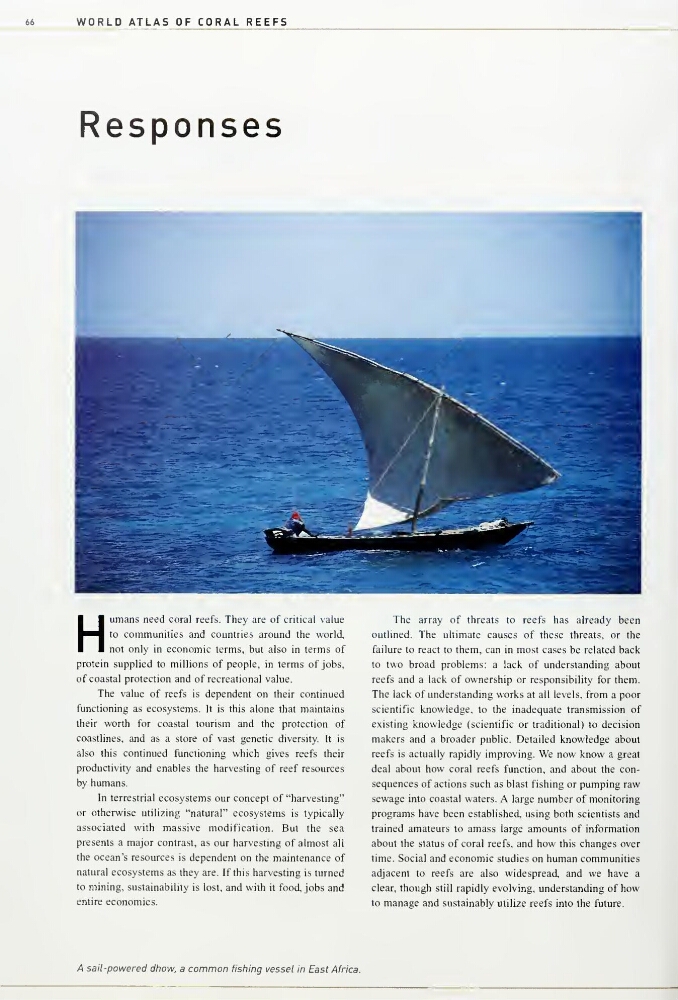
4 sail-powered dhow, a common fishing vessel in East Africa.
Responses
Humans
need coral reefs. They are of critical value
to communities and countries around the world,
not only in economic terms, but also in terms of
protein supplied to millions of people, m terms of jobs,
of coastal protection and of recreational value.
The value of reefs is dependent on their continued
functioning as ecosystems. It is this alone that maintains
their worth for coastal tourism and the protection of
coastlines, and as a store of vast genetic diversity. It is
also this continued functioning which gives reefs their
productivity and enables the harvesting of reef resources
by humans.
In terrestrial ecosystems our concept of "harvesting"
or otherwise utilizing "natural" ecosystems is typically
associated with massive modification. But the sea
presents a major contrast, as our harvesting of almost all
the ocean's resources is dependent on the maintenance of
natural ecosystems as they are. If this harvesting is turned
to mining, sustainability is lost, and with it food, jobs and
entire economies.
The array of threats to reefs has already been
outlined. The ultimate causes of these threats, or the
failure to react to them, can in most cases be related back
to two broad problems: a lack of understanding about
reefs and a lack of ownership or responsibility for them.
The lack of understanding works at all levels, from a poor
scientific knowledge, to the inadequate transmission of
existing knowledge (scientific or traditional) to decision
makers and a broader public. Detailed knowledge about
reefs is actually rapidly improving. We now know a great
deal about how coral reefs function, and about the consequences of actions such as blast fishing or pumping raw
sewage into coastal waters. A large number of monitoring
programs have been established, using both scientists and
trained amateurs to amass large amounts of information
about the status of coral reefs, and how this changes over
time. Social and economic studies on human communities
adjacent to reefs are also widespread, and we have a
clear, though still rapidly evolving, understanding of how
to manage and sustainably utilize reefs into the future.
4 sail-powered dhow, a common fishing vessel in East Africa.