

WORLD ATLAS OF CORAL REEFS
been recorded on coral reefs. Birds of prey, including
ospreys and sea eagles, are likewise occasional visitors
to the reef.
Marine mammals
With the exception of humans, mammals are not
widespread on coral reefs. One important group, the
sirenians, is often found in close proximity to reefs. These
animals, the manatees of the Caribbean and the dugongs
of the Indo-Pacific, are large herbivores that feed in
seagrass areas, rarely venturing over the reefs themselves.
Another group is seals and sea lions (pinnipeds).
Historically, monk seals were distributed in the Caribbean
and Hawai'i (with a third Mediterranean species). The
Caribbean monk seal is now extmct, and the Hawaiian
monk seal is still declining despite extensive measures for
its protection. Two other species, the Galapagos fur seal
and the Galapagos sea lion, are found in the Galapagos,
where there are coral communities but no true reefs.
Perhaps the best known and most diverse group is
that of the whales and dolphins (cetaceans). A number of
species are found in tropical waters and may be observed
near reefs. Dolphins in particular regularly shelter in bays
and lagoons near reefs, and occasionally feed on reef
organisms. Humpback whales return annually to breed in
tropical waters, and have a number of regular breeding
grounds close to coral reefs, including locations in
Hawai'i, the Great Barrier Reef and the Caribbean.
Despite these associations, cetaceans are typically only
visitors to coral reefs, and rarely dependent on them.
The human presence
Life on the coral reef is complex and diverse. Our
understanding of the diversity of life, of the complexity of
interactions, and of the structures and patterns that occur
on coral reefs around the world is still extremely limited.
Humans have lived in very close proximity to reefs for
millennia, and in many areas can certainly be considered
to be a part of these ecosystems. At the same time,
however, changes almost entirely related to human
activities are being imposed on coral reefs around the
world. In many areas structures are being degraded,
diversity is diminishing, and the complex interactions of
the reef are being reduced and undermined. These issues,
together with the efforts which are being made to redress
them, are considered in the next chapter.
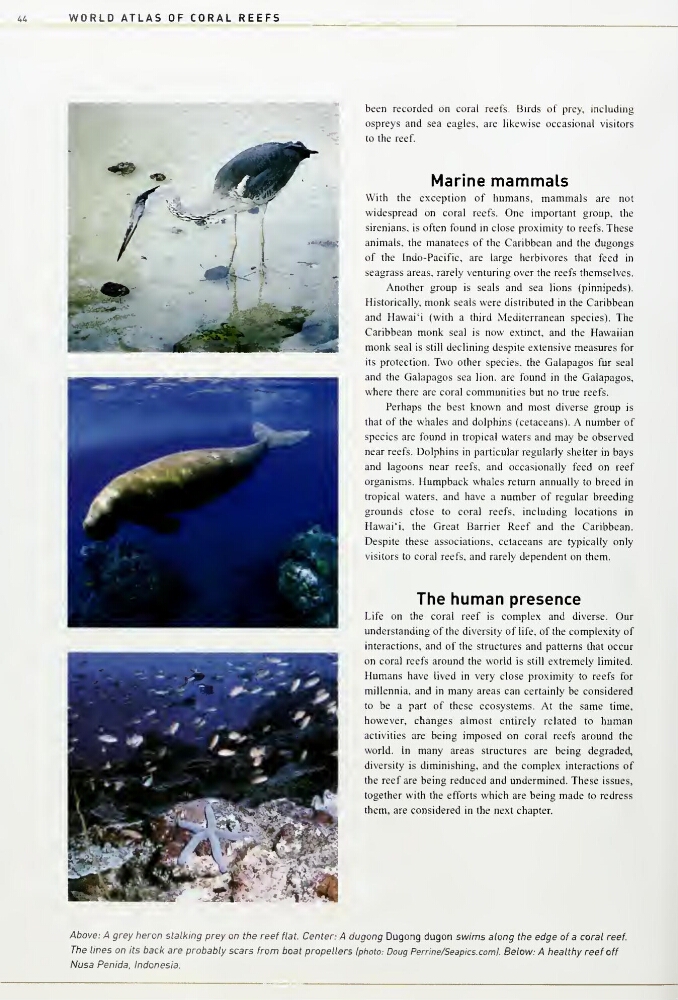
Above: A grey heron stalking prey on the reef flat. Center: A dugong Dugong dugon siv;ms along the edge of a coral reef.
The lines on its back are probably scars from boat propellers lpt)oto: Doug Pernne/Seapics.coml. Below: A healthy reef off
Nusa Penida, Indonesia.
been recorded on coral reefs. Birds of prey, including
ospreys and sea eagles, are likewise occasional visitors
to the reef.
Marine mammals
With the exception of humans, mammals are not
widespread on coral reefs. One important group, the
sirenians, is often found in close proximity to reefs. These
animals, the manatees of the Caribbean and the dugongs
of the Indo-Pacific, are large herbivores that feed in
seagrass areas, rarely venturing over the reefs themselves.
Another group is seals and sea lions (pinnipeds).
Historically, monk seals were distributed in the Caribbean
and Hawai'i (with a third Mediterranean species). The
Caribbean monk seal is now extmct, and the Hawaiian
monk seal is still declining despite extensive measures for
its protection. Two other species, the Galapagos fur seal
and the Galapagos sea lion, are found in the Galapagos,
where there are coral communities but no true reefs.
Perhaps the best known and most diverse group is
that of the whales and dolphins (cetaceans). A number of
species are found in tropical waters and may be observed
near reefs. Dolphins in particular regularly shelter in bays
and lagoons near reefs, and occasionally feed on reef
organisms. Humpback whales return annually to breed in
tropical waters, and have a number of regular breeding
grounds close to coral reefs, including locations in
Hawai'i, the Great Barrier Reef and the Caribbean.
Despite these associations, cetaceans are typically only
visitors to coral reefs, and rarely dependent on them.
The human presence
Life on the coral reef is complex and diverse. Our
understanding of the diversity of life, of the complexity of
interactions, and of the structures and patterns that occur
on coral reefs around the world is still extremely limited.
Humans have lived in very close proximity to reefs for
millennia, and in many areas can certainly be considered
to be a part of these ecosystems. At the same time,
however, changes almost entirely related to human
activities are being imposed on coral reefs around the
world. In many areas structures are being degraded,
diversity is diminishing, and the complex interactions of
the reef are being reduced and undermined. These issues,
together with the efforts which are being made to redress
them, are considered in the next chapter.
Above: A grey heron stalking prey on the reef flat. Center: A dugong Dugong dugon siv;ms along the edge of a coral reef.
The lines on its back are probably scars from boat propellers lpt)oto: Doug Pernne/Seapics.coml. Below: A healthy reef off
Nusa Penida, Indonesia.