

The World of Coral Reefs
43
and rays, jacks or trevallies, and barracuda. Reef fish play
a vitally important role in the wider functioning of the reef
ecosystem, as has been borne out by the observed impacts
of overfishing in many areas (see Chapter 2). They are
also among the best studied of all species found on reefs,
and many are widely regarded as indicators in the study of
wider patterns of biodiversity on reefs.
Reptiles
The overall diversity of reptiles in the oceans is very low.
Most modern reptiles have kidneys which are unable to
tolerate high salinities, so the two main groups which are
found on or near reefs are the ancient group of marine
turtles and the modern group of sea snakes. There are
seven species of marine turtle, all of which are found in
tropical and sub-tropical waters. None are strictly reef
species, but several regularly make use of reefs as a source
of food, notably hawksbill and loggerhead turtles, which
feed on invertebrates. Green turtles feed on marine plants
and algae and are often seen feeding in seagrass areas
near reefs. All marine turtles regularly nest on tropical
coastlines, often close to reefs.
There are some 55 species of sea snake belonging to
the family Elapidae, only found in the Indo-Pacific. The
largest group (sub-family Hydrophiinae) are the most
highly adapted, many never leave the water and all
give birth to live young. Another group, the sea kraits
(Laticaudinae) still leave the water to lay their eggs. All
are highly adapted to their aquatic environment, with
flattened tails to aid swimming, and considerable breathholding capabilities. Most eat fish, and have developed
highly toxic venom to ensure that their prey die quickly
before they have time to swim off.
Seabirds
Although not exhibiting spectacular diversity, a number of
seabirds are found regularly in coral reef environments.
These include predominantly pelagic seabirds which nest
on tropical oceanic islands, notably boobies (Sulidae),
tropicbirds (Phaethontidae). terns and noddies (Sternidae),
frigatebirds (Fregatidae) and shearwaters (Procellariidae).
These often breed in spectacular numbers on small coral
islands, especially where there is little human disturbance,
and no predation from introduced species such as rats.
Although they primarily feed on offshore pelagic species
they may take some nearshore species.
Smaller numbers of waders and other seabirds are
also found on or near reefs. These include sandpipers,
oystercatchers, turnstones and plovers. Egrets and herons
are also widespread, often feeding across the reef flat
at low tide. Pelicans are quite common on reefs in the
Caribbean region, and in a few places flamingos have
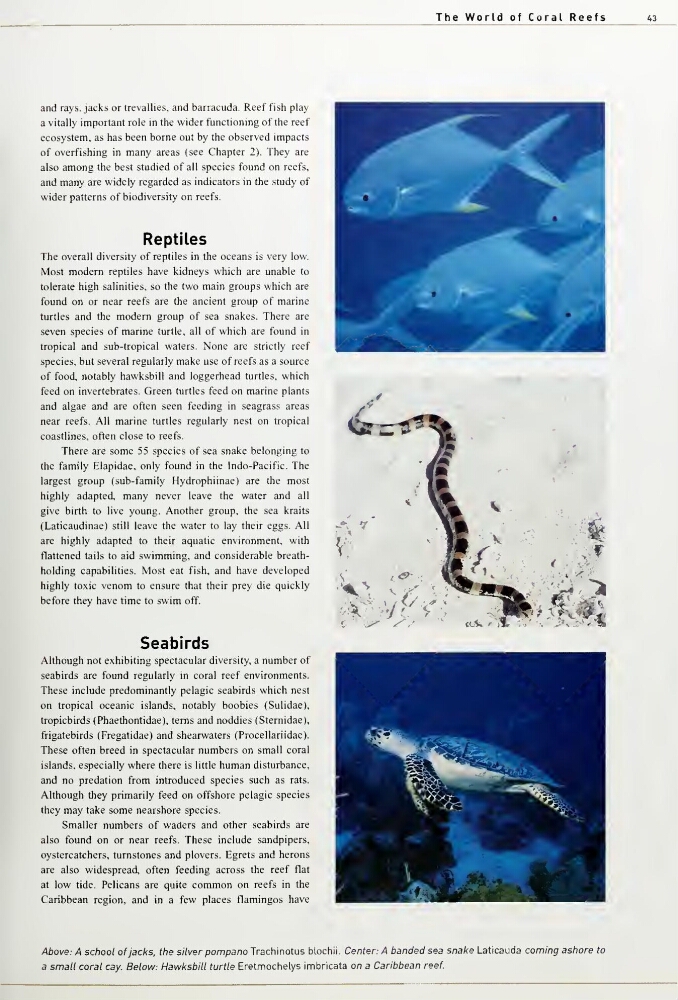
Above: A school of jacks, the silver pompano Trachmotus blochii. Center: A banded sea snake Laticauda coming ashore to
a small coral cay. Below: Hawksbill turtle Eretmochelys imbricata on a Caribbean reef.
43
and rays, jacks or trevallies, and barracuda. Reef fish play
a vitally important role in the wider functioning of the reef
ecosystem, as has been borne out by the observed impacts
of overfishing in many areas (see Chapter 2). They are
also among the best studied of all species found on reefs,
and many are widely regarded as indicators in the study of
wider patterns of biodiversity on reefs.
Reptiles
The overall diversity of reptiles in the oceans is very low.
Most modern reptiles have kidneys which are unable to
tolerate high salinities, so the two main groups which are
found on or near reefs are the ancient group of marine
turtles and the modern group of sea snakes. There are
seven species of marine turtle, all of which are found in
tropical and sub-tropical waters. None are strictly reef
species, but several regularly make use of reefs as a source
of food, notably hawksbill and loggerhead turtles, which
feed on invertebrates. Green turtles feed on marine plants
and algae and are often seen feeding in seagrass areas
near reefs. All marine turtles regularly nest on tropical
coastlines, often close to reefs.
There are some 55 species of sea snake belonging to
the family Elapidae, only found in the Indo-Pacific. The
largest group (sub-family Hydrophiinae) are the most
highly adapted, many never leave the water and all
give birth to live young. Another group, the sea kraits
(Laticaudinae) still leave the water to lay their eggs. All
are highly adapted to their aquatic environment, with
flattened tails to aid swimming, and considerable breathholding capabilities. Most eat fish, and have developed
highly toxic venom to ensure that their prey die quickly
before they have time to swim off.
Seabirds
Although not exhibiting spectacular diversity, a number of
seabirds are found regularly in coral reef environments.
These include predominantly pelagic seabirds which nest
on tropical oceanic islands, notably boobies (Sulidae),
tropicbirds (Phaethontidae). terns and noddies (Sternidae),
frigatebirds (Fregatidae) and shearwaters (Procellariidae).
These often breed in spectacular numbers on small coral
islands, especially where there is little human disturbance,
and no predation from introduced species such as rats.
Although they primarily feed on offshore pelagic species
they may take some nearshore species.
Smaller numbers of waders and other seabirds are
also found on or near reefs. These include sandpipers,
oystercatchers, turnstones and plovers. Egrets and herons
are also widespread, often feeding across the reef flat
at low tide. Pelicans are quite common on reefs in the
Caribbean region, and in a few places flamingos have
Above: A school of jacks, the silver pompano Trachmotus blochii. Center: A banded sea snake Laticauda coming ashore to
a small coral cay. Below: Hawksbill turtle Eretmochelys imbricata on a Caribbean reef.