

392
WORLD ATLAS OF CORAL REEFS
Hawai'i and the US minor
outlying islands
MAPS 14i and j
The
Hawaiian Islands are the most isolated
archipelago in the world, lying considerably north
and east of the vast majority of Pacific islands.
They were formed as the Pacific tectonic plate moved
northwest over a stationary hotspot beneath the ocean
floor. The youngest island in the group is thus the island
of Hawaii in the southeast, which shows near continuous
volcanic activity. Together with seven other main islands,
it forms a distinct block of high volcanic islands making
up the majority of the land area of the archipelago.
Moving northwest, the older volcanic islands have largely
subsided and there is a long chain of islands and reefs at
or near sea level leading to Kure Atoll in the northwest.
These latter reefs lie some distance north of the tropics.
Further north and west of these is the sequence of
Emperor Seamounts extending for thousands of kilometers towards the Kamchatka coastline of Siberia. These
represent former reef-capped volcanic islands. Their
northward migration took them to latitudes where reef
growth was insufficiently rapid to keep up with crustal
subsidence, and then out of the regions of hermatypic
coral growth completely.
The Hawaiian Islands lie in the path of the westerly
flowing North Pacific Equatorial Current. The surrounding
pelagic waters are renowned for their low productivity and
20 km
low nutrient content. Away from the high islands this is a
significant factor for coastal ecosystem productivity.
From March to October they are swept by the northeast
trade winds which generate cool air temperatures and a
pronounced windward to leeward gradient with greater
wave energies, but also higher rainfall and runoff on
eastern shores. There is a pronounced seasonality with
distinctly sub-tropical temperatures during winter months,
particularly in the northwestern islands. The islands are
occasionally swept by tropical cyclones.
Fringing reefs are by no means continuous among
the high islands of the southeast, though they are well
developed in a number of places, particularly on leeward
(southern and southwestern) shores. Along the coast of
Hawai'i Island there are no true fringing reefs, but well
developed submerged reefs occur along the western Kona
coast. Recent underwater lava flows provide a substrate for
looking at colonization by reef organisms in the south and
east. Fringing reefs are better developed in a few locations
along the western shores of Maui, the southern shores of
Molokai and the northeastern shores of Lanai. Oahu has a
number of well developed reefs, including a well studied
fringing reef in Hanauma Bay and one of the only barrier
reefs in Kanehoe Bay, which protects a large number of
patch reefs and a coastal fringing reef. Fringing reefs are
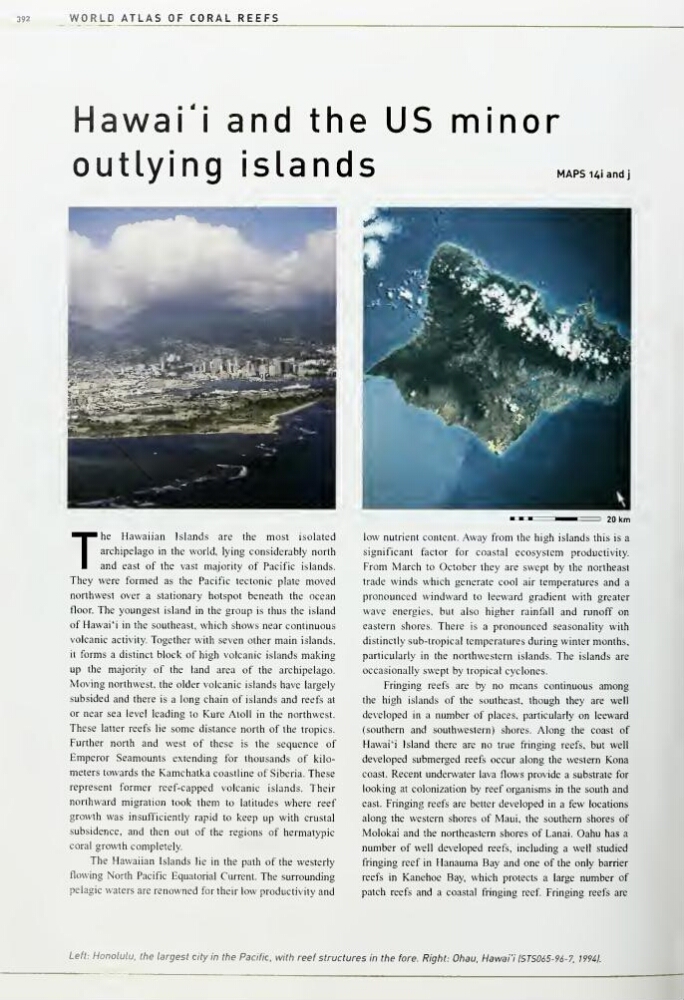
Left: Honolulu, the largest city in the Pacific, with reef structures in the fore. Right: Ohau, Hawai'i ISTS065-96-7. 19941.
WORLD ATLAS OF CORAL REEFS
Hawai'i and the US minor
outlying islands
MAPS 14i and j
The
Hawaiian Islands are the most isolated
archipelago in the world, lying considerably north
and east of the vast majority of Pacific islands.
They were formed as the Pacific tectonic plate moved
northwest over a stationary hotspot beneath the ocean
floor. The youngest island in the group is thus the island
of Hawaii in the southeast, which shows near continuous
volcanic activity. Together with seven other main islands,
it forms a distinct block of high volcanic islands making
up the majority of the land area of the archipelago.
Moving northwest, the older volcanic islands have largely
subsided and there is a long chain of islands and reefs at
or near sea level leading to Kure Atoll in the northwest.
These latter reefs lie some distance north of the tropics.
Further north and west of these is the sequence of
Emperor Seamounts extending for thousands of kilometers towards the Kamchatka coastline of Siberia. These
represent former reef-capped volcanic islands. Their
northward migration took them to latitudes where reef
growth was insufficiently rapid to keep up with crustal
subsidence, and then out of the regions of hermatypic
coral growth completely.
The Hawaiian Islands lie in the path of the westerly
flowing North Pacific Equatorial Current. The surrounding
pelagic waters are renowned for their low productivity and
20 km
low nutrient content. Away from the high islands this is a
significant factor for coastal ecosystem productivity.
From March to October they are swept by the northeast
trade winds which generate cool air temperatures and a
pronounced windward to leeward gradient with greater
wave energies, but also higher rainfall and runoff on
eastern shores. There is a pronounced seasonality with
distinctly sub-tropical temperatures during winter months,
particularly in the northwestern islands. The islands are
occasionally swept by tropical cyclones.
Fringing reefs are by no means continuous among
the high islands of the southeast, though they are well
developed in a number of places, particularly on leeward
(southern and southwestern) shores. Along the coast of
Hawai'i Island there are no true fringing reefs, but well
developed submerged reefs occur along the western Kona
coast. Recent underwater lava flows provide a substrate for
looking at colonization by reef organisms in the south and
east. Fringing reefs are better developed in a few locations
along the western shores of Maui, the southern shores of
Molokai and the northeastern shores of Lanai. Oahu has a
number of well developed reefs, including a well studied
fringing reef in Hanauma Bay and one of the only barrier
reefs in Kanehoe Bay, which protects a large number of
patch reefs and a coastal fringing reef. Fringing reefs are
Left: Honolulu, the largest city in the Pacific, with reef structures in the fore. Right: Ohau, Hawai'i ISTS065-96-7. 19941.