

Polynesia
391
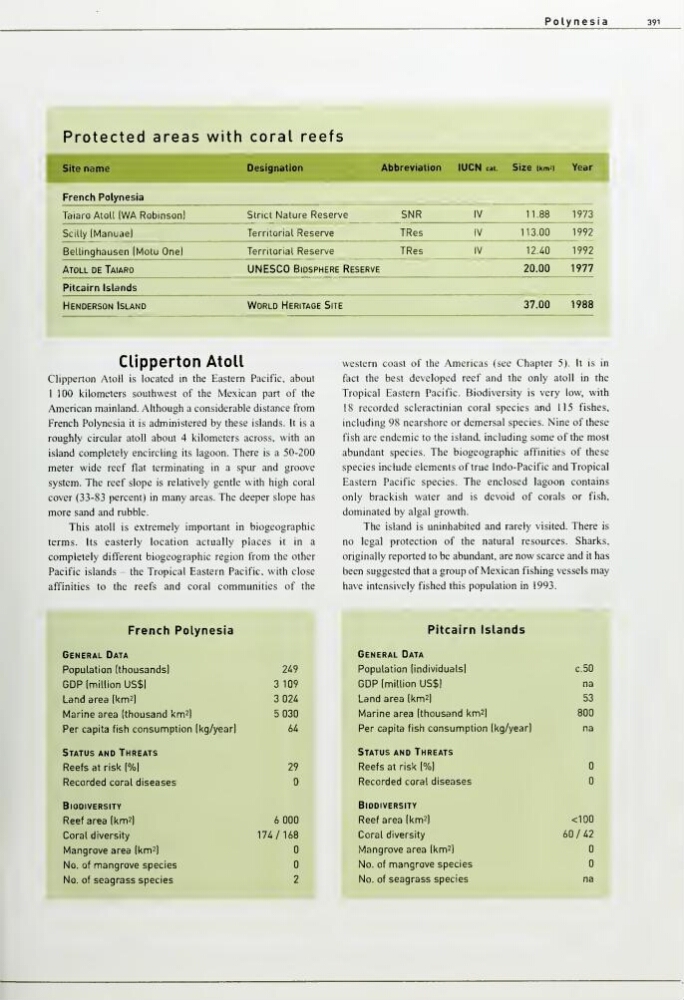
Protected areas wi th coral reefs
B Site name
Designation
Abbreviation
lUCN cat.
Size Ikm'l
Year
French Polynesia
TaiaroAtoUlWA Robinson)
Strict Nature Reserve
SNR
IV
11.88
1973
SciUy (Manuael
Territorial Reserve
TRes
IV
113.00
1992
1992
Bellinghausen (Motu One]
Territorial Reserve
TRes
IV
12, iO
Atoll de Taiaro
UNESCO Biosphere Reserve
20.00
1977
Pitcairn Islands
Henderson Island
World Heritage Site
37.00
1988
Clipperton Atoll
Clipperton Atoll is located in the Eastern Pacific, about
1
100 kilometers southwest of the Mexican part of the
American mainland. Although a considerable distance from
French Polynesia it is administered by these islands. It is a
roughly circular atoll about 4 kilometers across, with an
island completely encircling its lagoon. There is a 50-200
meter wide reef flat terminating in a spur and groove
system. The reef slope is relatively gentle with high coral
cover (33-83 percent) in many areas. The deeper slope has
more sand and rubble.
This atoll is extremely important in biogeographic
terms. Its easterly location actually places it in a
completely different biogeographic region from the other
Pacific islands - the Tropical Eastern Pacific, with close
affinities to the reefs and coral communities of the
western coast of the Americas (see Chapter 5). It is in
fact the best developed reef and the only atoll in the
Tropical Eastern Pacific. Biodiversity is very low, with
18 recorded scleractinian coral species and 115 fishes,
including 98 nearshore or demersal species. Nine of these
fish are endemic to the island, including some of the most
abundant species. The biogeographic affinities of these
species include elements of true Indo-Pacific and Tropical
Eastern Pacific species. The enclosed lagoon contains
only brackish water and is devoid of corals or fish,
dominated by algal growth.
The island is uninhabited and rarely visited. There is
no legal protection of the natural resources. Sharks,
originally reported to be abundant, are now scarce and it has
been suggested that a group of Mexican fishing vessels may
have intensively fished this population in 1993.
^^f
French Po lynesia
General Data
Population (thousands)
2^9
GDP (million US$1
3 109
Land area (km^l
3 02^
Marine area (thousand km2 I
5 030
Per capita fish consumption Ikg/year)
64
Status and Threats
Reefs at risk (%)
29
Recorded coral diseases
Biodiversity
Reef area (km^)
6 000
Coral diversity
174/168
Mangrove area (km^)
No. of mangrove species
No. of seagrass species
2
Pitcairn islands
General Data
Population (individuals)
C.50
GDP (million US$1
na
Land area (km^)
53
Marine area (thousand km^)
800
Per capita fish consumption (kg/year)
na
Status and Threats
Reefs at risk (%)
Recorded coral diseases
Biodiversity
Reef area Ikm^)
<100
Coral diversity
60/42
Mangrove area (km^l
No. of mangrove species
No. of seagrass species
na
391
Protected areas wi th coral reefs
B Site name
Designation
Abbreviation
lUCN cat.
Size Ikm'l
Year
French Polynesia
TaiaroAtoUlWA Robinson)
Strict Nature Reserve
SNR
IV
11.88
1973
SciUy (Manuael
Territorial Reserve
TRes
IV
113.00
1992
1992
Bellinghausen (Motu One]
Territorial Reserve
TRes
IV
12, iO
Atoll de Taiaro
UNESCO Biosphere Reserve
20.00
1977
Pitcairn Islands
Henderson Island
World Heritage Site
37.00
1988
Clipperton Atoll
Clipperton Atoll is located in the Eastern Pacific, about
1
100 kilometers southwest of the Mexican part of the
American mainland. Although a considerable distance from
French Polynesia it is administered by these islands. It is a
roughly circular atoll about 4 kilometers across, with an
island completely encircling its lagoon. There is a 50-200
meter wide reef flat terminating in a spur and groove
system. The reef slope is relatively gentle with high coral
cover (33-83 percent) in many areas. The deeper slope has
more sand and rubble.
This atoll is extremely important in biogeographic
terms. Its easterly location actually places it in a
completely different biogeographic region from the other
Pacific islands - the Tropical Eastern Pacific, with close
affinities to the reefs and coral communities of the
western coast of the Americas (see Chapter 5). It is in
fact the best developed reef and the only atoll in the
Tropical Eastern Pacific. Biodiversity is very low, with
18 recorded scleractinian coral species and 115 fishes,
including 98 nearshore or demersal species. Nine of these
fish are endemic to the island, including some of the most
abundant species. The biogeographic affinities of these
species include elements of true Indo-Pacific and Tropical
Eastern Pacific species. The enclosed lagoon contains
only brackish water and is devoid of corals or fish,
dominated by algal growth.
The island is uninhabited and rarely visited. There is
no legal protection of the natural resources. Sharks,
originally reported to be abundant, are now scarce and it has
been suggested that a group of Mexican fishing vessels may
have intensively fished this population in 1993.
^^f
French Po lynesia
General Data
Population (thousands)
2^9
GDP (million US$1
3 109
Land area (km^l
3 02^
Marine area (thousand km2 I
5 030
Per capita fish consumption Ikg/year)
64
Status and Threats
Reefs at risk (%)
29
Recorded coral diseases
Biodiversity
Reef area (km^)
6 000
Coral diversity
174/168
Mangrove area (km^)
No. of mangrove species
No. of seagrass species
2
Pitcairn islands
General Data
Population (individuals)
C.50
GDP (million US$1
na
Land area (km^)
53
Marine area (thousand km^)
800
Per capita fish consumption (kg/year)
na
Status and Threats
Reefs at risk (%)
Recorded coral diseases
Biodiversity
Reef area Ikm^)
<100
Coral diversity
60/42
Mangrove area (km^l
No. of mangrove species
No. of seagrass species
na