

386
WORLD ATLAS OF CORAL REEFS
larger group. They represent the eastern extent of French
Polynesia. The main islands are a cluster of four large volcanic islands (Mangareva, Taravai. Aukena and Akamaru)
surrounded by a single barrier reef These and other smaller
islands in the lagoon also show some fringing reef
development. The small atoll of Temoe is sometimes
considered part of the Gambler group.
The Austral Islands lie to the southwest and include the
rock pinnacles of Marotiri (Bass Islands) and the high
volcanic island of Rapa in the far southeast. These are the
southernmost islands of the region, with relatively low sea
temperatures. There are no fringing reefs although there
are significant coral communities. Pontes and Pachyseris
corals are absent, and algal cover is high. The remaining
islands in the Austral group lie much further north and have
well developed fringing and barrier reefs.
The reefs of French Polynesia include some of the best
studied in the Pacific, but there are nonetheless some 50
islands or atolls which have never been visited by scientists.
Information is particularly limited describing the Gambler,
Marquesas and Austral archipelagos. Located in the most
eastern region of the Indo-Pacific, diversity is generally
relatively low, particularly on a unit-area basis. The vast
total reef area and the considerable diversity of reef types
and physico-climatic conditions mean that such low
diversity is somewhat hidden in the species totals for the
country. Some 168 coral species, about 800 reef fish, 30
echinoderms, 346 species of algae and 1 159 molluscs have
been recorded. There appear to be some general patterns
in the dominant species among different reef types. The
lagoons of high volcanic islands are dominated by Pontes,
Acropora, Psammocora and Synaraea, while in atoll
ikm
lagoons only Poriies and Acropora dominate, and in the
near-closed lagoons only Acropora. Outer slopes largely
harbor Pocillopora. Acropora and Porites. with coral cover
ranging from 40 to 60 percent at a depth of 1 5 meters. Even
the deeper reef slopes have high coral cover, with over 90
percent cover in some atolls, down to 90 meters. There are
some distinctive features about the communities in each of
the archipelagos and, although general rates of endemism
are low, there arc a number of unique species recorded from
the Marquesas and Gambler archipelagos.
Cyclones have regularly affected the reefs of the
Tuamotus and Society Islands. A number of reefs were
impacted by crown-of-thorns starfish in the 1970s and
1980s, exacerbated by cyclone damage in some areas.
Bleaching at moderate levels was reported from various
locations in the 1980s, and a more severe bleaching event
in 1991 led to mortality of 20 percent of the live corals.
Further bleaching recorded in 1998 was relatively patchy
but led to significant mortalities in some areas.
The majority of islands and reefs in French Polynesia
are remote from significant human populations and remain
largely unimpacted by human activities. Fishing is critical
for all of the populated islands, but particularly for those
more remote from urban and tourism developments. In the
late 1990s it was estimated that about 4 000-4 500 tons of
lagoon fish were landed annually, about 3 500 of which
were at subsistence level. In a few places there may be
overfishing. One of the major industries in the country is
black pearl culture, which employs around 5 000 people
at 600 farms on some 50 islands. This industry supplies
about 98 percent of the world market in black pearls and
earns about US$130 million per annum. The oysters are
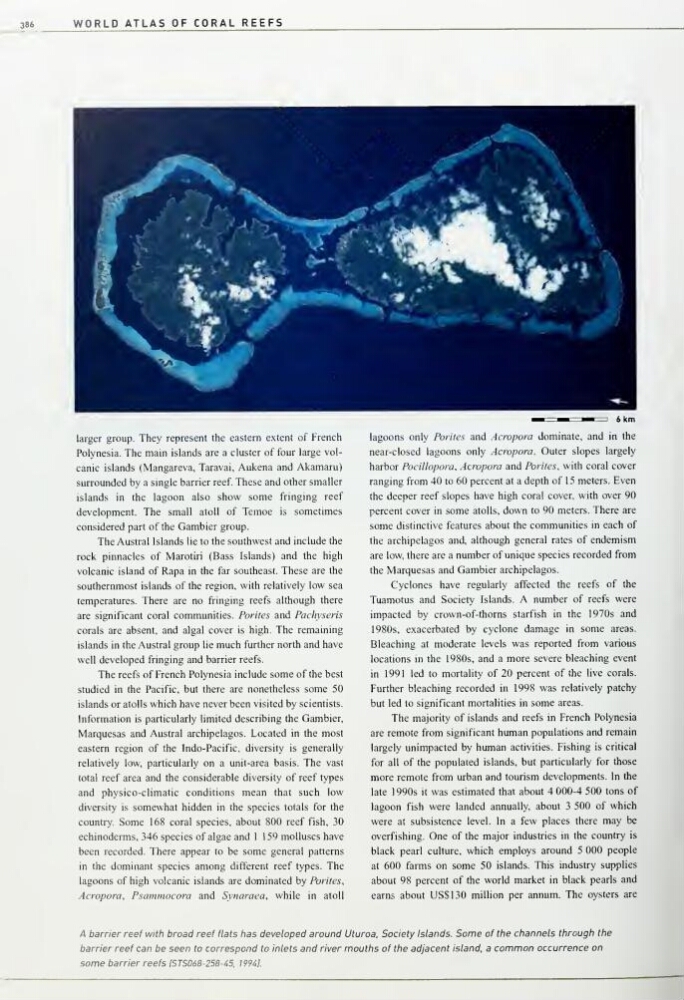
A barrier reef with broad reef flats has developed around Uturoa, Society Islands. Some of the channels through the
barrier reef can be seen to correspond to inlets and river mouths of the adjacent island, a common occurrence on
some barrier reefs ISTS068-258-45. t9941.
WORLD ATLAS OF CORAL REEFS
larger group. They represent the eastern extent of French
Polynesia. The main islands are a cluster of four large volcanic islands (Mangareva, Taravai. Aukena and Akamaru)
surrounded by a single barrier reef These and other smaller
islands in the lagoon also show some fringing reef
development. The small atoll of Temoe is sometimes
considered part of the Gambler group.
The Austral Islands lie to the southwest and include the
rock pinnacles of Marotiri (Bass Islands) and the high
volcanic island of Rapa in the far southeast. These are the
southernmost islands of the region, with relatively low sea
temperatures. There are no fringing reefs although there
are significant coral communities. Pontes and Pachyseris
corals are absent, and algal cover is high. The remaining
islands in the Austral group lie much further north and have
well developed fringing and barrier reefs.
The reefs of French Polynesia include some of the best
studied in the Pacific, but there are nonetheless some 50
islands or atolls which have never been visited by scientists.
Information is particularly limited describing the Gambler,
Marquesas and Austral archipelagos. Located in the most
eastern region of the Indo-Pacific, diversity is generally
relatively low, particularly on a unit-area basis. The vast
total reef area and the considerable diversity of reef types
and physico-climatic conditions mean that such low
diversity is somewhat hidden in the species totals for the
country. Some 168 coral species, about 800 reef fish, 30
echinoderms, 346 species of algae and 1 159 molluscs have
been recorded. There appear to be some general patterns
in the dominant species among different reef types. The
lagoons of high volcanic islands are dominated by Pontes,
Acropora, Psammocora and Synaraea, while in atoll
ikm
lagoons only Poriies and Acropora dominate, and in the
near-closed lagoons only Acropora. Outer slopes largely
harbor Pocillopora. Acropora and Porites. with coral cover
ranging from 40 to 60 percent at a depth of 1 5 meters. Even
the deeper reef slopes have high coral cover, with over 90
percent cover in some atolls, down to 90 meters. There are
some distinctive features about the communities in each of
the archipelagos and, although general rates of endemism
are low, there arc a number of unique species recorded from
the Marquesas and Gambler archipelagos.
Cyclones have regularly affected the reefs of the
Tuamotus and Society Islands. A number of reefs were
impacted by crown-of-thorns starfish in the 1970s and
1980s, exacerbated by cyclone damage in some areas.
Bleaching at moderate levels was reported from various
locations in the 1980s, and a more severe bleaching event
in 1991 led to mortality of 20 percent of the live corals.
Further bleaching recorded in 1998 was relatively patchy
but led to significant mortalities in some areas.
The majority of islands and reefs in French Polynesia
are remote from significant human populations and remain
largely unimpacted by human activities. Fishing is critical
for all of the populated islands, but particularly for those
more remote from urban and tourism developments. In the
late 1990s it was estimated that about 4 000-4 500 tons of
lagoon fish were landed annually, about 3 500 of which
were at subsistence level. In a few places there may be
overfishing. One of the major industries in the country is
black pearl culture, which employs around 5 000 people
at 600 farms on some 50 islands. This industry supplies
about 98 percent of the world market in black pearls and
earns about US$130 million per annum. The oysters are
A barrier reef with broad reef flats has developed around Uturoa, Society Islands. Some of the channels through the
barrier reef can be seen to correspond to inlets and river mouths of the adjacent island, a common occurrence on
some barrier reefs ISTS068-258-45. t9941.