

380
WORLD ATLAS OF CORAL REEFS
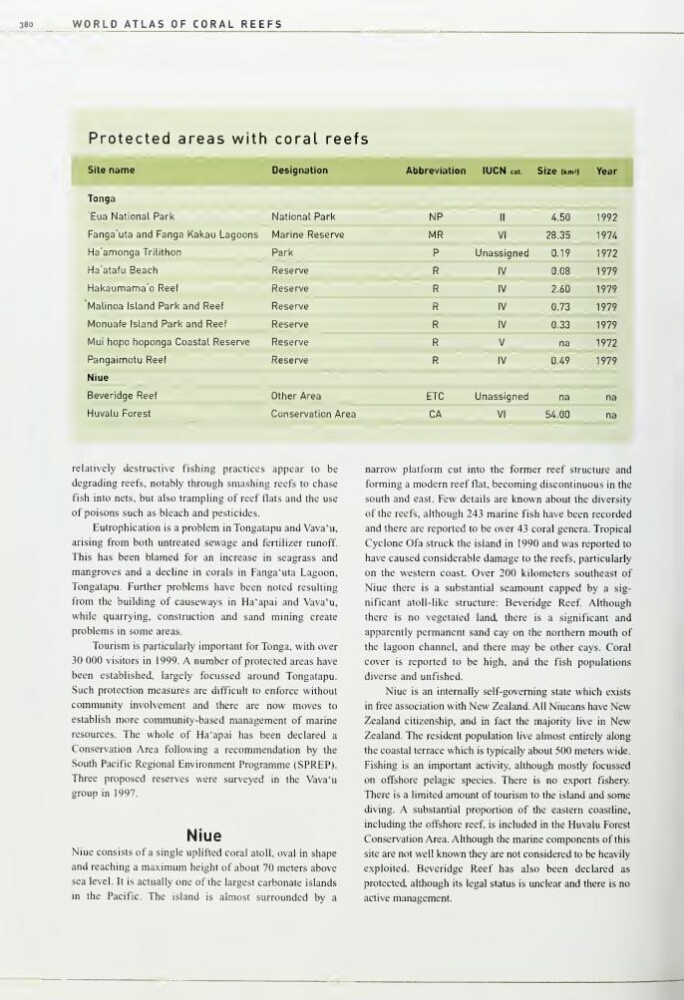
Protected areas with coral reefs
1
Site name
Designation
Abbreviation
lUCN cat.
Size lkm>l
Year ^
Tonga
'Eua National Park
National Park
MP
II
A.50
1992
Fanga'uta and Fanga Kakau Lagoons
t«larine Reserve
MR
VI
28.35
1974
Ha'amonga TriUthon
Park
P
Unassigned
0.19
1972
Ha'atatu Beach
Reserve
R
IV
0.08
1979
Hakaumama'o Reef
Reserve
R
IV
2.60
1979
Malinoa Island Park and Reef
Reserve
R
IV
0.73
1979
Monuafe Island Park and Reef
Reserve
R
IV
0.33
1979
Mui fiopo fioponga Coastal Reserve
Reserve
R
V
na
1972
Pangalmotu Reef
Reserve
R
IV
0.49
1979
Nlue
Beveridge Reef
Ottier Area
ETC
Unassigned
na
na
Huvalu Forest
Conservation Area
CA
VI
54.00
na
relatively destructive fishing practices appear to be
degrading reefs, notably through smashing reefs to chase
fish into nets, but also trampling of reef flats and the use
of poisons such as bleach and pesticides.
Eutrophication is a problem in Tongatapu and Vava'u.
arising from both untreated sewage and fertilizer runoff
This has been blamed for an increase in seagrass and
mangroves and a decline in corals in Fanga'uta Lagoon.
Tongatapu. Further problems have been noted resulting
from the building of causeways in Ha'apai and Vava'u.
while quarrying, construction and sand mining create
problems in some areas.
Tourism is particularly important for Tonga, with over
30 000 visitors in 1999. A number of protected areas have
been established, largely focussed around Tongatapu.
Such protection measures are difficult to enforce without
community involvement and there are now moves to
establish more community-based management of marine
resources. The whole of Ha'apai has been declared a
Conservation Area following a recommendation by the
South Pacific Regional Environment Programme (SPREP).
Three proposed reserves were surveyed in the Vava'u
group in 1997.
Niue
Nine consists of a single uplifted coral atoll, oval in shape
and reaching a maximum height of about 70 meters above
sea level. It is actually one of the largest carbonate islands
in the Pacific. The island is almost surrounded by a
narrow platform cut into the former reef structure and
forming a modern reef flat, becoming discontinuous in the
south and east. Few details are known about the diversity
of the reefs, although 243 marine fish have been recorded
and there are reported to be over 43 coral genera. Tropical
Cyclone Ofa struck the island in 1990 and was reported to
have caused considerable damage to the reefs, particularly
on the western coast. Over 200 kilometers southeast of
Niue there is a substantial seamount capped by a significant atoll-like structure: Beveridge Reef Although
there is no vegetated land, there is a significant and
apparently permanent sand cay on the northern mouth of
the lagoon channel, and there may be other cays. Coral
cover is reported to be high, and the fish populations
diverse and unfished.
Niue is an internally self-governing state which exists
in free association with New Zealand. All Niueans have New
Zealand citizenship, and in fact the majority live in New
Zealand. The resident population live almost entirely along
the coastal terrace which is typically about 500 meters wide.
Fishing is an important activity, although mostly focussed
on offshore pelagic species. There is no export fishery.
There is a limited amount of tourism to the island and some
diving. A substantial proportion of the eastern coastline,
including the offshore reef, is included in the Huvalu Forest
Conservation Area. Although the marine components of this
site are not well known they are not considered to be heavily
exploited. Beveridge Reef has also been declared as
protected, although its legal status is unclear and there is no
active management.
WORLD ATLAS OF CORAL REEFS
Protected areas with coral reefs
1
Site name
Designation
Abbreviation
lUCN cat.
Size lkm>l
Year ^
Tonga
'Eua National Park
National Park
MP
II
A.50
1992
Fanga'uta and Fanga Kakau Lagoons
t«larine Reserve
MR
VI
28.35
1974
Ha'amonga TriUthon
Park
P
Unassigned
0.19
1972
Ha'atatu Beach
Reserve
R
IV
0.08
1979
Hakaumama'o Reef
Reserve
R
IV
2.60
1979
Malinoa Island Park and Reef
Reserve
R
IV
0.73
1979
Monuafe Island Park and Reef
Reserve
R
IV
0.33
1979
Mui fiopo fioponga Coastal Reserve
Reserve
R
V
na
1972
Pangalmotu Reef
Reserve
R
IV
0.49
1979
Nlue
Beveridge Reef
Ottier Area
ETC
Unassigned
na
na
Huvalu Forest
Conservation Area
CA
VI
54.00
na
relatively destructive fishing practices appear to be
degrading reefs, notably through smashing reefs to chase
fish into nets, but also trampling of reef flats and the use
of poisons such as bleach and pesticides.
Eutrophication is a problem in Tongatapu and Vava'u.
arising from both untreated sewage and fertilizer runoff
This has been blamed for an increase in seagrass and
mangroves and a decline in corals in Fanga'uta Lagoon.
Tongatapu. Further problems have been noted resulting
from the building of causeways in Ha'apai and Vava'u.
while quarrying, construction and sand mining create
problems in some areas.
Tourism is particularly important for Tonga, with over
30 000 visitors in 1999. A number of protected areas have
been established, largely focussed around Tongatapu.
Such protection measures are difficult to enforce without
community involvement and there are now moves to
establish more community-based management of marine
resources. The whole of Ha'apai has been declared a
Conservation Area following a recommendation by the
South Pacific Regional Environment Programme (SPREP).
Three proposed reserves were surveyed in the Vava'u
group in 1997.
Niue
Nine consists of a single uplifted coral atoll, oval in shape
and reaching a maximum height of about 70 meters above
sea level. It is actually one of the largest carbonate islands
in the Pacific. The island is almost surrounded by a
narrow platform cut into the former reef structure and
forming a modern reef flat, becoming discontinuous in the
south and east. Few details are known about the diversity
of the reefs, although 243 marine fish have been recorded
and there are reported to be over 43 coral genera. Tropical
Cyclone Ofa struck the island in 1990 and was reported to
have caused considerable damage to the reefs, particularly
on the western coast. Over 200 kilometers southeast of
Niue there is a substantial seamount capped by a significant atoll-like structure: Beveridge Reef Although
there is no vegetated land, there is a significant and
apparently permanent sand cay on the northern mouth of
the lagoon channel, and there may be other cays. Coral
cover is reported to be high, and the fish populations
diverse and unfished.
Niue is an internally self-governing state which exists
in free association with New Zealand. All Niueans have New
Zealand citizenship, and in fact the majority live in New
Zealand. The resident population live almost entirely along
the coastal terrace which is typically about 500 meters wide.
Fishing is an important activity, although mostly focussed
on offshore pelagic species. There is no export fishery.
There is a limited amount of tourism to the island and some
diving. A substantial proportion of the eastern coastline,
including the offshore reef, is included in the Huvalu Forest
Conservation Area. Although the marine components of this
site are not well known they are not considered to be heavily
exploited. Beveridge Reef has also been declared as
protected, although its legal status is unclear and there is no
active management.