

Polynesia
379
islands. By contrast, reefs are widespread and well
developed among the eastern islands. There are fringing
reefs surrounding most coasts, while platform and barriertype structures are also located in most of the mam island
groups. The most extensive areas of reef are in the Hapa'ai
group. The dominant winds are southeast trade winds,
particularly from March to October From November to
March there is a cyclone season, although trade winds still
predominate much of the time.
Little information is available describing the biodiversity of Tongan reefs. Some 192 species of scleractinian corals have been recorded at 1 1 reefs around
Tongatapu. Other studies have revealed 229 reef fish
from 39 families, 55 bivalves, 83 gastropods and 13
holothurians. In all cases these are likely to be considerable underestimates. Coral cover on the reefs is likely to
be highly variable, with records of only 2 percent in
Monuafe but up to 50 percent at Hakaumama'o Reef
Although large numbers of crown-of-thorns starfish have
been reported in many areas, major outbreaks have not
been recorded. Cyclones cause periodic damage to reefs,
with the latest ones reported in 1995, 1997, 1999 and
2000. Although largely unaffected by the 1998 bleaching,
the Tongan reefs appeared to have suffered a major
bleaching event similar to that reported in Fiji in 2000.
Artisanal fisheries are an important activity in the
country. Studies have shown that almost 70 percent of the
artisanal catch is made up of reef fish (notably emperors
and mullet). Turtle eggs and meat are still eaten in many
areas. There are also several important commercial
fisheries, notably an aquarium trade dealing in fish,
coral and live rock (small pieces of reef rock housing
numerous species) together with limited numbers of
invertebrates. Holothurians have also been widely taken,
particularly the sandfish Hololhuria scabra. Overfishing
is a problem in areas of high population density, notably
around Tongatapu. Target species for export have also
been overfished throughout the country. Two giant clam
species, Tridacna gigas and Hippopus hippopus. were
thought to have become locally extinct, but were reintroduced in 1990 and 1991. A number of giant clam
nurseries have been established to be managed at the
community level. A complete ban on sea cucumber export
was imposed for ten years in 1997 as a response to chronic
overharvesting. These problems of overfishing have been
exacerbated by a lack of local ownership of reef resources,
enabling commercial collectors to harvest even close to
local communities. In addition to overfishing, certain
^^^^V
Tonga
General Data
Population (thousands)
102
GDP (million US$1
U9
Land area (km^)
697
Marine area (thousand km^l
700
Per capita fish consumption (kg/yearl
35
Status and Threats
Reefs at risk (%|
i6
Recorded coral diseases
Biodiversity
Reef area (km^j
1 500
Coral diversity
na/218
Mangrove area (km^l
10
No. of mangrove species
8
No. of seagrass species
na
Niue
General Data
Population (thousands)
2
GDP (million US$)
na
Land area (km^)
228
Marine area (thousand km^)
390
Per capita fish consumption (kg/year)
62
Status and Threats
Reefs at risk [%)
43
Recorded coral diseases
Biodiversity
Reef area (km^)
170
Coral diversity
na/189
Mangrove area (km')
na
No. of mangrove species
1
No. of seagrass species
na
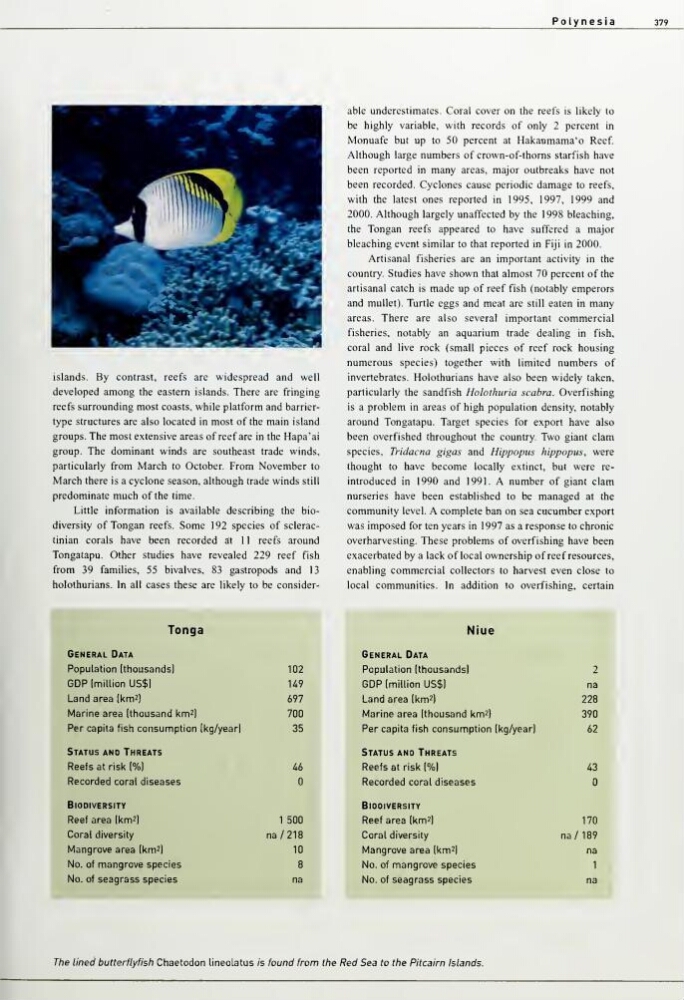
The lined butterftyfish Chaetodon lineolatus is found from the Red Sea to the Pitcairn Islands.
379
islands. By contrast, reefs are widespread and well
developed among the eastern islands. There are fringing
reefs surrounding most coasts, while platform and barriertype structures are also located in most of the mam island
groups. The most extensive areas of reef are in the Hapa'ai
group. The dominant winds are southeast trade winds,
particularly from March to October From November to
March there is a cyclone season, although trade winds still
predominate much of the time.
Little information is available describing the biodiversity of Tongan reefs. Some 192 species of scleractinian corals have been recorded at 1 1 reefs around
Tongatapu. Other studies have revealed 229 reef fish
from 39 families, 55 bivalves, 83 gastropods and 13
holothurians. In all cases these are likely to be considerable underestimates. Coral cover on the reefs is likely to
be highly variable, with records of only 2 percent in
Monuafe but up to 50 percent at Hakaumama'o Reef
Although large numbers of crown-of-thorns starfish have
been reported in many areas, major outbreaks have not
been recorded. Cyclones cause periodic damage to reefs,
with the latest ones reported in 1995, 1997, 1999 and
2000. Although largely unaffected by the 1998 bleaching,
the Tongan reefs appeared to have suffered a major
bleaching event similar to that reported in Fiji in 2000.
Artisanal fisheries are an important activity in the
country. Studies have shown that almost 70 percent of the
artisanal catch is made up of reef fish (notably emperors
and mullet). Turtle eggs and meat are still eaten in many
areas. There are also several important commercial
fisheries, notably an aquarium trade dealing in fish,
coral and live rock (small pieces of reef rock housing
numerous species) together with limited numbers of
invertebrates. Holothurians have also been widely taken,
particularly the sandfish Hololhuria scabra. Overfishing
is a problem in areas of high population density, notably
around Tongatapu. Target species for export have also
been overfished throughout the country. Two giant clam
species, Tridacna gigas and Hippopus hippopus. were
thought to have become locally extinct, but were reintroduced in 1990 and 1991. A number of giant clam
nurseries have been established to be managed at the
community level. A complete ban on sea cucumber export
was imposed for ten years in 1997 as a response to chronic
overharvesting. These problems of overfishing have been
exacerbated by a lack of local ownership of reef resources,
enabling commercial collectors to harvest even close to
local communities. In addition to overfishing, certain
^^^^V
Tonga
General Data
Population (thousands)
102
GDP (million US$1
U9
Land area (km^)
697
Marine area (thousand km^l
700
Per capita fish consumption (kg/yearl
35
Status and Threats
Reefs at risk (%|
i6
Recorded coral diseases
Biodiversity
Reef area (km^j
1 500
Coral diversity
na/218
Mangrove area (km^l
10
No. of mangrove species
8
No. of seagrass species
na
Niue
General Data
Population (thousands)
2
GDP (million US$)
na
Land area (km^)
228
Marine area (thousand km^)
390
Per capita fish consumption (kg/year)
62
Status and Threats
Reefs at risk [%)
43
Recorded coral diseases
Biodiversity
Reef area (km^)
170
Coral diversity
na/189
Mangrove area (km')
na
No. of mangrove species
1
No. of seagrass species
na
The lined butterftyfish Chaetodon lineolatus is found from the Red Sea to the Pitcairn Islands.