

362
WORLD ATLAS OF CORAL REEFS
they are concentrated into a relatively small area.
Consequently there are various environmental problems,
including sewage and solid waste pollution. Much
development has taken place with little concern for the
environment, and the mining of lagoon sand to obtain
building materials is widespread. There has been some
breakdown of traditional landuse and cultural systems,
exacerbated by the considerable movements forced during
the nuclear testmg (see below). However, artisanal fishing
remains very important, and is now being more widely
encouraged. Commercial fishing is largely restricted to
foreign-licensed tuna vessels, but there is also an aquarium fishery which has been operating out of Majuro for
about 20 years, largely exporting to Hawai'i. Some high
value species are also being exploited, including trochus,
giant clams and marine turtles. Shark fins are obtained as
by-catch from the tuna fisheries. There is also a limited
amount of aquaculture development, focussed on clams
(for the aquarium trade), pearl oysters and trochus. Sealevel rise associated with climate change is a particular
threat to these low-lying islands.
Perhaps the best known "use" of the atolls of the
Marshall Islands was nuclear weapons testing by the USA
in the 1940s and 1950s, when some 67 nuclear detonations
were performed on Bikini and Enewetak atolls. These tests
were carried out on land, in the air near ground level or
over the water. The largest test, the Bravo hydrogen bomb
at Bikini, measured 1 5 megatons (1 000 times the strength
of the Hiroshima bomb); fallout from this explosion was
carried to the inhabited atolls of Rongelap. Ailinginae,
Rongerik, Utrik and others. A study carried out in 1994
confirmed that some 15 atolls and islands were subject
to some radioactive fallout during the 1950s, although
most of them are now considered clear. The detailed
impacts of these tests on the coral reef environment are
still unknown, although there were obviously significant
physical affects in the areas of direct impact, while a
number of large ships were also sunk in the atoll lagoons.
Since the 1960s human pressures on these evacuated atolls
(Bikini. Enewetak and Rongelap have been repopulated
and re-evacuated on different occasions up to the present
day) has been minimal. One positive result of this has
been significant increases in some fish groups, including
predators such as sharks and jacks (Carangidae) on the
surrounding reefs. It may be that these are among the
most "pristine" coral reef communities in the region. The
USA maintains a military presence in these islands and
continues to operate the Kwajalein Missile Range on
Kwajalein Atoll.
Although there is a considerable amount of environmental legislation, enforcement is limited. Two protected
areas (Bikar and Bokaak Atolls) were established prior to
independence but have not been re-established and hence
are not officially recognized. Tourism is growing in the
islands but remains very low level. There is now some
dive tourism to Bikini Atoll where the sharks and wrecks
are considered major attractions.
Marshall 1 slands
General Data
Population (thousands)
68
GDP (million US$1
75
Land area (km^l
134
Marine area (thousand km^J
2 131
Per capita fish consumption (kg/yearl
61
Status and Threats
Reefs at risk (%)
3
Recorded coral diseases
1
Biodiversity
Reef area (km^l
6110
Coral diversity
222/340
Mangrove area [km^]
na
No. of mangrove species
4
No. of seagrass species
na
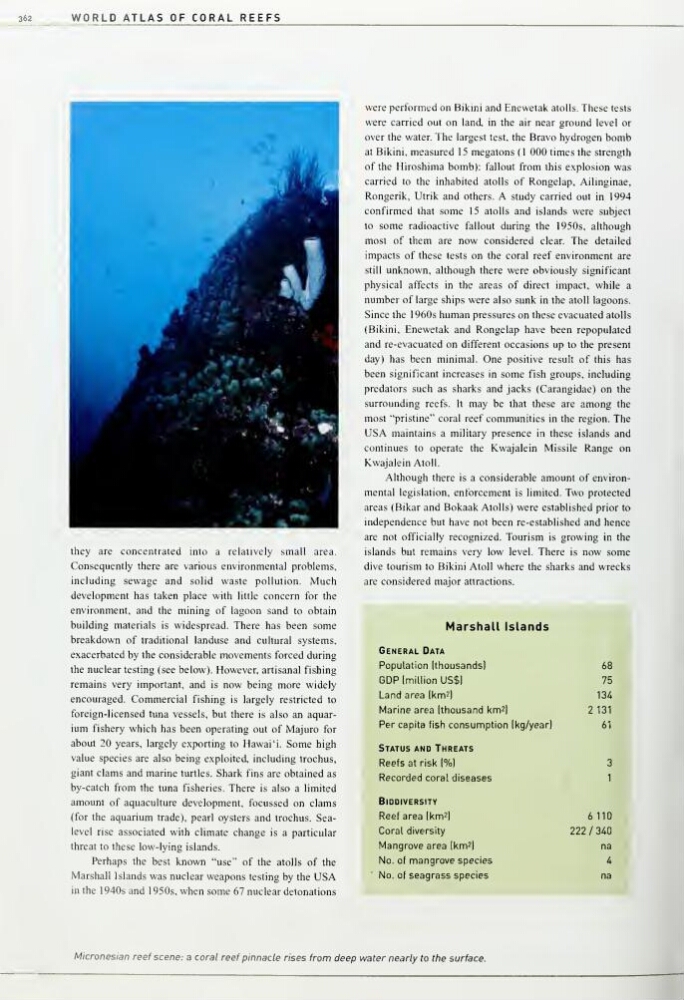
Micronesian reef scene: a coral reef pinnacle rises from deep water nearly to tfie surface.
WORLD ATLAS OF CORAL REEFS
they are concentrated into a relatively small area.
Consequently there are various environmental problems,
including sewage and solid waste pollution. Much
development has taken place with little concern for the
environment, and the mining of lagoon sand to obtain
building materials is widespread. There has been some
breakdown of traditional landuse and cultural systems,
exacerbated by the considerable movements forced during
the nuclear testmg (see below). However, artisanal fishing
remains very important, and is now being more widely
encouraged. Commercial fishing is largely restricted to
foreign-licensed tuna vessels, but there is also an aquarium fishery which has been operating out of Majuro for
about 20 years, largely exporting to Hawai'i. Some high
value species are also being exploited, including trochus,
giant clams and marine turtles. Shark fins are obtained as
by-catch from the tuna fisheries. There is also a limited
amount of aquaculture development, focussed on clams
(for the aquarium trade), pearl oysters and trochus. Sealevel rise associated with climate change is a particular
threat to these low-lying islands.
Perhaps the best known "use" of the atolls of the
Marshall Islands was nuclear weapons testing by the USA
in the 1940s and 1950s, when some 67 nuclear detonations
were performed on Bikini and Enewetak atolls. These tests
were carried out on land, in the air near ground level or
over the water. The largest test, the Bravo hydrogen bomb
at Bikini, measured 1 5 megatons (1 000 times the strength
of the Hiroshima bomb); fallout from this explosion was
carried to the inhabited atolls of Rongelap. Ailinginae,
Rongerik, Utrik and others. A study carried out in 1994
confirmed that some 15 atolls and islands were subject
to some radioactive fallout during the 1950s, although
most of them are now considered clear. The detailed
impacts of these tests on the coral reef environment are
still unknown, although there were obviously significant
physical affects in the areas of direct impact, while a
number of large ships were also sunk in the atoll lagoons.
Since the 1960s human pressures on these evacuated atolls
(Bikini. Enewetak and Rongelap have been repopulated
and re-evacuated on different occasions up to the present
day) has been minimal. One positive result of this has
been significant increases in some fish groups, including
predators such as sharks and jacks (Carangidae) on the
surrounding reefs. It may be that these are among the
most "pristine" coral reef communities in the region. The
USA maintains a military presence in these islands and
continues to operate the Kwajalein Missile Range on
Kwajalein Atoll.
Although there is a considerable amount of environmental legislation, enforcement is limited. Two protected
areas (Bikar and Bokaak Atolls) were established prior to
independence but have not been re-established and hence
are not officially recognized. Tourism is growing in the
islands but remains very low level. There is now some
dive tourism to Bikini Atoll where the sharks and wrecks
are considered major attractions.
Marshall 1 slands
General Data
Population (thousands)
68
GDP (million US$1
75
Land area (km^l
134
Marine area (thousand km^J
2 131
Per capita fish consumption (kg/yearl
61
Status and Threats
Reefs at risk (%)
3
Recorded coral diseases
1
Biodiversity
Reef area (km^l
6110
Coral diversity
222/340
Mangrove area [km^]
na
No. of mangrove species
4
No. of seagrass species
na
Micronesian reef scene: a coral reef pinnacle rises from deep water nearly to tfie surface.