

354
WORLD ATLAS OF CORAL REEFS
Palau and the Federated
States of Micronesia
MAPS 13b and c
PSlaU
makes up the western end of the Caroline
Islands. It is dominated by a large complex of islands
and reefs, consisting of the ICayangel Islands in the
north; the large island of Babeldaob (Babelthuap) in
the center; and the Rock Islands (Chelbacheb Islands) to
the south. These islands are of mixed geological origin -
Babeldaob, Meiuns. Malakal and the western part of
Koror are of volcanic origin, while the remainder are
limestone. Of the limestone islands, a large number,
particularly in the Rock Island group, are high and edged
with dramatic cliffs, often undercut at sea level. Coral
reefs are widespread. Most of the northern islands are
concentrated on a single shelf fringed by a well developed
barrier reef some 290 kilometers in length. In the southern
parts of the lagoon there is a considerable number of
fringing and platform reefs. North of this large platform,
Kayangel and Ngaruangel are both atolls. To the southeast
of this main group of islands there are several quite widely
separated ones. These are mostly platform islands (Fana,
Sonsorol, Pulo Anna, and Tobi), although Merir and Helen
Reef are atolls with a single island on each. Helen Reef
has a partially submerged rim.
The climate in Palau is warm and generally humid.
From November to June the northeasterly trade winds
'' /'••
-
'•
.
{if-'- :.
0: V^---W-j
;j
dominate, but for much of the rest of the year winds are
lighter and more variable, although occasional typhoons
also occur around this time.
Levels of biodiversity are very high. Some 425 species
of coral have been reported, including an estimated 300-350
stony corals, together with 1 278 species of reef fish and
well over 300 species of sponge. The southern reefs are
swept by strong currents and dominated by blue coral
Heliopora coerulea, however they are also very diverse.
Helen Reef was recorded as having 248 stony coral
species, perhaps the highest number of any Pacific atoll.
Coral cover in all areas was high prior to 1998, typically
over 50 percent and reaching 70-80 percent on outer reef
slopes in many areas. Marine turtles are relatively common and the estuarine crocodile Crocodylus porosus and
dugong Dugong dugon are found in the lagoon. There are
important areas of mangrove and seagrass communities.
One interesting and perhaps unique ecosystem in this
country is found in its large number of marine lakes. These
are inland, but many appear to be connected to the ocean
by cave systems and have developed highly distinctive
communities which appear to have evolved in situ from
species that entered the lakes in larval forms. The most
distinctive of such organisms are the jellyfish, notably
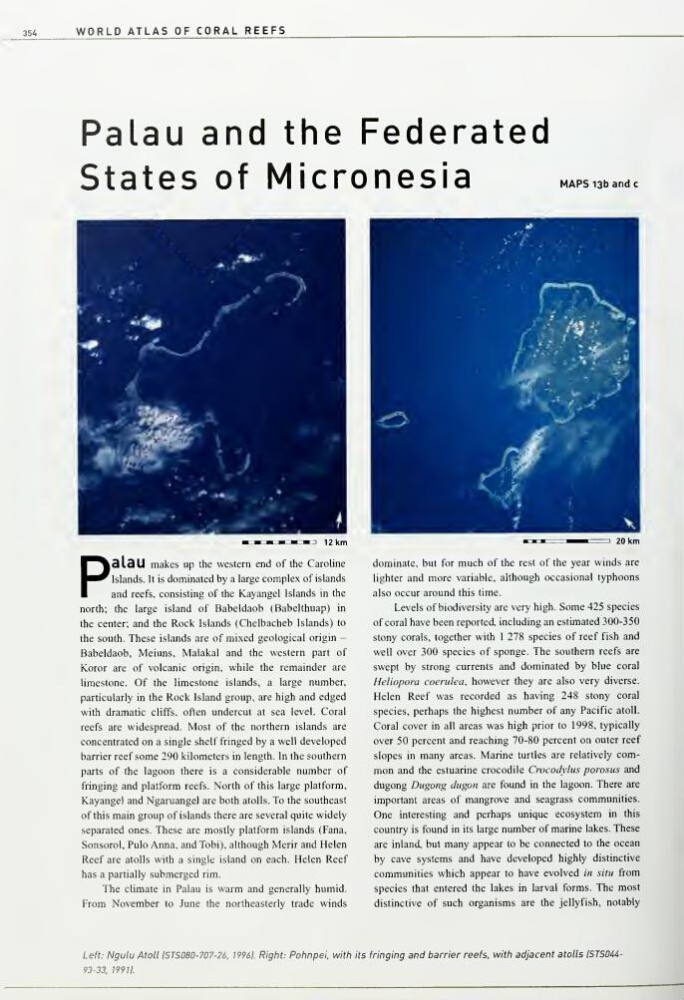
Left: Ngutu AtoU ISTS080-707-26. J996I. Right: Pohnpei, witli its fringing and barrier reefs, witfi adjacent atolls ISTSOii93-33, 19911.
WORLD ATLAS OF CORAL REEFS
Palau and the Federated
States of Micronesia
MAPS 13b and c
PSlaU
makes up the western end of the Caroline
Islands. It is dominated by a large complex of islands
and reefs, consisting of the ICayangel Islands in the
north; the large island of Babeldaob (Babelthuap) in
the center; and the Rock Islands (Chelbacheb Islands) to
the south. These islands are of mixed geological origin -
Babeldaob, Meiuns. Malakal and the western part of
Koror are of volcanic origin, while the remainder are
limestone. Of the limestone islands, a large number,
particularly in the Rock Island group, are high and edged
with dramatic cliffs, often undercut at sea level. Coral
reefs are widespread. Most of the northern islands are
concentrated on a single shelf fringed by a well developed
barrier reef some 290 kilometers in length. In the southern
parts of the lagoon there is a considerable number of
fringing and platform reefs. North of this large platform,
Kayangel and Ngaruangel are both atolls. To the southeast
of this main group of islands there are several quite widely
separated ones. These are mostly platform islands (Fana,
Sonsorol, Pulo Anna, and Tobi), although Merir and Helen
Reef are atolls with a single island on each. Helen Reef
has a partially submerged rim.
The climate in Palau is warm and generally humid.
From November to June the northeasterly trade winds
'' /'••
-
'•
.
{if-'- :.
0: V^---W-j
;j
dominate, but for much of the rest of the year winds are
lighter and more variable, although occasional typhoons
also occur around this time.
Levels of biodiversity are very high. Some 425 species
of coral have been reported, including an estimated 300-350
stony corals, together with 1 278 species of reef fish and
well over 300 species of sponge. The southern reefs are
swept by strong currents and dominated by blue coral
Heliopora coerulea, however they are also very diverse.
Helen Reef was recorded as having 248 stony coral
species, perhaps the highest number of any Pacific atoll.
Coral cover in all areas was high prior to 1998, typically
over 50 percent and reaching 70-80 percent on outer reef
slopes in many areas. Marine turtles are relatively common and the estuarine crocodile Crocodylus porosus and
dugong Dugong dugon are found in the lagoon. There are
important areas of mangrove and seagrass communities.
One interesting and perhaps unique ecosystem in this
country is found in its large number of marine lakes. These
are inland, but many appear to be connected to the ocean
by cave systems and have developed highly distinctive
communities which appear to have evolved in situ from
species that entered the lakes in larval forms. The most
distinctive of such organisms are the jellyfish, notably
Left: Ngutu AtoU ISTS080-707-26. J996I. Right: Pohnpei, witli its fringing and barrier reefs, witfi adjacent atolls ISTSOii93-33, 19911.