

Micronesia
353
Protected areas with coral reefs
Site name
Designation
Abbreviation
lUCN cat. Size Ihm'l
Year
Guam
Anao
Conservation Reserve
CRes
IV
2.63
1953
Guam
Territorial Seashore Park
TSea
VI
61.35
1978
Maputo
Ecological Reserve Area
ERA
IV
1.02
198i
Orote Peninsula
Ecological Reserve Area
ERA
IV
0.66
198/i
Rati Point
Natural Area
NA
IV
1.12
1973
War in the Pacific
National Historic Park
NHP
V
7.79
1978
Northern Marianas
Managaha
Fish Preserve
FiPr
IV
na
2000
Sasanhaya
Fish Preserve
FiPr
IV
na
1994
the far north cooler conditions may further restrict
certain species. An expedition to the uninhabited northern
islands in 1992 listed 161 species of cnidarians. 520
marine molluscs and 463 fish. Crown-of-thorns starfish
had devastating effects, notably in Guam from 1968 to
1970, and again in 1979. killing 90 percent of corals in
some areas.
Natural pressures on the reefs around Guam have
been greatly exacerbated in recent years by human
activities. Agriculture, development and the burning of
natural areas have led to increased sedimentation in the
surrounding waters, while overfishing is widespread and
total catch per unit of effort reportedly fell by 78 percent
between 1985 and 1997. The overall impact on the reefs
has been considerable. Coral cover is reported to have
dropped significantly since the 1970s, when it was over
50 percent in many areas. Algal cover has increased since
the crown-of-thorns outbreaks and remains high, possibly
due to overexploitation of herbivorous fish. Coral and fish
recruitment is also reported to have fallen. Human pressures are largely focussed around the urban areas of the
barrier reef system in western Saipan, but also at Rota
West Harbor and San Jose Harbor on Tinian where there
are problems of pollution and sedimentation. Overfishing
IS believed to be occurring on Saipan and Tinian. where
fisheries data show low average sizes of many reef
species. Finally, the island of Farallon de Medinilla has
been extensively used for target practice by the US
military. Local objections have been raised, with campaigns to have this activity restricted or moved to one
of the more active volcanoes where the impacts may be
less detectable. Thus far no serious efforts to relocate have
been made.
The economy of both territories is highly dependent
on tourism. Guam receives more than 1.4 million visitors
per year, while the CNMI receives about 500 000,
primarily limited to the island of Saipan. Diving and
snorkelling are popular tourist activities. Research on the
reefs is well advanced, particularly in Guam where there is
an active marine laboratory associated with the University
of Guam. Several protected areas have been established,
including a number of coastal and marine sites in Guam,
and some in the CNMI.
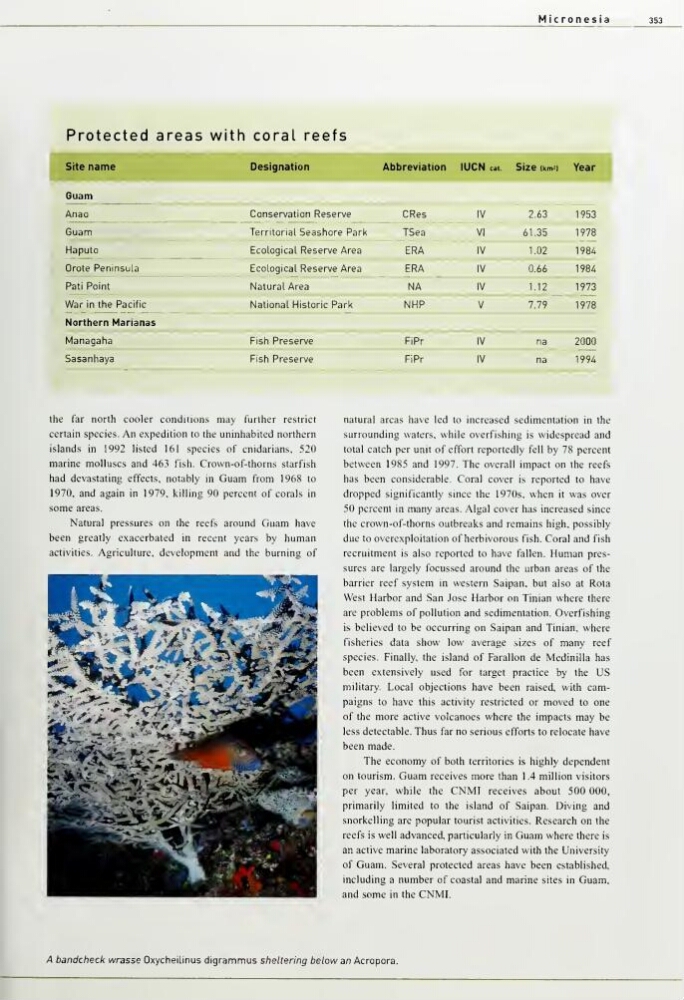
A bandcheck wrasse Ox/cheilinus digrammus sheltering below an Acropora.
353
Protected areas with coral reefs
Site name
Designation
Abbreviation
lUCN cat. Size Ihm'l
Year
Guam
Anao
Conservation Reserve
CRes
IV
2.63
1953
Guam
Territorial Seashore Park
TSea
VI
61.35
1978
Maputo
Ecological Reserve Area
ERA
IV
1.02
198i
Orote Peninsula
Ecological Reserve Area
ERA
IV
0.66
198/i
Rati Point
Natural Area
NA
IV
1.12
1973
War in the Pacific
National Historic Park
NHP
V
7.79
1978
Northern Marianas
Managaha
Fish Preserve
FiPr
IV
na
2000
Sasanhaya
Fish Preserve
FiPr
IV
na
1994
the far north cooler conditions may further restrict
certain species. An expedition to the uninhabited northern
islands in 1992 listed 161 species of cnidarians. 520
marine molluscs and 463 fish. Crown-of-thorns starfish
had devastating effects, notably in Guam from 1968 to
1970, and again in 1979. killing 90 percent of corals in
some areas.
Natural pressures on the reefs around Guam have
been greatly exacerbated in recent years by human
activities. Agriculture, development and the burning of
natural areas have led to increased sedimentation in the
surrounding waters, while overfishing is widespread and
total catch per unit of effort reportedly fell by 78 percent
between 1985 and 1997. The overall impact on the reefs
has been considerable. Coral cover is reported to have
dropped significantly since the 1970s, when it was over
50 percent in many areas. Algal cover has increased since
the crown-of-thorns outbreaks and remains high, possibly
due to overexploitation of herbivorous fish. Coral and fish
recruitment is also reported to have fallen. Human pressures are largely focussed around the urban areas of the
barrier reef system in western Saipan, but also at Rota
West Harbor and San Jose Harbor on Tinian where there
are problems of pollution and sedimentation. Overfishing
IS believed to be occurring on Saipan and Tinian. where
fisheries data show low average sizes of many reef
species. Finally, the island of Farallon de Medinilla has
been extensively used for target practice by the US
military. Local objections have been raised, with campaigns to have this activity restricted or moved to one
of the more active volcanoes where the impacts may be
less detectable. Thus far no serious efforts to relocate have
been made.
The economy of both territories is highly dependent
on tourism. Guam receives more than 1.4 million visitors
per year, while the CNMI receives about 500 000,
primarily limited to the island of Saipan. Diving and
snorkelling are popular tourist activities. Research on the
reefs is well advanced, particularly in Guam where there is
an active marine laboratory associated with the University
of Guam. Several protected areas have been established,
including a number of coastal and marine sites in Guam,
and some in the CNMI.
A bandcheck wrasse Ox/cheilinus digrammus sheltering below an Acropora.