

Melanesia
345
range of techniques are used including traps, fences,
spears, gill nets, hand nets and poisonous plants (notably
derris root). Some fishers now also utilize scuba and
hookah gear. Gleaning at low tide is also important for
shellfish, sea cucumbers, sea urchins and octopus.
Customary marine tenure at the level of individual villages has controlled utilization of reefs in many areas, with
villages having rights of access to fishing areas ox qoliqolis.
Although such systems are still in place on many islands,
there are increasing problems of overexploitation.
Nearshore commercial fisheries probably contribute a
further 6 000 tons to the annual fish catch. In many areas
target stocks have now declined considerably and this
is largely linked to overfishing, although pollution, particularly near urban centers, may play a role. Stocks of
emperors, mullets and trevally have declined, while the
bump-headed parrotfish Bolhomeiopon municciium has
not been caught in Lau, Kadavu or Vanua Levu for at least
ten years and may have been locally extirpated. In a
similar manner, collection of bivalves has long been
popular as a food source and led to the extermination of
the giant clam Tridaciw gigas. which was last recorded
over 50 years ago. Other clam species, including the
relatively recently discovered Tridacna tevoroa (only
recorded from Fiji and Tonga) are also reported to have
declined significantly. Black-lip pearl oysters, trochus and
the main target species of sea cucumber have also been
greatly reduced in recent years, but continue to be
collected. Fiji is the major exporter of live coral and fish
for aquaria in the Pacific, and there is also a company
exporting live fish for the food trade in Hong Kong.
Efforts are also underway to establish seaweed farming.
In addition to urban centers, other land-based
activities which threaten or degrade reefs in Fiji include
mangrove clearance for land reclamation, runoff from
mines, agriculture, sugar and timber mills, poorly planned
tourist development and solid waste disposal. Although
there is some sewage treatment in the larger urban areas
this is often inadequate, while solid waste is not only a
visual problem but may be a health hazard to both
humans and coastal species. Industrial pollution (mainly
eutrophication, although there have been recent oil spills
in the harbor) is a particular problem close to Suva. On
Viti Levu and Vanua Levu intensive commercial farming
on steep slopes has led to considerable soil erosion.
Similar problems of sedimentation have been observed in
some of the more remote and uninhabited islands as a
result of overgrazing by goats.
Traditional management of reefs has led to their
sustamable use throughout the archipelago for thousands
of years. Although the ownership of the seabed now resides
with the state, the customary fishing rights of indigenous
Fijians remain, under the Fisheries Act of 1 942. Traditional
management of reefs by the villages continues to some
Fiji
General Data
Population Ithousandsl
832
GDPImillion U5$l
1
602
Land area Ikm^l
19 379
Marine area (thousand km^l
1 217
Per capita fish consumption (kg/year)
33
Status and Threats
Reefs at risk (%)
68
Recorded coral diseases
1
Biodiversity
Reef area (km^l
10 020
Coral diversity
177/398
Mangrove area Ikm^j
385
No. of mangrove species
9
No. of seagrass species
5
degree, particularly in the outer islands, and includes the
setting aside (using taboos) of certain areas such as those
which become overfished. Traditional fishing areas have
been mapped by the national government. Customary
fishing rights have hindered the formal establishment of
marine protected areas and, while existing protected areas
extend to the shoreline in a number of places, none
incorporate sub-littoral elements. Despite this, a number
of tourist resorts have established small private sanctuaries through agreements with customary fishing rights
holders. Similarly, community-based marine reserves are
being established in a few areas, with the support of the
government, non-governmental organizations and local
communities. These, together with the wider recognition of
customary marine tenure, increasing environmental education and the establishment of reef monitoring, may well
suffice to protect much larger areas of Fiji's coral reefs in
the short and medium term.
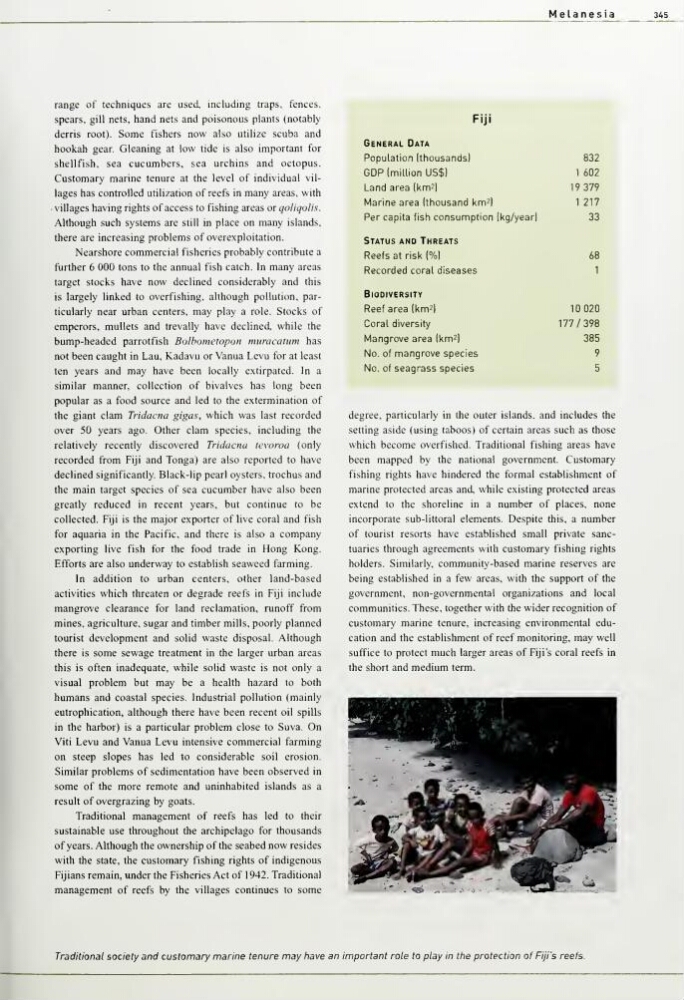
Traditional society and customary marine tenure may have an important role to play in the protection of Fiji's reefs.
345
range of techniques are used including traps, fences,
spears, gill nets, hand nets and poisonous plants (notably
derris root). Some fishers now also utilize scuba and
hookah gear. Gleaning at low tide is also important for
shellfish, sea cucumbers, sea urchins and octopus.
Customary marine tenure at the level of individual villages has controlled utilization of reefs in many areas, with
villages having rights of access to fishing areas ox qoliqolis.
Although such systems are still in place on many islands,
there are increasing problems of overexploitation.
Nearshore commercial fisheries probably contribute a
further 6 000 tons to the annual fish catch. In many areas
target stocks have now declined considerably and this
is largely linked to overfishing, although pollution, particularly near urban centers, may play a role. Stocks of
emperors, mullets and trevally have declined, while the
bump-headed parrotfish Bolhomeiopon municciium has
not been caught in Lau, Kadavu or Vanua Levu for at least
ten years and may have been locally extirpated. In a
similar manner, collection of bivalves has long been
popular as a food source and led to the extermination of
the giant clam Tridaciw gigas. which was last recorded
over 50 years ago. Other clam species, including the
relatively recently discovered Tridacna tevoroa (only
recorded from Fiji and Tonga) are also reported to have
declined significantly. Black-lip pearl oysters, trochus and
the main target species of sea cucumber have also been
greatly reduced in recent years, but continue to be
collected. Fiji is the major exporter of live coral and fish
for aquaria in the Pacific, and there is also a company
exporting live fish for the food trade in Hong Kong.
Efforts are also underway to establish seaweed farming.
In addition to urban centers, other land-based
activities which threaten or degrade reefs in Fiji include
mangrove clearance for land reclamation, runoff from
mines, agriculture, sugar and timber mills, poorly planned
tourist development and solid waste disposal. Although
there is some sewage treatment in the larger urban areas
this is often inadequate, while solid waste is not only a
visual problem but may be a health hazard to both
humans and coastal species. Industrial pollution (mainly
eutrophication, although there have been recent oil spills
in the harbor) is a particular problem close to Suva. On
Viti Levu and Vanua Levu intensive commercial farming
on steep slopes has led to considerable soil erosion.
Similar problems of sedimentation have been observed in
some of the more remote and uninhabited islands as a
result of overgrazing by goats.
Traditional management of reefs has led to their
sustamable use throughout the archipelago for thousands
of years. Although the ownership of the seabed now resides
with the state, the customary fishing rights of indigenous
Fijians remain, under the Fisheries Act of 1 942. Traditional
management of reefs by the villages continues to some
Fiji
General Data
Population Ithousandsl
832
GDPImillion U5$l
1
602
Land area Ikm^l
19 379
Marine area (thousand km^l
1 217
Per capita fish consumption (kg/year)
33
Status and Threats
Reefs at risk (%)
68
Recorded coral diseases
1
Biodiversity
Reef area (km^l
10 020
Coral diversity
177/398
Mangrove area Ikm^j
385
No. of mangrove species
9
No. of seagrass species
5
degree, particularly in the outer islands, and includes the
setting aside (using taboos) of certain areas such as those
which become overfished. Traditional fishing areas have
been mapped by the national government. Customary
fishing rights have hindered the formal establishment of
marine protected areas and, while existing protected areas
extend to the shoreline in a number of places, none
incorporate sub-littoral elements. Despite this, a number
of tourist resorts have established small private sanctuaries through agreements with customary fishing rights
holders. Similarly, community-based marine reserves are
being established in a few areas, with the support of the
government, non-governmental organizations and local
communities. These, together with the wider recognition of
customary marine tenure, increasing environmental education and the establishment of reef monitoring, may well
suffice to protect much larger areas of Fiji's coral reefs in
the short and medium term.
Traditional society and customary marine tenure may have an important role to play in the protection of Fiji's reefs.