

344
WORLD ATLAS OF CORAL REEFS
of which are submerged but may be considered a nearatoll or barrier-type structure.
The Lau Islands make up the eastern edge of the Fiji
group and lie at the top of the Lau Ridge, separated from
the Fiji Platform by the Nanuku Channel. Most of the
northern islands are high and of volcanic origin, but
further south carbonate islands predominate. There are a
number of atolls and near-atolls throughout the chain. The
Exploring Isles make up one of the largest structures in
this group, including the high island of Vanua Balavu, as
well as a long barrier reef running out to the east and
enclosing a number of smaller islands. Towards the center
of the group the Bukatatanoa Reefs are another massive
barrier reef complex. Lying considerably to the south of
the main group of Lau Islands are the smaller islands of
Vatoa (a high limestone island with a barrier reef) and the
atoll of Vuata Vatoa. Further south again is a complex of
four small reef systems including Oni-i-Lau, a small
group of islands enclosed by a barrier reef
The Koro Sea is a relatively enclosed sea between
the Lau Islands and Viti Levu. There are a few islands
scattered in this area. The Lomaiviti group east of Viti
Levu is mostly volcanic and has well developed fringing
and barrier structures. Further south, the Moala group is
made up of three high volcanic islands with predominantly fringing reefs around them.
Far from the main islands of Fiji are three other reef
areas. In the far northwest, the island of Rotuma is
volcanic and has wide fringing reefs. A number of smaller
islands nearby also have fringing reef structures. In the far
southwest Conway Reef or Ceva-i-Ra is a small coral cay
of some 200 by 50 meters on a platform reef Finally, in
the southeast, Fiji claims the Minerva Reefs, although
these are also claimed by Tonga.
Some of the reefs of the country have been extensively studied in terms of their ecology and biodiversity,
but. given the overall extent of Fijian reefs, a vast proportion remain poorly known. Species numbers are high,
as might be expected from the location of these reefs in
relation to the Indo-Pacific center of diversity as well as
from the sheer variety of reef types. Most of the studies
have been undertaken close to the University of the South
Pacific in Suva or on the Great Astrolabe Reef where there
is an associated field study station. Some 298 species
of scleractinian coral have been recorded, alongside over
475 species of mollusc (including 253 nudibranchs and
102 bivalves) and some 60 species of ascideans. A total of
1
198 species of fish have been recorded in Fiji's waters,
the majority of them reef-associated. The algal flora of
these reefs is also well known, and some 422 species have
been documented. Early in 2000, a major warming event
in the surface waters around Fiji and neighboring countries
led to between 50 and 100 percent of corals becoming
bleached over wide areas, and extending to depths of
30 meters. Many corals subsequently died, particularly in
southern parts of Viti Levu and Vanua Levu.
The rural people of Fiji depend on coral reefs for the
vast bulk of their protein, and subsistence catches from
reefs are estimated at approximately 1 7 000 tons per year.
Although fishing with hand lines is most common, a vast
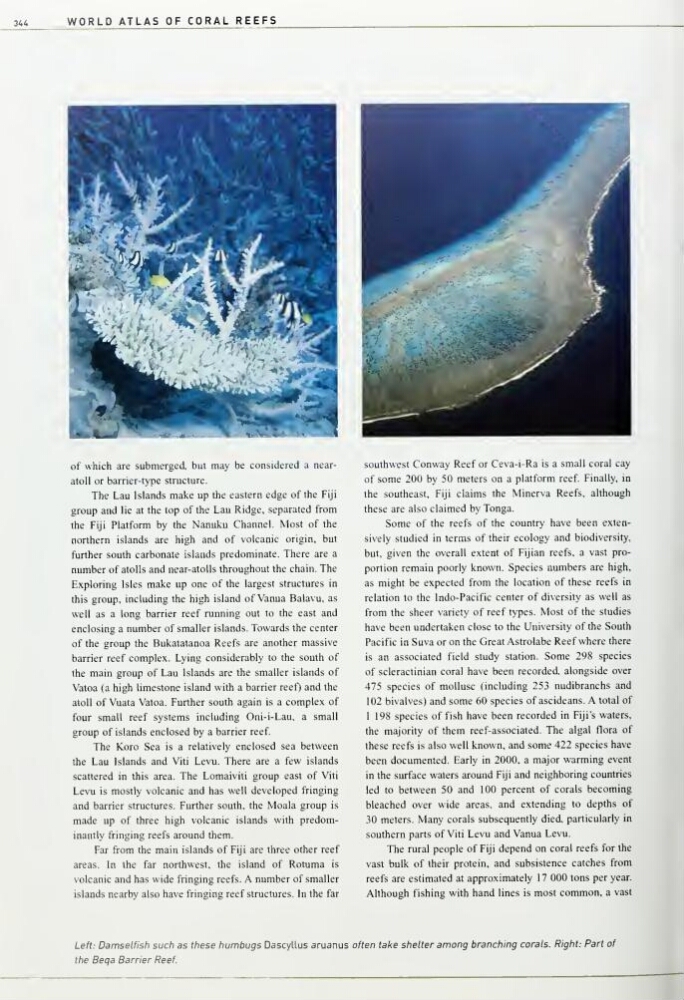
Left: Damselfish such as these humbugs Dascyllus aruanus often take shelter among branching corals. Right: Part of
the Beqa Barrier Reef.
WORLD ATLAS OF CORAL REEFS
of which are submerged but may be considered a nearatoll or barrier-type structure.
The Lau Islands make up the eastern edge of the Fiji
group and lie at the top of the Lau Ridge, separated from
the Fiji Platform by the Nanuku Channel. Most of the
northern islands are high and of volcanic origin, but
further south carbonate islands predominate. There are a
number of atolls and near-atolls throughout the chain. The
Exploring Isles make up one of the largest structures in
this group, including the high island of Vanua Balavu, as
well as a long barrier reef running out to the east and
enclosing a number of smaller islands. Towards the center
of the group the Bukatatanoa Reefs are another massive
barrier reef complex. Lying considerably to the south of
the main group of Lau Islands are the smaller islands of
Vatoa (a high limestone island with a barrier reef) and the
atoll of Vuata Vatoa. Further south again is a complex of
four small reef systems including Oni-i-Lau, a small
group of islands enclosed by a barrier reef
The Koro Sea is a relatively enclosed sea between
the Lau Islands and Viti Levu. There are a few islands
scattered in this area. The Lomaiviti group east of Viti
Levu is mostly volcanic and has well developed fringing
and barrier structures. Further south, the Moala group is
made up of three high volcanic islands with predominantly fringing reefs around them.
Far from the main islands of Fiji are three other reef
areas. In the far northwest, the island of Rotuma is
volcanic and has wide fringing reefs. A number of smaller
islands nearby also have fringing reef structures. In the far
southwest Conway Reef or Ceva-i-Ra is a small coral cay
of some 200 by 50 meters on a platform reef Finally, in
the southeast, Fiji claims the Minerva Reefs, although
these are also claimed by Tonga.
Some of the reefs of the country have been extensively studied in terms of their ecology and biodiversity,
but. given the overall extent of Fijian reefs, a vast proportion remain poorly known. Species numbers are high,
as might be expected from the location of these reefs in
relation to the Indo-Pacific center of diversity as well as
from the sheer variety of reef types. Most of the studies
have been undertaken close to the University of the South
Pacific in Suva or on the Great Astrolabe Reef where there
is an associated field study station. Some 298 species
of scleractinian coral have been recorded, alongside over
475 species of mollusc (including 253 nudibranchs and
102 bivalves) and some 60 species of ascideans. A total of
1
198 species of fish have been recorded in Fiji's waters,
the majority of them reef-associated. The algal flora of
these reefs is also well known, and some 422 species have
been documented. Early in 2000, a major warming event
in the surface waters around Fiji and neighboring countries
led to between 50 and 100 percent of corals becoming
bleached over wide areas, and extending to depths of
30 meters. Many corals subsequently died, particularly in
southern parts of Viti Levu and Vanua Levu.
The rural people of Fiji depend on coral reefs for the
vast bulk of their protein, and subsistence catches from
reefs are estimated at approximately 1 7 000 tons per year.
Although fishing with hand lines is most common, a vast
Left: Damselfish such as these humbugs Dascyllus aruanus often take shelter among branching corals. Right: Part of
the Beqa Barrier Reef.