

Melanesia
Protected areas wi th coral reefs
I Site name
^^^^
Designation
Abbreviation
lUCN cat.
Size Ikmil
Year
Solomon Islands
Arnavon
Marine Conservation Area
MarCA
VI
82.70
na
East Rennell
World Heritage Site
370.00
1998
there have been reports of extensive damage. Coral pieces
are broken off for collection, damaging methods such
as cyanide are used to capture reef fish, and reefs are
trampled during capture, resulting in coral breakage.
One unusual but highly significant threat to reefs in the
Solomon Islands comes from the use of lime in the habit
of chewing betel nuts. The latter are taken from the fruits
of a palm and are chewed with a pepper leaf and lime in an
addictive habit. The lime is prepared by burning branching
corals (typically Acropora). Major users may consume 20
kilos of lime per year (derived from over 30 kilos of live
coral), and in some areas, such as the lagoon reefs of
Malaita, these corals are highly depleted. One estimate suggested that about 6 million kilos of lime are used per year,
derived from 10 million kilos of live coral, making this one
of the largest single threats to reefs in the country. There are
some ongoing efforts to establish coral gardens which might
be harvested sustainably, and some communities report that
they utilize coral patches on a rotation system.
Although many of the Solomon Islands remain
forested, logging is ongoing in many areas and there are
few efforts to control sediment runoff Although there
have been no studies it seems highly likely that coral reefs
will be impacted in some areas. Particular concern has
been expressed about logging activities on the island of
Vangunu and the potential impact on the Marovo Lagoon.
Previously selectively logged areas on this island are now
being clear-felled and converted to oil-palm plantations,
and there is concern that the conversion process may
produce even higher levels of sedimentation, and that subsequent fertilizer use could create ongoing problems.
There is no sewage treatment in any of the urban
centers in the Solomon Islands. As populations grow this
will increasingly threaten the health of both humans and
reefs. Tourism has never been a major industry, although
there are various hotels and "live-aboards" which cater for
divers. The establishment of legally gazetted protected
areas in the Solomon Islands is complicated by the customary tenure of all reefs. A number of island sanctuaries
have recently been repealed. As negotiations on the ownership of at least one of these have been ongoing, there is
evidence that a number of villages have been using the
confusion to rapidly deplete the surrounding reef resources.
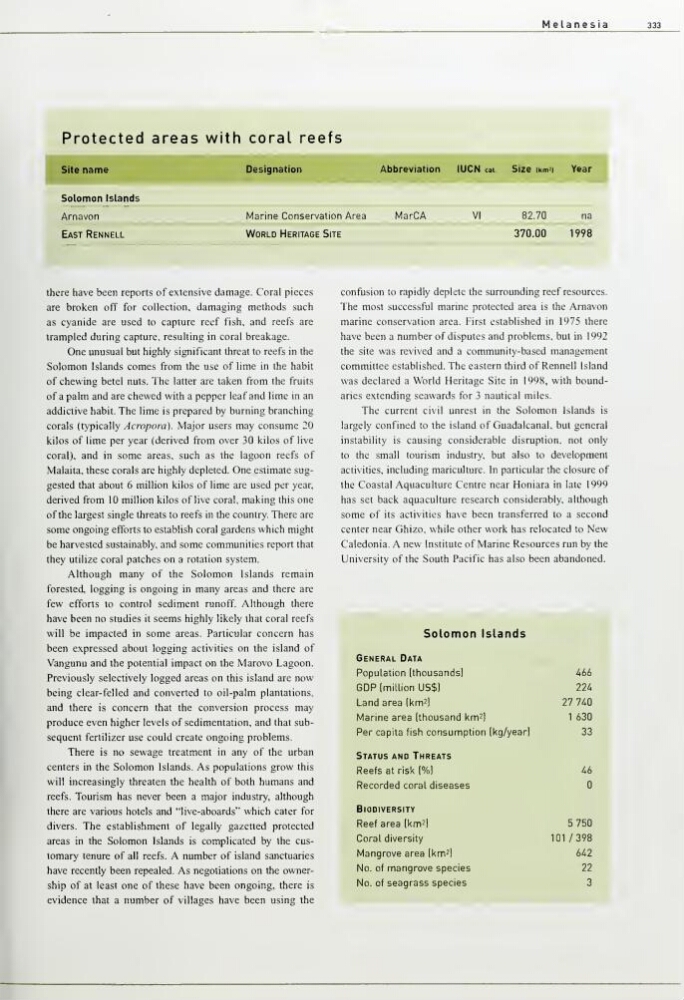
The most successful marine protected area is the Arnavon
marine conservation area. First established in 1975 there
have been a number of disputes and problems, but in 1992
the site was revived and a community-based management
committee established. The eastern third of Rennell Island
was declared a World Heritage Site in 1998, with boundaries extending seawards for 3 nautical miles.
The current civil unrest in the Solomon Islands is
largely confined to the island of Guadalcanal, but general
instability is causing considerable disruption, not only
to the small tourism industry, but also to development
activities, including mariculture. In particular the closure of
the Coastal Aquaculture Centre near Honiara in late 1999
has set back aquaculture research considerably, although
some of its activities have been transferred to a second
center near Ghizo. while other work has relocated to New
Caledonia. A new Institute of Marine Resources run by the
University of the South Pacific has also been abandoned.
Solomon 1 stands
General Data
Population (thousands)
/i66
GDP (million US$1
22i
Land area (km^)
27 740
Marine area (thousand km^l
1 630
Per capita fish consumption [kg/yearl
33
Status and Threats
Reefs at risk (%l
46
Recorded coral diseases
Biodiversity
Reef area (km^l
5 750
Coral diversity
101 /398
Mangrove area [km^l
642
No. of mangrove species
22
No. of seagrass species
3
Protected areas wi th coral reefs
I Site name
^^^^
Designation
Abbreviation
lUCN cat.
Size Ikmil
Year
Solomon Islands
Arnavon
Marine Conservation Area
MarCA
VI
82.70
na
East Rennell
World Heritage Site
370.00
1998
there have been reports of extensive damage. Coral pieces
are broken off for collection, damaging methods such
as cyanide are used to capture reef fish, and reefs are
trampled during capture, resulting in coral breakage.
One unusual but highly significant threat to reefs in the
Solomon Islands comes from the use of lime in the habit
of chewing betel nuts. The latter are taken from the fruits
of a palm and are chewed with a pepper leaf and lime in an
addictive habit. The lime is prepared by burning branching
corals (typically Acropora). Major users may consume 20
kilos of lime per year (derived from over 30 kilos of live
coral), and in some areas, such as the lagoon reefs of
Malaita, these corals are highly depleted. One estimate suggested that about 6 million kilos of lime are used per year,
derived from 10 million kilos of live coral, making this one
of the largest single threats to reefs in the country. There are
some ongoing efforts to establish coral gardens which might
be harvested sustainably, and some communities report that
they utilize coral patches on a rotation system.
Although many of the Solomon Islands remain
forested, logging is ongoing in many areas and there are
few efforts to control sediment runoff Although there
have been no studies it seems highly likely that coral reefs
will be impacted in some areas. Particular concern has
been expressed about logging activities on the island of
Vangunu and the potential impact on the Marovo Lagoon.
Previously selectively logged areas on this island are now
being clear-felled and converted to oil-palm plantations,
and there is concern that the conversion process may
produce even higher levels of sedimentation, and that subsequent fertilizer use could create ongoing problems.
There is no sewage treatment in any of the urban
centers in the Solomon Islands. As populations grow this
will increasingly threaten the health of both humans and
reefs. Tourism has never been a major industry, although
there are various hotels and "live-aboards" which cater for
divers. The establishment of legally gazetted protected
areas in the Solomon Islands is complicated by the customary tenure of all reefs. A number of island sanctuaries
have recently been repealed. As negotiations on the ownership of at least one of these have been ongoing, there is
evidence that a number of villages have been using the
confusion to rapidly deplete the surrounding reef resources.
The most successful marine protected area is the Arnavon
marine conservation area. First established in 1975 there
have been a number of disputes and problems, but in 1992
the site was revived and a community-based management
committee established. The eastern third of Rennell Island
was declared a World Heritage Site in 1998, with boundaries extending seawards for 3 nautical miles.
The current civil unrest in the Solomon Islands is
largely confined to the island of Guadalcanal, but general
instability is causing considerable disruption, not only
to the small tourism industry, but also to development
activities, including mariculture. In particular the closure of
the Coastal Aquaculture Centre near Honiara in late 1999
has set back aquaculture research considerably, although
some of its activities have been transferred to a second
center near Ghizo. while other work has relocated to New
Caledonia. A new Institute of Marine Resources run by the
University of the South Pacific has also been abandoned.
Solomon 1 stands
General Data
Population (thousands)
/i66
GDP (million US$1
22i
Land area (km^)
27 740
Marine area (thousand km^l
1 630
Per capita fish consumption [kg/yearl
33
Status and Threats
Reefs at risk (%l
46
Recorded coral diseases
Biodiversity
Reef area (km^l
5 750
Coral diversity
101 /398
Mangrove area [km^l
642
No. of mangrove species
22
No. of seagrass species
3