

332
WORLD ATLAS OF CORAL REEFS
communities in tlie Santa Cruz Islands identified 725
species (including non-reef species). Some of the most
detailed data describing the reefs of the region were
gathered during a 1965 Royal Society expedition which
visited a large number of the western islands. Overall this
expedition concluded that coral reef growth was not well
developed, and listed only 87 species of scleractinian
coral. But it would appear that these observations were
misplaced: little use was made of scuba diving, and it
has been further suggested that the reefs may have been
impacted by some form of mass mortality just prior to
the expedition. Coral bleaching was reported from a wide
range of localities in 2000, at the same time as the major
bleaching event recorded in Fiji. These include observations from the high islands in the west, but also from
Ontong Java Atoll. There is no information about the
degree of associated mortality.
The coral reefs of the Solomon Islands include
wide areas still largely unimpacted by human activities,
although there are also areas where such pressures are
large and growing. The islands have one of the fastest
population growth rates in the world, and 86 percent of
the people are rural. Dependence on coral reefs for protein
remains high and subsistence fishing is widespread. In
the more populous areas this is leading to overfishing
and in certain parts, such as the Lau Lagoon off north
Malaita. many of the preferred edible species have been
lost. Fishing methods can also be destructive, whether
trampling and damaging the reefs with nets, or poison
fishing including traditional methods that use coastal
plant species to provide the poison. This poison is
unselective, killing a number of non-targeted species and
reportedly damaging corals.
Traditional management systems are still of considerable importance in the Solomon Islands, as customary
marine tenure is widely held and all reefs are "owned"
by particular groups who have fishing rights. Christian
leaders, traditional kastom men, or even the villagers
themselves regularly place taboos on particular reefs,
usually for a restricted period of time. More complete
protection is provided in some areas by other beliefs, such
as around Onogou (Ramos) Island, which is believed to
house the spirits of the dead and can only be visited after
following strict protocols.
Commercial fishing has probably had more farreaching effects across the islands, notably for selected
target species. In 1999 the export of trochus and related
snails brought in over US$1 million, with sea cucumbers,
shark fins, live fish and spiny lobster also bringing in
substantial amounts. Both trochus and sea cucumbers
are already overfished and their numbers are declining
rapidly in many areas. A significant giant clam fishery
peaked in 1983, but overharvesting has depleted these
stocks in all areas, exacerbated by illegal poaching by
foreign vessels. (A Taiwanese vessel was captured on
the Indispensable Reefs in 1986 with 10 tons of frozen
adductor muscles on board, representing many tens of
thousands of individual clams.) There is some concern
that as these different fisheries collapse exploitation of
other stocks, such as those used in the live fish trade,
will increase.
Efforts to establish giant clam mariculture have been
ongoing for about ten years. While this has been interrupted by violence on Guadalcanal, a smaller operation
continues near Ghizo. Pearl exports have traditionally
been an important industry in the Solomons, and with
the export of wild-caught stocks prohibited there are
now ongoing efforts to establish a farm near Ghizo. The
aquarium trade has been increasing relatively rapidly,
much of it around Nggela in the Florida Islands, where
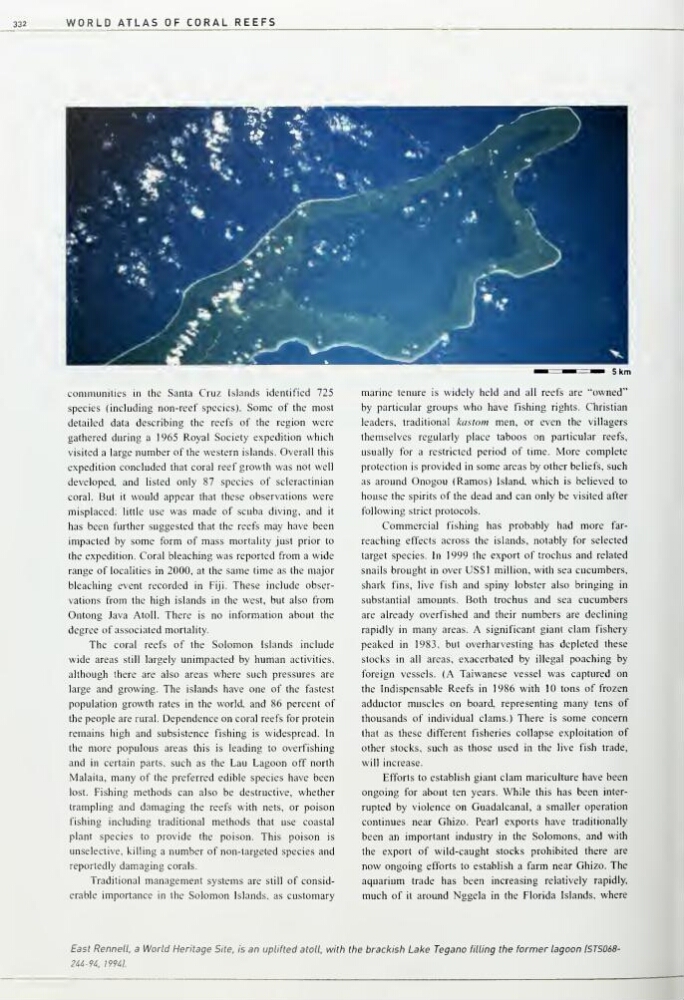
East Rennell, a World Heritage Site, is an uplifted atoll, with the brackish Lake Tegano filling the former lagoon ISTS068244-94, 1994].
WORLD ATLAS OF CORAL REEFS
communities in tlie Santa Cruz Islands identified 725
species (including non-reef species). Some of the most
detailed data describing the reefs of the region were
gathered during a 1965 Royal Society expedition which
visited a large number of the western islands. Overall this
expedition concluded that coral reef growth was not well
developed, and listed only 87 species of scleractinian
coral. But it would appear that these observations were
misplaced: little use was made of scuba diving, and it
has been further suggested that the reefs may have been
impacted by some form of mass mortality just prior to
the expedition. Coral bleaching was reported from a wide
range of localities in 2000, at the same time as the major
bleaching event recorded in Fiji. These include observations from the high islands in the west, but also from
Ontong Java Atoll. There is no information about the
degree of associated mortality.
The coral reefs of the Solomon Islands include
wide areas still largely unimpacted by human activities,
although there are also areas where such pressures are
large and growing. The islands have one of the fastest
population growth rates in the world, and 86 percent of
the people are rural. Dependence on coral reefs for protein
remains high and subsistence fishing is widespread. In
the more populous areas this is leading to overfishing
and in certain parts, such as the Lau Lagoon off north
Malaita. many of the preferred edible species have been
lost. Fishing methods can also be destructive, whether
trampling and damaging the reefs with nets, or poison
fishing including traditional methods that use coastal
plant species to provide the poison. This poison is
unselective, killing a number of non-targeted species and
reportedly damaging corals.
Traditional management systems are still of considerable importance in the Solomon Islands, as customary
marine tenure is widely held and all reefs are "owned"
by particular groups who have fishing rights. Christian
leaders, traditional kastom men, or even the villagers
themselves regularly place taboos on particular reefs,
usually for a restricted period of time. More complete
protection is provided in some areas by other beliefs, such
as around Onogou (Ramos) Island, which is believed to
house the spirits of the dead and can only be visited after
following strict protocols.
Commercial fishing has probably had more farreaching effects across the islands, notably for selected
target species. In 1999 the export of trochus and related
snails brought in over US$1 million, with sea cucumbers,
shark fins, live fish and spiny lobster also bringing in
substantial amounts. Both trochus and sea cucumbers
are already overfished and their numbers are declining
rapidly in many areas. A significant giant clam fishery
peaked in 1983, but overharvesting has depleted these
stocks in all areas, exacerbated by illegal poaching by
foreign vessels. (A Taiwanese vessel was captured on
the Indispensable Reefs in 1986 with 10 tons of frozen
adductor muscles on board, representing many tens of
thousands of individual clams.) There is some concern
that as these different fisheries collapse exploitation of
other stocks, such as those used in the live fish trade,
will increase.
Efforts to establish giant clam mariculture have been
ongoing for about ten years. While this has been interrupted by violence on Guadalcanal, a smaller operation
continues near Ghizo. Pearl exports have traditionally
been an important industry in the Solomons, and with
the export of wild-caught stocks prohibited there are
now ongoing efforts to establish a farm near Ghizo. The
aquarium trade has been increasing relatively rapidly,
much of it around Nggela in the Florida Islands, where
East Rennell, a World Heritage Site, is an uplifted atoll, with the brackish Lake Tegano filling the former lagoon ISTS068244-94, 1994].