

328
WORLD ATLAS OF CORAL REEFS
The nearby high island of Rossel is also surrounded by a
large barrier reef some 200 kilometers in circumference.
In addition to the reefs described above, quite a
number of other systems lie even more remote from the
high islands. There are several atolls far off the continental
shelf in the Pacific Ocean, including Lyra. Malum and
Nuguria east from New Ireland and Takuu and Nukumanu
east from Bougainville. The remote reefs of the northern
Coral Sea fall under Australian jurisdiction, but a few are
visited by dive vessels operating from Papua New Guinea.
Biodiversity
The reefs of Papua New Guinea are only just being
explored in terms of their biodiversity, and studies in
the late 1990s revealed extremely diverse communities,
including many hitherto undescribed species. A recent
survey of multiple sites in the Milne Bay area revealed
some 869 reef and nearshore fishes, 637 molluscs and
362 scleractinian corals. When combined with the limited
records from previous surveys these totals become even
larger, with 1 039 fishes and a predicted 420 coral species
from this region alone. While there are affinities with
Great Barrier Reef and Coral Sea faunas, the reefs of
Milne Bay and by implication all the reefs to the north are
thus still closely linked to the Indonesian and Philippine
centers of diversity and endemism. With such a variety
of reefs it is, of course, not possible to describe anything
like a typical reef community. Reefs include a complete
range of geomorphological structures, while complex
and diverse reef communities have also developed on
new volcanic slopes where true reef structures have yet to
form. Similarly coral cover, and the doininant species or
groups, are highly varied, from low diversity, low coral
cover locations, notably close to areas of high sediment
loads, to diverse coral slopes with coral cover reaching 100
percent in many areas. Coral bleaching has been observed
on a few occasions, with the earliest report describing
extensive bleaching at a location in Kimbe Bay in 1983.
This led to close to 100 percent mortality, although there
was a near complete recovery within 10 years. In 1996-97,
bleaching was observed in a number of locations, and was
reported to have led to mortalities approaching 80 percent
around Motopure Island in Kimbe Bay. In Milne Bay over
50 percent of corals were reported to have bleached in one
study in June 1996, however recovery was good. Bleaching
was also observed at a number of locations in 2000.
Socio-economic considerations
The most widespread use of coral reefs in Papua New
Guinea is for subsistence fisheries. However, few settlements are wholly dependent on fish resources, as fishing is
generally second to agriculture for food and income. The
dominant commercial offshore fishery is tuna, largely
conducted by foreign vessels under license. Inshore commercial fisheries include lobster, sea cucumber, trochus,
green snail, pearl shell and some reef fish. The live fish
trade has been operating in a few areas since 1991, and
numbers of large reef fish are reported to be reduced in the
northwest. There have also been reports of blast fishing,
particularly around urban centers.
Direct pollution from human settlements is limited to
areas close to major towns. Unfortunately there are various
other threats which may significantly impact the reefs of
Papua New Guinea in the near future. The major commercial industries are logging and mining. Logging is occurring
over large areas, although not on the same scale as in much
of Southeast Asia, and there is a considerable threat that
increased sedimentation will impact nearby nearshore reefs.
Mining, notably for copper, gold and silver, is a major
industry, and in the late 1 990s environmental controls were
still weak. Deliberate or accidental discharge of mine
tailings into rivers or directly offshore has caused problems in a number of locations, both by smothering corals
and from toxic impacts. The Panguana copper mine on
Bougainville was reported to have smothered some 100
square kilometers of sea floor with its tailings prior to its
closure in 1989 as a result of civil war. The Ok Tedi mine
in the southwest has released tens of millions of tons of
tailings into the Ok Tedi and Fly Rivers, causing massive
damage to inland forests and possibly affecting offshore
reefs. The Misima gold mine in Milne Bay was reported to
have caused extensive destruction on nearshore reefs, and
there are similar mines at many other localities on the
mainland and offshore islands.
Natural factors also affect the status of reefs in Papua
New Guinea. The country lies within the cyclone belt, with
considerable implications for the reefs. A few have also
been severely damaged by volcanic and seismic activity. In
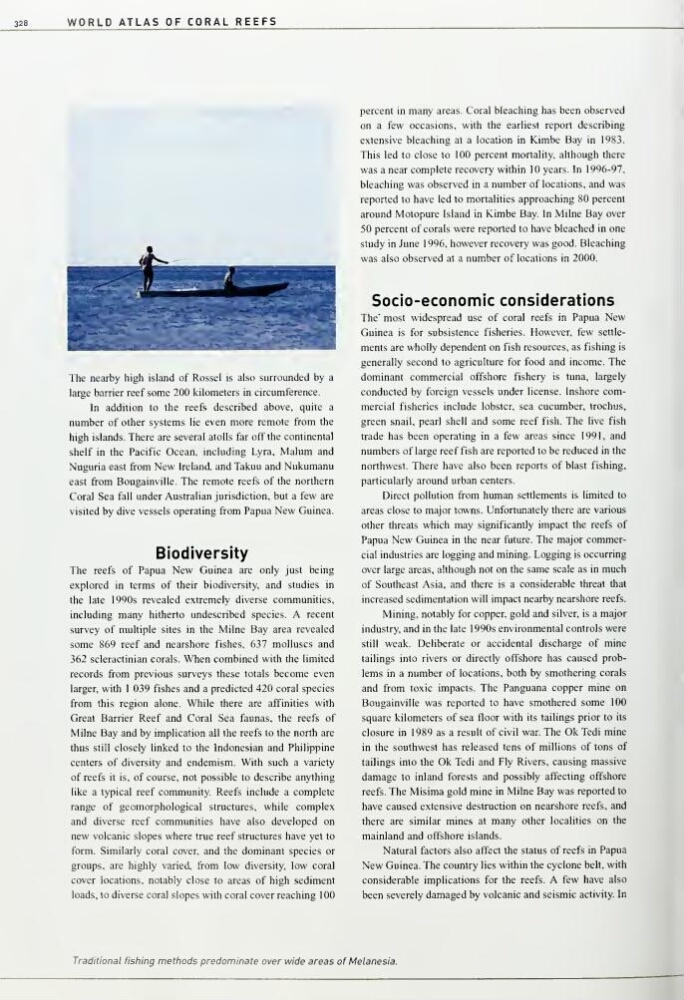
Traditional fishing methods predominate over wide areas of Melanesia.
WORLD ATLAS OF CORAL REEFS
The nearby high island of Rossel is also surrounded by a
large barrier reef some 200 kilometers in circumference.
In addition to the reefs described above, quite a
number of other systems lie even more remote from the
high islands. There are several atolls far off the continental
shelf in the Pacific Ocean, including Lyra. Malum and
Nuguria east from New Ireland and Takuu and Nukumanu
east from Bougainville. The remote reefs of the northern
Coral Sea fall under Australian jurisdiction, but a few are
visited by dive vessels operating from Papua New Guinea.
Biodiversity
The reefs of Papua New Guinea are only just being
explored in terms of their biodiversity, and studies in
the late 1990s revealed extremely diverse communities,
including many hitherto undescribed species. A recent
survey of multiple sites in the Milne Bay area revealed
some 869 reef and nearshore fishes, 637 molluscs and
362 scleractinian corals. When combined with the limited
records from previous surveys these totals become even
larger, with 1 039 fishes and a predicted 420 coral species
from this region alone. While there are affinities with
Great Barrier Reef and Coral Sea faunas, the reefs of
Milne Bay and by implication all the reefs to the north are
thus still closely linked to the Indonesian and Philippine
centers of diversity and endemism. With such a variety
of reefs it is, of course, not possible to describe anything
like a typical reef community. Reefs include a complete
range of geomorphological structures, while complex
and diverse reef communities have also developed on
new volcanic slopes where true reef structures have yet to
form. Similarly coral cover, and the doininant species or
groups, are highly varied, from low diversity, low coral
cover locations, notably close to areas of high sediment
loads, to diverse coral slopes with coral cover reaching 100
percent in many areas. Coral bleaching has been observed
on a few occasions, with the earliest report describing
extensive bleaching at a location in Kimbe Bay in 1983.
This led to close to 100 percent mortality, although there
was a near complete recovery within 10 years. In 1996-97,
bleaching was observed in a number of locations, and was
reported to have led to mortalities approaching 80 percent
around Motopure Island in Kimbe Bay. In Milne Bay over
50 percent of corals were reported to have bleached in one
study in June 1996, however recovery was good. Bleaching
was also observed at a number of locations in 2000.
Socio-economic considerations
The most widespread use of coral reefs in Papua New
Guinea is for subsistence fisheries. However, few settlements are wholly dependent on fish resources, as fishing is
generally second to agriculture for food and income. The
dominant commercial offshore fishery is tuna, largely
conducted by foreign vessels under license. Inshore commercial fisheries include lobster, sea cucumber, trochus,
green snail, pearl shell and some reef fish. The live fish
trade has been operating in a few areas since 1991, and
numbers of large reef fish are reported to be reduced in the
northwest. There have also been reports of blast fishing,
particularly around urban centers.
Direct pollution from human settlements is limited to
areas close to major towns. Unfortunately there are various
other threats which may significantly impact the reefs of
Papua New Guinea in the near future. The major commercial industries are logging and mining. Logging is occurring
over large areas, although not on the same scale as in much
of Southeast Asia, and there is a considerable threat that
increased sedimentation will impact nearby nearshore reefs.
Mining, notably for copper, gold and silver, is a major
industry, and in the late 1 990s environmental controls were
still weak. Deliberate or accidental discharge of mine
tailings into rivers or directly offshore has caused problems in a number of locations, both by smothering corals
and from toxic impacts. The Panguana copper mine on
Bougainville was reported to have smothered some 100
square kilometers of sea floor with its tailings prior to its
closure in 1989 as a result of civil war. The Ok Tedi mine
in the southwest has released tens of millions of tons of
tailings into the Ok Tedi and Fly Rivers, causing massive
damage to inland forests and possibly affecting offshore
reefs. The Misima gold mine in Milne Bay was reported to
have caused extensive destruction on nearshore reefs, and
there are similar mines at many other localities on the
mainland and offshore islands.
Natural factors also affect the status of reefs in Papua
New Guinea. The country lies within the cyclone belt, with
considerable implications for the reefs. A few have also
been severely damaged by volcanic and seismic activity. In
Traditional fishing methods predominate over wide areas of Melanesia.