

Australia
based sediments and pollutants. The distance from the
mainland of most reefs also makes access more difficult,
while the coastal population adjacent to the reef is small
overall and does not generally exert a very large direct
impact on the reefs, except for some commercial fisheries.
The utilization of marine and coastal resources has
a long tradition among the Aboriginal inhabitants of
Australia. Further north in Cape York and the Torres
Strait, the Torres Strait Islanders, who are of different
ethnographic origin, have also been great users of reef
resources. Following European colonization the numbers
of these peoples diminished and many of their traditional
ways of life broke down. There remain some 1 1 Torres
Strait Islander and Aborigmal communities, mostly in the
far north, with a population of about 1 1 000, together with
a slightly larger number in urban areas. A small proportion
still engage in hunting and fishing on the reef, however
their impact, even on such species as dugongs and turtles,
is probably still at sustainable levels.
Utilization of marine resources by the wider population is far more significant than that by indigenous
communities. Recreational fishing is extremely popular,
although it typically targets the reefs closest to the
mainland and near the major population centers. The
recreational fishing catch has been estimated at 3 5004 300 tons per year. Commercial reef fish exploitation is
predominantly a line fishery concentrated on groupers
("coral trout") and emperors, with a combined annual
catch of some 3 000-4 000 tons. Part of this is for the
live fish trade, with groupers being air-freighted to the
Far East, notably Hong Kong. There is also an important
lobster fishery to the north, collecting some 50-200 tons
annually, and a separate fishery operating in the Torres
Strait. In addition there are some fairly small-scale
fisheries associated with the aquarium trade, trochus and
sea cucumber The most important commercial fishing
within the Great Barrier Reef area is actually trawling,
with some 840 licensed vessels, typically landing prawns
(5 000-6 500 tons), fish (1 500 tons), scallops (200-1 000
tons) and other crustaceans (500 tons). There are some
concerns over the size of the by-catch (typically over 50
percent and sometimes as much as 90 percent of hauls),
which includes benthic organisms, fish, and even sea
snakes and turtles, and over the wider impacts on benthic
communities, particularly in areas of repetitive trawling.
Trawling is not permitted over known seagrass communities and in a few other protected areas, however illegal
trawling still occurs. There is evidence of overfishing of
some target reef fish species, although this is mostly on a
small scale and restricted in spatial extent.
The vast majority of the Great Barrier Reef receives
protection as the Great Barrier Reef Marine Park, the
world's second largest protected area. This covers most
of the lagoon and all of the offshore reefs from the
Capricorn-Bunker group to the northern tip of Cape York
Peninsula. A large proportion of the remaining coastal
waters and terrestrial areas of offshore islands which are
not covered by the park fall within other protected areas.
The park itself is zoned. About 80 percent of its total area
is open for general use including commercial fishing and
trawling (with permits), and a further 16 percent is also
for general use but with trawling prohibited. Only about
5 percent is closed to fishing activities, but this includes
over 120 reefs (about 12 percent of the total). The park is
managed by a specially designated federal agency, the
Great Barrier Reef Marine Park Authority, in collaboration with the Queensland Department of Environment
and Heritage. Between them, these organizations employ
some 210 staff with an operating budget of Au$27.2
million in 1998-99. About 30 percent of this budget is
provided by an environmental management charge levied
on all visitors to the park. For administrative purposes
the park is divided into four broad sectors. Detailed
management plans have been developed for particular
localities, while an overall 25-year strategic plan has been
developed in collaboration with the major stakeholders.
Active scientific research within the Great Barrier
Reef is carried out by a number of organizations, including several universities and the management authorities,
however the major research institution which undertakes
monitoring and core scientific research is the Australian
Institute of Marine Science based in Townsville.
The reefs of the Torres Strait lie outside the Great
Barrier Reef Marine Park and do not fall under any strict
legal protection, although a fisheries management agreement has been developed with Papua New Guinea.
Overfishing is certainly a pressure within the region,
while there remains a significant potential threat of
pollution, both from the mines in Papua New Guinea and
from oil spills associated with the relatively heavy
shipping traffic in the strait.
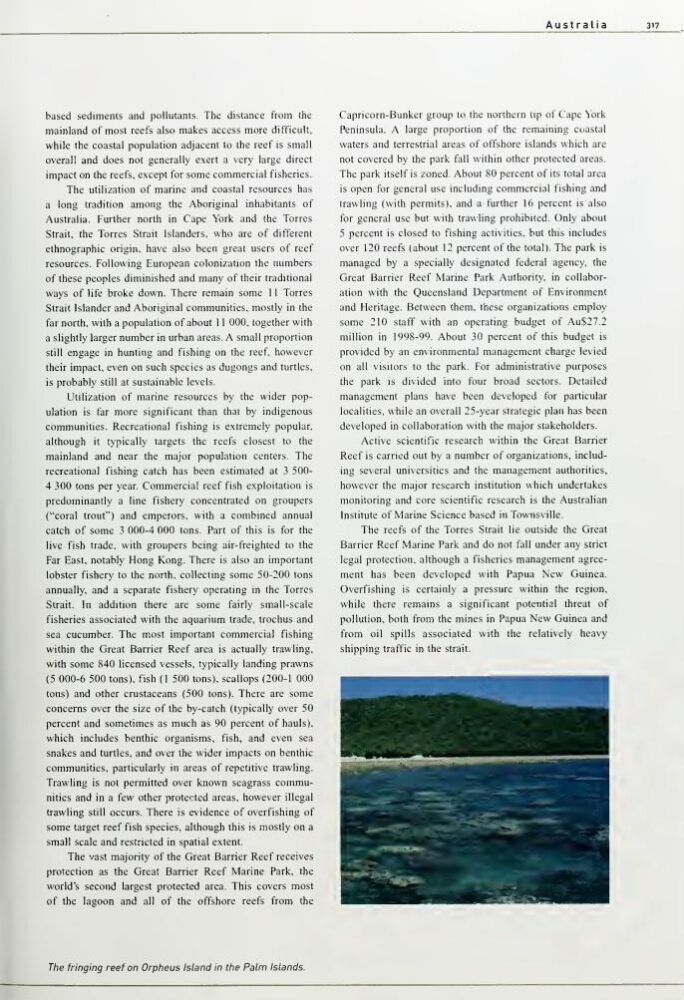
The fringing reef on Orpheus Island in the Palm Islands.
based sediments and pollutants. The distance from the
mainland of most reefs also makes access more difficult,
while the coastal population adjacent to the reef is small
overall and does not generally exert a very large direct
impact on the reefs, except for some commercial fisheries.
The utilization of marine and coastal resources has
a long tradition among the Aboriginal inhabitants of
Australia. Further north in Cape York and the Torres
Strait, the Torres Strait Islanders, who are of different
ethnographic origin, have also been great users of reef
resources. Following European colonization the numbers
of these peoples diminished and many of their traditional
ways of life broke down. There remain some 1 1 Torres
Strait Islander and Aborigmal communities, mostly in the
far north, with a population of about 1 1 000, together with
a slightly larger number in urban areas. A small proportion
still engage in hunting and fishing on the reef, however
their impact, even on such species as dugongs and turtles,
is probably still at sustainable levels.
Utilization of marine resources by the wider population is far more significant than that by indigenous
communities. Recreational fishing is extremely popular,
although it typically targets the reefs closest to the
mainland and near the major population centers. The
recreational fishing catch has been estimated at 3 5004 300 tons per year. Commercial reef fish exploitation is
predominantly a line fishery concentrated on groupers
("coral trout") and emperors, with a combined annual
catch of some 3 000-4 000 tons. Part of this is for the
live fish trade, with groupers being air-freighted to the
Far East, notably Hong Kong. There is also an important
lobster fishery to the north, collecting some 50-200 tons
annually, and a separate fishery operating in the Torres
Strait. In addition there are some fairly small-scale
fisheries associated with the aquarium trade, trochus and
sea cucumber The most important commercial fishing
within the Great Barrier Reef area is actually trawling,
with some 840 licensed vessels, typically landing prawns
(5 000-6 500 tons), fish (1 500 tons), scallops (200-1 000
tons) and other crustaceans (500 tons). There are some
concerns over the size of the by-catch (typically over 50
percent and sometimes as much as 90 percent of hauls),
which includes benthic organisms, fish, and even sea
snakes and turtles, and over the wider impacts on benthic
communities, particularly in areas of repetitive trawling.
Trawling is not permitted over known seagrass communities and in a few other protected areas, however illegal
trawling still occurs. There is evidence of overfishing of
some target reef fish species, although this is mostly on a
small scale and restricted in spatial extent.
The vast majority of the Great Barrier Reef receives
protection as the Great Barrier Reef Marine Park, the
world's second largest protected area. This covers most
of the lagoon and all of the offshore reefs from the
Capricorn-Bunker group to the northern tip of Cape York
Peninsula. A large proportion of the remaining coastal
waters and terrestrial areas of offshore islands which are
not covered by the park fall within other protected areas.
The park itself is zoned. About 80 percent of its total area
is open for general use including commercial fishing and
trawling (with permits), and a further 16 percent is also
for general use but with trawling prohibited. Only about
5 percent is closed to fishing activities, but this includes
over 120 reefs (about 12 percent of the total). The park is
managed by a specially designated federal agency, the
Great Barrier Reef Marine Park Authority, in collaboration with the Queensland Department of Environment
and Heritage. Between them, these organizations employ
some 210 staff with an operating budget of Au$27.2
million in 1998-99. About 30 percent of this budget is
provided by an environmental management charge levied
on all visitors to the park. For administrative purposes
the park is divided into four broad sectors. Detailed
management plans have been developed for particular
localities, while an overall 25-year strategic plan has been
developed in collaboration with the major stakeholders.
Active scientific research within the Great Barrier
Reef is carried out by a number of organizations, including several universities and the management authorities,
however the major research institution which undertakes
monitoring and core scientific research is the Australian
Institute of Marine Science based in Townsville.
The reefs of the Torres Strait lie outside the Great
Barrier Reef Marine Park and do not fall under any strict
legal protection, although a fisheries management agreement has been developed with Papua New Guinea.
Overfishing is certainly a pressure within the region,
while there remains a significant potential threat of
pollution, both from the mines in Papua New Guinea and
from oil spills associated with the relatively heavy
shipping traffic in the strait.
The fringing reef on Orpheus Island in the Palm Islands.